

Recessed Shade Pockets
Hidden roller shades that live in the ceiling. Blindspace® S, M and C Series concealment boxes, sized to your Lutron, Somfy or Crestron shade, installed at framing and closed by a cover you will never notice.
The shade you see is the fabric. The rest is in the ceiling.
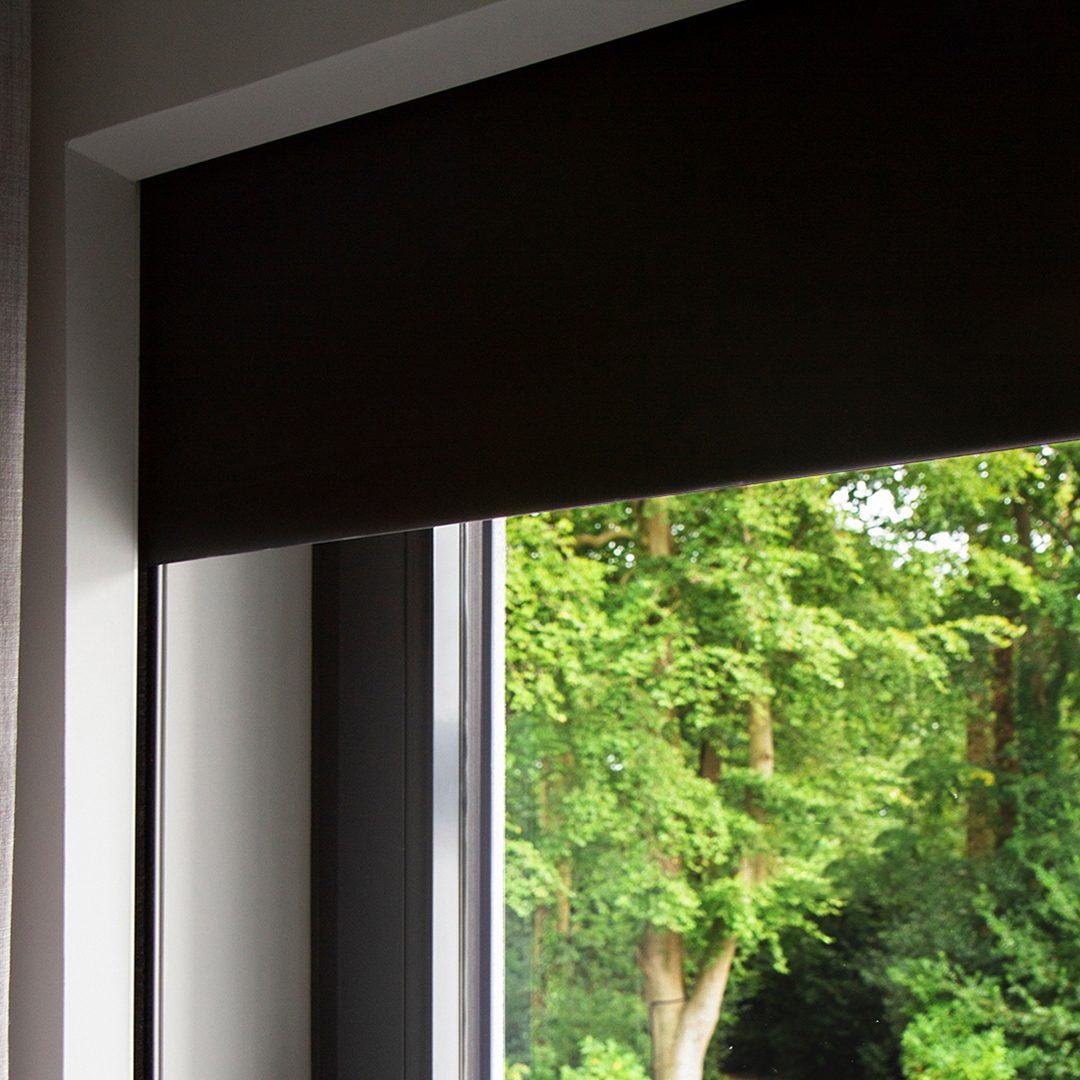
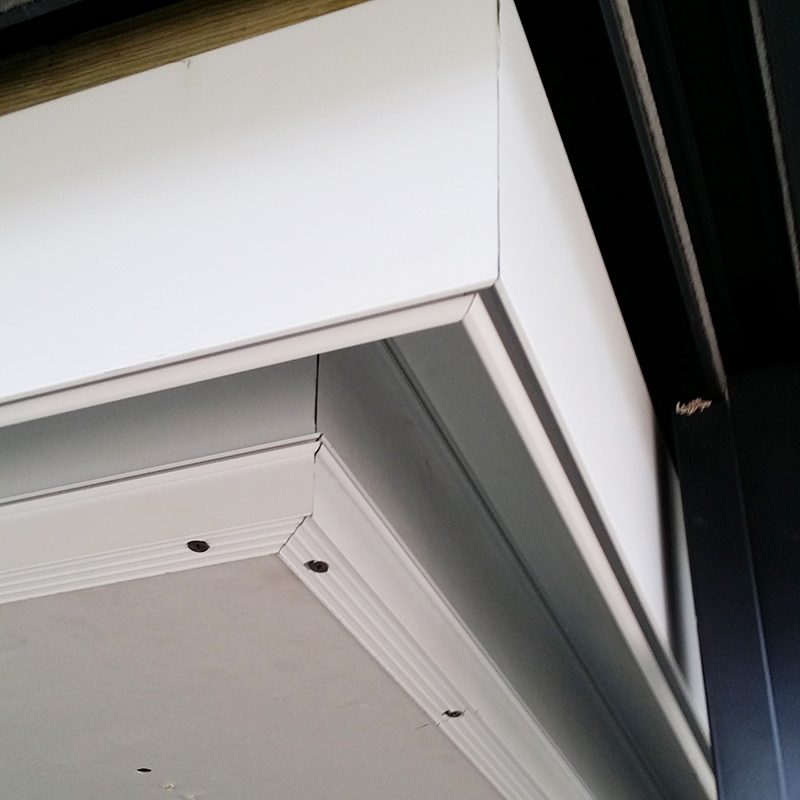
A recessed shade pocket is an extruded aluminum box built into the ceiling, wall or window reveal during construction. The roller, its motor and its brackets sit inside; a hinged cover plate closes the box flush with the plaster, leaving an opening just wide enough for the fabric and hem bar. Raise the shade and the window is bare glass with a hairline above it. No fascia, no cassette, no bracket.
The short answer. A recessed shade pocket is an extruded aluminum box built into the ceiling, wall or window reveal during construction; the roller, motor and brackets sit inside and only the fabric and hem bar show through a hairline opening. Blindspace S100 pockets are 3.94 in square and take single rollers to about 94 in wide; S130 pockets are 5.12 in square and take rollers to about 157 in. The pocket is sized from the Lutron, Somfy or Crestron shade that will go in it, installed at framing and closed by a cover you never notice.
This is the detail that separates a shading specialist from a shade installer, and it is what architects, designers and exacting owners ask us for. We size the pocket from the shade we will actually install, place the wiring in the box before the drywall goes up, and come back after paint to fit and program the shade. One team, one responsibility, from the first plan review to the last scene. Part of our recessed window treatments service.
Recently: Landmark Ranch Estates, Southwest Ranches - a new estate with not one surface-mounted treatment: every roller, drapery track and Roman in a ceiling pocket framed before the drywall closed, coupled rollers on one motor, corners deducted so one shade passes in front of the other, all measured on a live construction site.
One pocket system, every window
Single Shades
A head box in the ceiling or wall with one motorized roller per window, shade facing the glass or the room depending on handles and mullions. The standard for floor-to-ceiling glass and sliding doors.
Blackout Shades
A head box plus two side boxes hide the side channels; an optional hem bar box at the sill hides the bottom bar. All boxes share the same width, so the window is framed by an even, plastered line.
Dual Shades
Sheer plus blackout, solar plus privacy, or shade plus insect screen in one larger box, side by side (for example C200x100) or stacked (C110x170), with side boxes where one of the two runs in channels.
Corner Windows
Mitred or butt-jointed boxes for floating glass corners. Shades facing the room give the smallest gap between the two; specialist zip shades can close the corner completely.
Skylights and Sloped Glass
A frame of C Series boxes on three or four sides of the opening hides the shade, its side channels and, on four-sided frames, the hem bar. Pair it with our motorized skylight shades.
Shaped and Bottom-Up
Sloping head boxes for gable windows, pelmets for trapezoid glass, and bottom-up shades concealed above doors or in the floor, pulled up on thin wires or channels.
Choosing the box
Blindspace® makes three families of pocket. Most residential projects use the S Series; blackout rooms move to the M Series; anything large, dual, sloped or overhead is a custom C Series box made to the millimeter.
| Series | Sizes (W x H) | Capacity (approx.) | What makes it different | Lengths |
|---|---|---|---|---|
| S Series standard | S100x100, 100 x 100 mm (3.94 in square) S130x130, 130 x 130 mm (5.12 in square) | 100 box: single rollers to about 2,400 mm (94 in) wide. 130 box: rollers to about 4,000 mm (157 in), zip shades to about 2,500 mm (98 in) | The reference concealment box: extruded aluminum EN 6063 T6, powder coated white RAL 9016 (any RAL or raw on request), patented safety hinge, skim-coat flanges on both sides (SS), one side (SN) or none (NN) | 6,000 mm (19 ft 8 in), cut to length or spliced |
| M Series modular | M100x100 (3.94 in square) M130x130 (5.12 in square) | 100 box: rollers to about 2,500 mm (98 in). 130 box: rollers to about 3,900 mm (154 in), zip shades to about 2,800 mm (110 in) | Superior blackout performance: head box black anodized inside (SM16) to minimize light transmission, 2 to 5 mm extrusions, aluminum hinge, corner flanges for skim coat or painted finish, side boxes M100x70 / M130x70 for channels up to 60 mm deep | 5,000 mm (16 ft 5 in), cut to length or spliced |
| C Series custom | Any size from about 90 x 90 mm. Examples: C200x100 (7.87 x 3.94 in), C110x170 (4.33 x 6.69 in), C260x130 (10.24 x 5.12 in) | Very large shades, dual shades side by side or stacked, gable and skylight shades | Fabricated to the drawing: 2 mm aluminum sheet back box (EN AW-1050A) with extruded front corners and cover (6063 T66); corners in skim coat (S), upstand (U), visible plain (V), no flange (N) or perforated (P); covers from C65 to C200 | 3,000 mm (9 ft 10 in), cut to length or spliced |
Capacities depend on the shade system, tube diameter and fabric; boxes are supplied up to 6,000 mm wide and spliced for longer runs. Roller motors sit inside the tube and need no extra pocket depth.
Lutron, Somfy and Crestron, by model
The pocket is brand-agnostic. What we put inside it is not: we install the systems we are certified on, and we size the box to each one.
| System | Shade models we recess | Typical pocket | Wiring placed at framing |
|---|---|---|---|
| Lutron | Sivoia QS Wireless rollers, Palladiom shading system, Triathlon battery rollers; Lutron drapery tracks recess in TrackTrim® | R20 and R64 in the S100x100 to 96 in wide (or the slim C89x89); R100 and R150 in the S130x130 to 120 in, the WIDR versions to 173 in; dual shades and side channels in C Series boxes, all from Blindspace's Lutron drawings (S Series, C Series) | QS link and power for wired Sivoia QS and Palladiom; none for battery Triathlon or Palladiom Wire-Free, which still benefit from a pocket for service access |
| Somfy | Sonesse 28 WireFree, Sonesse 30, Sonesse 40 and Sonesse 50 rollers, RTS or SDN; Somfy Glydea tracks recess in TrackTrim® | Drawn by Blindspace as generic rollers: a standard roller in the S100x100 (to 110 x 118 in), a large roller in the S130x130 (to 157 x 157 in), zip shades in the S130x130 to about 98 in; dual shades in C Series boxes (sizes) | Power at the motor end for RTS motors (120 V or 24 V depending on the Sonesse model), the SDN bus plus power for wired projects, nothing for WireFree |
| Crestron | Crestron motorized roller shades and dual rollers; Crestron CSS drapery tracks recess in TrackTrim® | ARCH3 in the S100x100 or a C110x110 to 96 in wide, ARCH5 in a C150x150 to 168 in, dual-bracket versions in a C140x190 or C200x280, from Blindspace's Crestron drawings (sizes); corner and skylight frames in C Series | Cresnet or power at the specified motor end, coordinated with your integrator |
| Manual | Chain-operated rollers, zip shades and cellular shades | S or C Series with chain guide CG100 / CG130 in the cover | None |
Cover openings, side boxes and accessories
| Box | Cover plate | Opening for the shade |
|---|---|---|
| S100x100 | C65, 65 mm (2.56 in), default | 29 mm (1.14 in) |
| C75, 75 mm (2.95 in) | 19 mm (0.75 in) | |
| C92 / C95 | Closed (future-proofing) | |
| S130x130 | C65, 65 mm (2.56 in) | 59 mm (2.32 in) |
| C75, 75 mm (2.95 in) | 49 mm (1.93 in) | |
| C85, 85 mm (3.35 in) | 39 mm (1.54 in) | |
| C95, 95 mm (3.74 in), default | 29 mm (1.14 in) | |
| C122 / C125 | Closed (future-proofing) | |
| M100x100 | 50 mm (1.97 in) | 30 mm (1.18 in) |
| 60 mm (2.36 in) | 20 mm (0.79 in) | |
| M130x130 | 80 mm (3.15 in) | 30 mm (1.18 in) |
| 90 mm (3.54 in) | 20 mm (0.79 in) | |
| C Series | C65, C75, C85, C92, C95, C115, C122, C125, C150, C200 | Designed to the shade and hem bar; can fully close the box |
| Item | Detail |
|---|---|
| Side boxes | S100x50 and S130x50 (1.97 in deep) for side channels and guide wires; M100x70 and M130x70 (2.76 in deep) for channels up to 60 mm (2.36 in); C Series side boxes in any size, e.g. C200x50, C110x50 |
| Hem bar boxes | Same profile as the side box, installed at the sill or at the far end of a skylight frame so only fabric shows when the shade is deployed |
| Cover hinge | Patented safety hinge: cover clicks shut, stays in place, can be installed on either side of the box and in any orientation (vertical, sloped, overhead, reverse); clip-on hinge CH25, extra strong CH25H |
| Joining | Splice pin SPLI1 to align and connect boxes, splice plate SPLA1 to align covers; boxes supplied cut to finished length or in stock lengths |
| End caps | SEC100x100, SEC130x130, SEC100x50, SEC130x50 for S Series; CEC Small, Medium, Large and Extra Large for C Series; butted corners with or without end caps |
| Wiring | Cable grommet HG1 and cable holder inside the box; power and control routed to the motor end at framing |
| Other | Chain guides CG100 / CG130 for manual shades, universal brackets UNI100 / UNI130, wall mount for installations without a head box, double-sided tape for custom fabrication, box corners for local fabrication |
| Finish | Powder coated white RAL 9016 30% gloss (S and C), white RAL 9003 covers (M), any RAL color, or raw aluminum for site painting; plaster feathered over skim-coat flanges leaves a hairline |
| Fixing | Countersunk screws every 200 mm (7.87 in) through the back and both flanges into solid backing; scrim tape on flanges; finished plaster flush with the chamfered edge; 3 mm (0.12 in) recess allowance |
Complete system tables, curtain track profiles and site requirements are on the recessed window treatments specification section.
What we check that a fascia never asks of anyone
Roll-up diameter, not guesswork
The cover opening is picked from the manufacturer's chart for your fabric thickness and drop. A 65 mm cover on a 100 box leaves 29 mm; a thick blackout on a tall slider may need the 130 box. We decide this before the box is ordered, not after the shade arrives.
Shade side and handle clearance
Sliding door handles, mullions and window operators decide whether the shade faces the glass or the room. The hinge goes on the matching side so the cover opens away from the fabric.
Alignment across a wall of glass
Boxes are spliced with pins and covers with plates so a 30 ft run reads as one line. Every shade in the run is the same model with the same hem bar, aligned on Somfy SDN or the Lutron QS link so they travel together.
Light gaps measured, not assumed
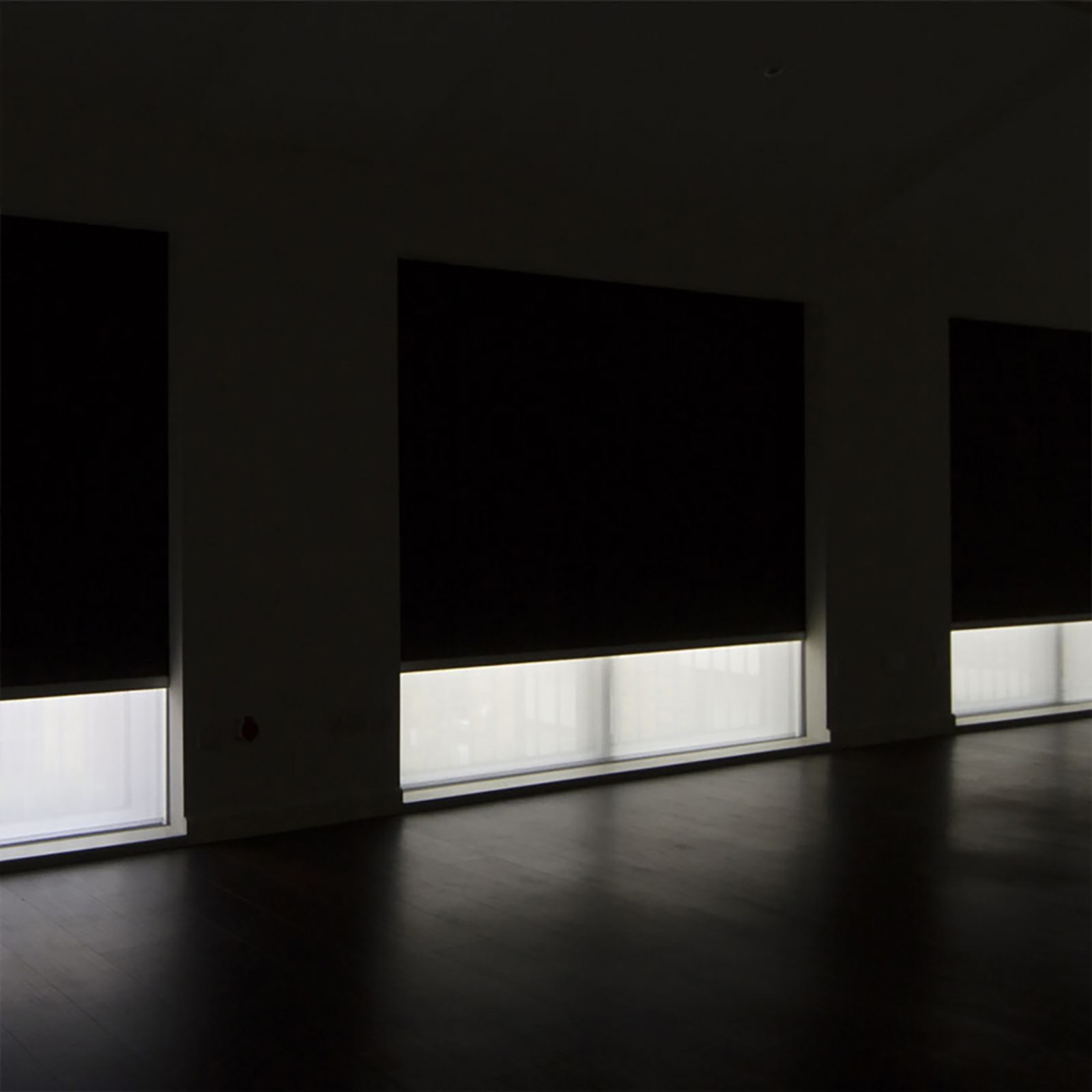
Blackout rooms get side boxes, a hem bar box and the M Series black interior. We check the light line at the sill and jambs on the mock-up, then repeat the same dimensions on every window.
The plasterer's checklist
Scrim tape, screws every 200 mm, flush with the chamfer, 3 mm allowance. We inspect before the skim coat because a box that is 2 mm proud cannot be fixed with paint.
Service for the life of the building
The safety hinge means any shade can be adjusted or replaced from the pocket later. We document the box, cover and motor per window so the next visit takes minutes.
Decide at plan stage, install at framing, shade after paint
Pockets go in with the framing and disappear under the plaster. The shades are surveyed and ordered only when the room is finished, so nothing expensive sits on a construction site. If shades are not decided yet, we install closed boxes and wiring anyway: the window is future-proofed for a motorized shade years from now, with no ceiling opened.
Already framed or painted? Ask. A shallow ceiling build-up sometimes still allows an S100x100 box, and where it does not, we will tell you plainly and specify the cleanest fascia instead.
Frequently asked
How big does the pocket need to be?
For a standard motorized roller shade the S100x100 box (3.94 in square) is the usual answer, good for shades up to about 2,400 mm (94 in) wide. Larger tubes, wider glass, zip shades and dual shades move to the S130x130 (5.12 in) or a custom C Series box. We size every pocket from the shade's roll-up diameter for your exact fabric and drop, not from an average.
Do Lutron, Somfy and Crestron motors fit in the same pocket?
Yes. Blindspace® boxes are not tied to any manufacturer. Roller motors sit inside the shade tube, so a Lutron Sivoia QS, Palladiom or Triathlon roller, a Somfy Sonesse RTS, SDN or WireFree roller and a Crestron roller motor all occupy the same space as the tube they drive. What changes is the wiring we place in the box at framing.
What if the shade ever needs service?
The cover plate sits on the patented Blindspace® safety hinge. It opens with a click for access to the shade and motor, cannot fall to the floor, and closes flush again. A shade can be adjusted, reprogrammed or replaced years later without touching the ceiling.
Can the pocket be installed now and the shade later?
Yes. That is the future-proofing use: a closed box with wiring in place at construction. When you are ready, we survey the opening, order the shade and swap the closed cover for one with the right opening. Closed covers can also be cut down and powder coated locally.
Can I hide shades in a skylight or a corner window?
Yes. Skylights use a frame of C Series boxes on three or four sides with side channels hidden in the side boxes and, on four-sided frames, the hem bar hidden at the far end. Floating corners use mitred or butt-jointed boxes with the two shades facing the room for the smallest gap, or a specialist shade that zips together in the corner.
Does a pocket give better blackout than a fascia?
Considerably. Side channels sit inside side boxes, the hem bar drops into a hem bar box at the sill, and the M Series box has a black anodized interior so light does not reflect out of the pocket. A surface-mounted fascia always leaves a light line above the tube; a pocket does not.
What does it cost?
The Blindspace® hardware is a modest line on a project where the shade, motor and fabric are the larger numbers; the real cost is deciding late. We quote pockets and shades together per window from your plans, and can send a budgetary figure from a floor plan before the site is ready.
Discerning homeowners, designers, and developers across South Florida trust Exotic with their most important spaces.
“We recently moved into a new condo and knew we wanted Lutron shades. Since there was no electrical wiring near the windows, Exotic Shades recommended battery powered Lutron roller shades. It was the perfect solution.the installation was clean, the shades work beautifully, and we are very happy happy. Good job!”
“As a contractor l've worked with a lot of window treatment companies and Exotic Shades is the best. Motorized sheers in a living room job, made the whole room feel bigger and tied everything together. Their own team, clean install, on time. Couldn't ask for a better partner”
“It was a pleasure working with this team. They did exactly what they promised and went above and beyond. They took the extra time to conceal every wire for my motorized blinds and carefully silicone-sealed all the gaps. Their attention to detail was outstanding. I couldn’t ask for better service.”
Hide the hardware. Keep the view.
One free hour with our team routinely saves owners thousands in avoidable mistakes. Send the plans and we will return a pocket schedule, wiring notes and a budget for the complete shade package.