

Recessed Window Treatments
Recessed window treatments from Exotic Shades & Draperies hide the shade tube, motor and drapery track inside Blindspace pockets and plaster-in profiles designed into the ceiling, specified at the design stage, coordinated at framing and finished with Lutron, Somfy and Crestron motorization, across Fort Lauderdale, Miami Beach and Sunny Isles Beach.
Nothing to see but fabric. Or nothing at all.
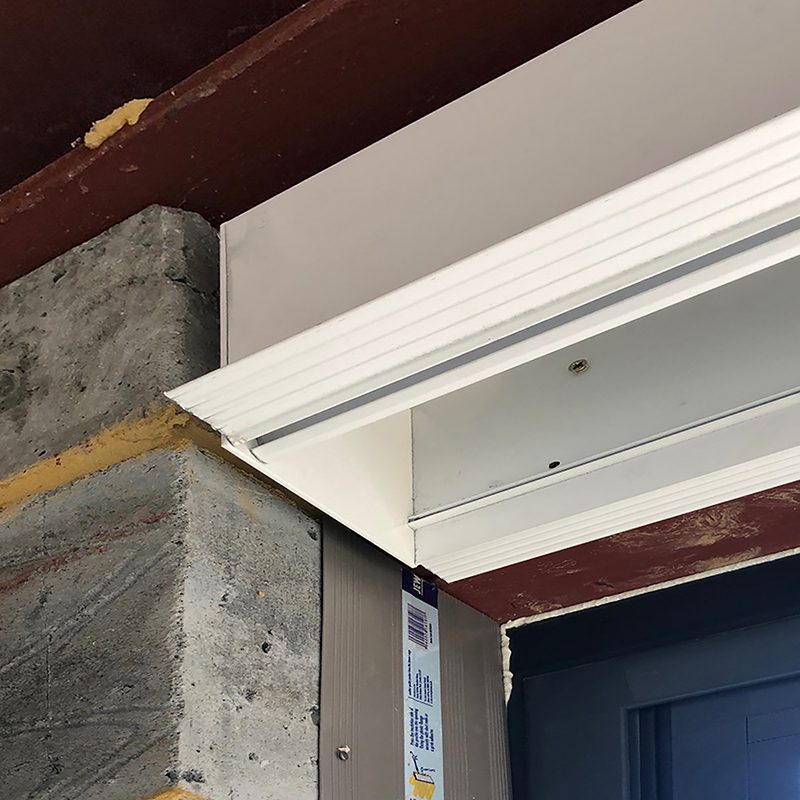
A recessed window treatment is one whose hardware was designed into the building. The shade tube, motor and brackets live inside an aluminum pocket flush with the ceiling; the drapery track sits inside a profile plastered into the drywall. Raise the shade or open the drapery and the room shows a hairline in the ceiling and nothing else. No fascia, no bracket, no pelmet, no visible track.
See it done: at Trump Tower III in Sunny Isles Beach, every roller and the drapery track disappear into ceiling pockets across a stepped and curved oceanfront facade - each opening templated individually.
We are a Blindspace® dealer and installer, and a Lutron, Crestron, Somfy Expert and SDN Specialist certified shading company with our own drapery workroom. That combination matters here: the pocket, the motor, the fabric and the wiring have to be decided together, early, by one team that will also be the one standing on the ladder at the end. This page covers both systems, the full specifications, and exactly which motorized models fit.
Recently: Landmark Ranch Estates, Southwest Ranches - our largest recessed project to date: every shade, track and Roman of a new estate inside a ceiling pocket, coupled rollers on one motor, sixteen-foot drapery flush to the floor.
What can be recessed
Recessed Shade Pockets
Blindspace® S, M and C Series boxes hide roller, dual, blackout, zip and skylight shades in the ceiling, wall or window reveal, closed by a cover plate on a patented safety hinge. Explore recessed shade pockets.
Recessed Curtain Tracks
TrackTrim® and TrackTrim® Click profiles recess Lutron, Somfy and Crestron drapery tracks flush with the ceiling, with end sets shaped to each motor. Straight, curved or corner. Explore recessed curtain tracks.
Shades and Draperies Together
The most requested combination in South Florida glass: a sheer or blackout shade in the pocket, a ripplefold drapery on a recessed track in front of it, one clean ceiling line across the whole wall.
Corners, Skylights, Shaped Glass
Mitred or butt-jointed corner pockets, three- and four-sided skylight frames, sloping boxes for gable windows, bottom-up shades hidden in the floor. The windows most installers give up on.
Future-Proofing
Not ready to choose shades? We install closed pockets and wiring at construction. Any window can take a motorized shade years later without opening the ceiling.
Commercial and Hospitality
The same systems scale from a penthouse to a lobby or a hotel floor, on Somfy SDN or Lutron wired networks, with every shade concealed and aligned. See commercial window treatments.
Where an expert stops, a specialist begins
Almost nobody asks for recessed window treatments by accident. The people who do are architects who drew a flush ceiling and expect it to stay flush, designers who chose a fabric and do not want a bracket competing with it, and owners who notice a two millimeter step in a reveal from across the room. This work is for them, and it is judged by details that a good general installer never has to think about.
The hairline, not the gap
Blindspace® skim-coat flanges let the plasterer feather the finish over the box so the only thing left is a hairline between ceiling and cover. That needs the box fixed every 200 mm, scrim tape on the flanges, plaster flush with the chamfered edge and a 3 mm recess allowance, and someone checking all of it before the painter arrives.
An opening sized to the millimeter
The cover plate is chosen for the exact roll-up diameter of your fabric and drop and the hem bar you selected. Too wide and the pocket shows; too narrow and the shade rubs. We size it from the manufacturer's roll-up chart, not from a rule of thumb.
Light control that is actually dark
Blackout in a pocket means side channels hidden in side boxes, a hem bar box at the sill, and for bedrooms and media rooms the M Series box with a black anodized interior so light does not bounce out of the pocket. Surface-mounted fascias cannot do this.
End sets that fit the motor, not a generic hole
TrackTrim® end sets are made for the specific drive unit and belt return of the Lutron Sivoia QS, Somfy Glydea and Crestron CSS tracks we install. The track is fixed through its own body, centered, with no wedge and no visible bracket.
Corners that read as one line
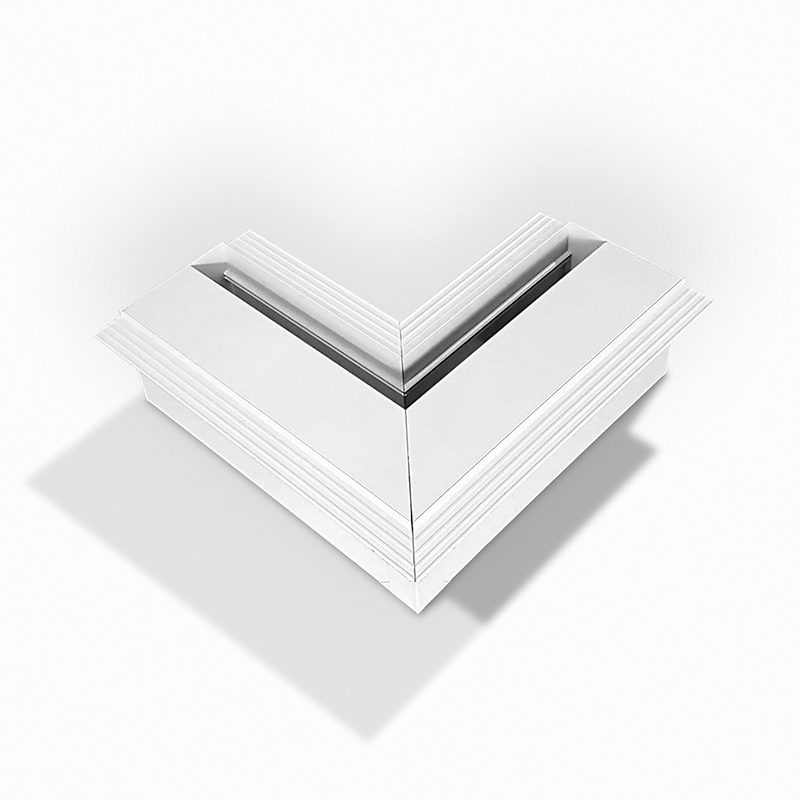
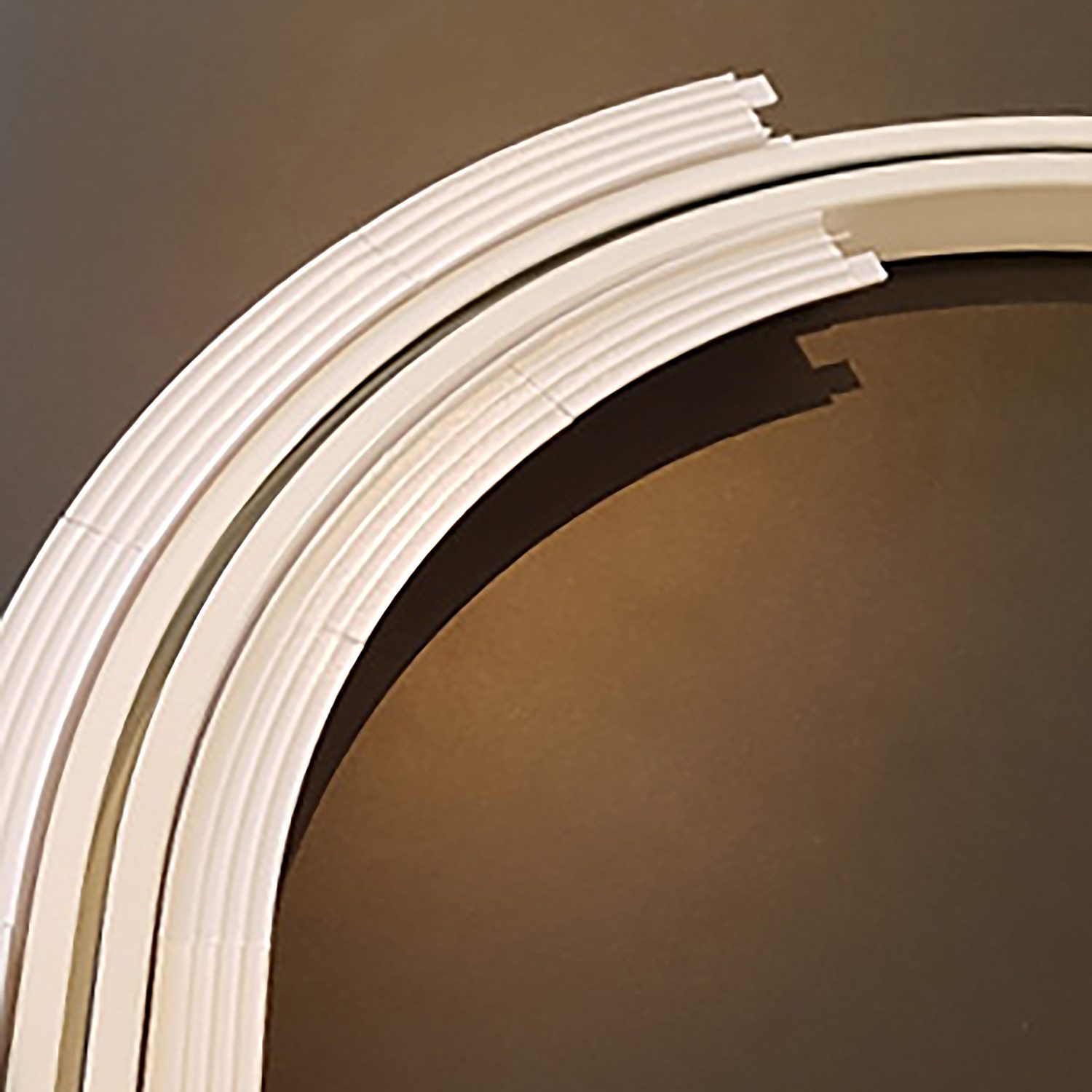
Curved sections in eight radii let a ripplefold sheer turn a corner or follow a bay in a continuous wave. Mitred corner pockets keep the two shades of a floating glass corner within a few millimeters of each other.
Wiring you will never see
Power and control cables enter through grommets inside the pocket before drywall, positioned for the motor end we already specified. No surface conduit, no junction box in the reveal, no drilling into a finished ceiling later.
Built for the systems we are certified on
Blindspace® is hardware-agnostic: the pockets accept any roller, and the track profiles are made with brand-specific end sets. This is what we install inside them, by name.
| System | Recessed drapery tracks (TrackTrim® / Click) | Recessed shade pockets (S, M, C Series) |
|---|---|---|
| Lutron | Sivoia QS drapery track with matching motor end TTLMB1F and return end TTLRB1F, one-piece corner return TTLCRB1F, fixing bracket TTL1 or Click clip TTCL1. Dual tracks at 140 mm (5.51 in) spacing for sheer plus blackout. | Sivoia QS Wireless, Palladiom and Triathlon roller shades. The motor is inside the tube, so the shade needs no extra pocket depth. Blindspace's Lutron drawings: R20 and R64 in the S100x100 to 96 in wide; R100 and R150 in the S130x130 to 120 in (173 in for the wide-diameter WIDR versions); dual shades in a C150x230, C200x280 or C220x360 box (stacked on Lutron's dual bracket) or a C260x130 or C380x200 (side by side). Tables: S Series, C Series. |
| Somfy | Glydea motorized track with motor end TTSMB1F, inverted motor end TTSIMB1F for reversed installs, return end TTSRB1F, corner return TTSCRB1F, bracket TTS1 or Click clip TTCS1. Dual tracks at 140 mm (5.51 in) or 180 mm (7.09 in) spacing. | Sonesse 28 WireFree, Sonesse 30, 40 and 50 rollers, RTS or SDN. Blindspace draws Somfy-driven shades as generic rollers: a standard roller in the S100x100 (to 110 x 118 in), a large roller in the S130x130 (to 157 x 157 in), zip shades in the S130x130 to about 98 in wide; dual shades in C Series boxes, a C200x100 or C260x130 side by side and a C110x170 or C140x230 stacked. Sizes. |
| Crestron | CSS drapery track with motor end TTCMB1F, return end TTCRB1F and fixing brackets TTC1 / TTC2. Integrated with the rest of the Crestron home through your integrator. | Crestron motorized roller shades. Blindspace's Crestron drawings: ARCH3 in the S100x100 or a C110x110 to 96 in wide, ARCH5 in a C150x150 to 168 in, both also drawn with side channels; dual-bracket ARCH3 and ARCH5 with side channels in a C140x190 or C200x280. Wiring for Cresnet or wireless placed in the box at framing. Sizes. |
| Manual and other | Manual curtain tracks with flat end sets TTFE35F / TTFE35. Blindspace® also makes end sets for Silent Gliss 5100 and 5600, QMotion and Coulisse tracks. | Any manual or motorized roller, dual roller, zip and skylight shade; chain guides for manual shades. |
Part references are Blindspace® end-set and bracket codes; box and maximum shade sizes are from Blindspace's published drawings. We confirm every combination against the current Blindspace and motor manufacturer drawings before ordering. Every drawing, filterable by system: the Blindspace® library.
Blindspace® system specifications
Everything an architect, designer or contractor needs to draw the pocket: sizes, capacities, cover openings, flanges, materials, finishes, lengths and fixing. Metric first because the system is metric; inches follow. Detail pages: shade pockets, curtain tracks and the Blindspace® library with every published drawing.
1. Shade pocket series at a glance
| Series | Sizes (W x H) | Shade width capacity (approx.) | Construction and finish | Profile length | Use it for |
|---|---|---|---|---|---|
| S Series standard | S100x100: 100 x 100 mm (3.94 x 3.94 in) S130x130: 130 x 130 mm (5.12 x 5.12 in) | 100 box: single rollers to about 2,400 mm (94 in) wide 130 box: rollers to about 4,000 mm (157 in); zip shades to about 2,500 mm (98 in) | Extruded aluminum EN 6063 T6, 2 mm; powder coated white RAL 9016 30% gloss, any RAL, or raw; polymer safety hinge | 6,000 mm (19 ft 8 in), cut to length or spliced | Standard motorized rollers, floor-to-ceiling glass, sliding doors, future-proofing |
| M Series modular | M100x100: 100 x 100 mm (3.94 in) M130x130: 130 x 130 mm (5.12 in) | 100 box: rollers to about 2,500 mm (98 in) 130 box: rollers to about 3,900 mm (154 in); zip shades to about 2,800 mm (110 in) | Extruded aluminum 2 to 5 mm; head box SM16 black anodized inside to minimize light transmission; covers white RAL 9003 or any RAL; aluminum hinge | 5,000 mm (16 ft 5 in), cut to length or spliced | Blackout bedrooms, media rooms, anywhere light bouncing out of the pocket would show |
| C Series custom | Any size; smallest useful box about 90 x 90 mm (3.5 in). Examples: C200x100 (7.87 x 3.94 in) dual side by side; C110x170 (4.33 x 6.69 in) dual stacked; C260x130 (10.24 x 5.12 in) large dual | Very large shades, dual shades, gable and shaped windows, skylights of any size | Back box 2 mm aluminum sheet EN AW-1050A; front corners and cover extruded 6063 T66; white RAL 9016, any RAL, or raw; polymer hinge | 3,000 mm (9 ft 10 in), cut to length or spliced | Dual and oversized shades, corners, skylights, sloped and shaped glazing, bottom-up shades |
Shade widths depend on the shade system, tube and fabric used; boxes are supplied up to 6,000 mm wide (S), 5,000 mm (M) or spliced for longer runs. Roller motors sit inside the tube and need no extra space; cellular shade motors sit in the head rail.
2. Cover plates and opening sizes
| S Series box | Cover plate | Opening left for the shade |
|---|---|---|
| S100x100 | C65, 65 mm (2.56 in), default | 29 mm (1.14 in) |
| C75, 75 mm (2.95 in) | 19 mm (0.75 in) | |
| C92 / C95 | Closed box (future-proofing) | |
| S130x130 | C65, 65 mm (2.56 in) | 59 mm (2.32 in) |
| C75, 75 mm (2.95 in) | 49 mm (1.93 in) | |
| C85, 85 mm (3.35 in) | 39 mm (1.54 in) | |
| C95, 95 mm (3.74 in), default | 29 mm (1.14 in) | |
| C122 / C125 | Closed box (future-proofing) |
| M Series box | Cover plate | Opening left for the shade |
|---|---|---|
| M100x100 | 50 mm (1.97 in) | 30 mm (1.18 in) |
| 60 mm (2.36 in) | 20 mm (0.79 in) | |
| M130x130 | 80 mm (3.15 in) | 30 mm (1.18 in) |
| 90 mm (3.54 in) | 20 mm (0.79 in) | |
| C Series | C65, C75, C85, C92, C95, C115, C122, C125, C150, C200 | Opening designed to the shade and hem bar; covers can fully close the box |
Covers are supplied in 6,000 mm lengths, can be powder coated to a RAL color or primed and painted on site to match the ceiling, and hinge on either side of the box so the shade can face the room or the glass. Closed covers can be cut down locally when a pocket is activated later.
3. Side boxes, hem bar boxes and corner options
| Item | S Series | M Series | C Series |
|---|---|---|---|
| Side box (hides side channels or guide wires) | S100x50 (3.94 x 1.97 in) and S130x50 (5.12 x 1.97 in) | M100x70 and M130x70 (2.76 in deep) for side channels up to 60 mm (2.36 in); side covers available | Any size, e.g. C200x50 or C110x50; same width as the head box for an even frame |
| Hem bar box (hides the bottom bar at the sill) | S100x50 / S130x50 | By configuration | Any size, matching the head and side boxes; used on four-sided skylight frames |
| Corner / flange options | SS skim-coat flanges both sides, SN one side, NN no flange | Corner flanges for skim coat or for a painted finish; corner hinge; brush holder | S skim coat, U upstand, V visible plain, N no flange, P perforated |
| End caps | SEC100x100, SEC130x130, SEC100x50, SEC130x50 | By configuration | CEC Small (to 100x100), Medium (to 130x130), Large (to 155x155), Extra Large (above) |
| Accessories | Clip-on cover hinge CH25 (extra strong CH25H), splice pin SPLI1 to align boxes, splice plate SPLA1 to align covers, chain guides CG100 / CG130 for manual shades, cable grommet HG1, cable holder, universal brackets UNI100 / UNI130, wall mount for installations without a head box | ||
4. Recessed curtain track profiles (TrackTrim®)
| Item | Specification |
|---|---|
| Profiles | TT1F track with screw channel, TT2F for screw-through fixing, TTC1F TrackTrim® Click (no drilling: fixing clips TTCL1 for Lutron and TTCS1 for Somfy every 500 mm, 100 mm within the drapery stack), RT1E flangeless (Reese) profile with flangeless end sets for installations that need no skim-coat flange |
| Profile size | 90 mm wide x 30 mm high (3.54 x 1.18 in), supplied in 2,000 mm (6 ft 7 in) lengths, cut to size or joined with splice pins for longer runs |
| End sets | Lutron: TTLMB1F motor, TTLRB1F return, TTLCRB1F one-piece corner return, TTLSRB1F straight return connector. Somfy: TTSMB1F motor, TTSIMB1F inverted motor, TTSRB1F return, TTSCRB1F corner, TTSSRB1F straight. Crestron: TTCMB1F motor, TTCRB1F return. Manual: flat ends TTFE35F (flanged) / TTFE35. Also Silent Gliss 5100 / 5600, QMotion, Coulisse and others |
| Fixing brackets | TTL1 Lutron, TTS1 Somfy, TTC1 / TTC2 Crestron, TTSG1 / TTSG2 Silent Gliss; installation kit CTIK2 with track protector CTP and Allen key AKFB |
| Curved sections | 22.5 degree segments, four per 90 degree corner, radii 250, 290, 300, 330, 365, 440, 480 and 508 mm (9.8, 11.4, 11.8, 13.0, 14.4, 17.3, 18.9 and 20 in); short splice pin SPLI2 between segments |
| Dual tracks | Two profiles side by side at 140 mm (5.51 in) spacing for Lutron or Somfy, or 180 mm (7.09 in) for Somfy, for sheer plus drapery or drapery plus blackout at one window |
| Material and finish | Track in aluminum EN 6060 T66; end sets and curves in POM or ABS polymer; white, plastered in and painted on site to match the ceiling, or powder coated to a RAL color |
| Fixing and loads | Countersunk screws every 200 mm (7.87 in) through the profile and flanges into solid blocking above; the track carries the full drapery weight, most of it where the panels stack. Finished plaster flush with the chamfered edge |
5. Installation requirements we coordinate on site
| Stage | Requirement |
|---|---|
| Blocking | Solid backing behind every pocket and track, plumb and level within industry tolerances; the drapery track blocking carries the curtain load |
| Fixing | Countersunk screws every 200 mm (7.87 in) through the back and through both flanges where present; boxes aligned with splice pins, covers with splice plates |
| Wiring | Power and control (Lutron QS link, Somfy SDN or RTS power, Crestron Cresnet) run into the pocket through the cable grommet before drywall, at the motor end we specified |
| Plaster | Scrim tape over skim-coat flanges, finish feathered flush with the chamfered edge, 3 mm (0.12 in) recess allowance so the cover and shade install cleanly |
| Paint | Covers primed and painted with the ceiling, or supplied powder coated to the ceiling RAL; boxes protected until completion |
| Window treatments | Shades and draperies surveyed after decoration, ordered to the finished opening, installed and programmed last; cover on the safety hinge gives service access forever |
| Documentation | Pocket schedule per window, section details and Blindspace® CAD (DWG and PDF) for the design team; a mock-up pocket on large projects before the rest go in |
From drawings to fabric, one team
Design-stage consultation
We read the plans with you, your architect or designer, agree which windows get shades, draperies or both, and write the pocket and track schedule with sizes and wiring.
Pockets at framing
Blindspace® boxes and TrackTrim® profiles arrive cut to length. We coordinate blocking, fixing, grommets and cable routes with the GC and electrician, and check every pocket before drywall.
Plaster, paint, close
Flanges are taped and skimmed, covers painted with the ceiling. The pocket disappears. Nothing about the shades is on site yet, so nothing gets damaged.
Shades and draperies last
After decoration we survey the finished openings, order the Lutron, Somfy or Crestron shades and sew the draperies in our workroom, then install, program and hand over.
Specify it once, correctly
We supply pocket dimensions, section details and Blindspace® CAD files for your drawings, answer the electrician's questions before the walls close, and provide a floor-plan budget for the complete package: pockets, motors, fabrics, fabrication and installation. Trade partners receive our published trade discount.
Already past framing? Tell us anyway. Depending on the ceiling build-up there is often still a way to recess a track or pocket a shade, and if there is not, we will say so and propose the cleanest visible alternative.
Frequently asked
What is a recessed window treatment?
A shade or drapery whose hardware is built into the ceiling or wall instead of mounted on it. The shade tube, motor and brackets sit inside a purpose-made aluminum pocket (Blindspace® S, M or C Series) closed by a hinged cover plate, or the drapery track sits inside a flush TrackTrim® profile plastered into the ceiling. When the treatment is raised or open, you see a hairline in the ceiling and nothing else.
When does it have to be decided?
Before drywall. The pockets and track profiles are installed during construction, then plastered and painted with the ceiling. The shades and draperies themselves go in last, once the room is finished. If a project is already at paint, options shrink to visible pelmets or fascias, so the earlier we are in the conversation, the more we can hide.
Which motorized systems fit inside?
The systems we are certified on. Recessed curtain tracks: Lutron Sivoia QS drapery track, Somfy Glydea (standard or inverted motor) and Crestron CSS drapery track, each with its own perfect-fit motor and return end set, plus manual tracks. Shade pockets: Lutron Sivoia QS, Palladiom and Triathlon rollers, Somfy Sonesse RTS, SDN and WireFree rollers, and Crestron roller motors. Roller motors sit inside the tube, so no extra space is needed; the pocket is sized to the shade's roll-up diameter.
Can you add a shade later if I only install the pocket now?
Yes. That is the future-proofing use of Blindspace®: we install closed boxes at construction with wiring in place. Years later, a shade is surveyed, ordered and dropped into the pocket without opening the ceiling. Closed covers are swapped for a cover with the right opening.
Does a recessed pocket work for blackout?
Yes, and it is where a pocket outperforms a surface mount. Blackout shades run in side channels hidden inside side boxes, the hem bar disappears into a hem bar box, and the M Series box has a black anodized interior to minimize light transmission. The result is a clean opening with no visible hardware and a much tighter light seal than a fascia.
Do you provide drawings for the architect or contractor?
Yes. We supply pocket dimensions, section details and Blindspace® CAD drawings (DWG and PDF) for the design team, and we coordinate blocking, wiring and drywall returns with the GC and electrician at framing. On large projects we recommend a mock-up of one pocket for approval before the rest are installed.
Can recessed tracks turn corners or follow a curved wall?
Yes. TrackTrim® curved sections come in eight radii from 250 mm to 508 mm (9.8 in to 20 in) in 22.5 degree segments; four segments make a 90 degree corner. Ripplefold and wave draperies ride the bend without a break, so a corner window or bay reads as one continuous line of fabric.
Where in South Florida do you install recessed window treatments?
Miami-Dade, Broward and Palm Beach: new construction, condo build-outs and renovations from Miami Beach and Brickell to Fort Lauderdale, Boca Raton and West Palm Beach. Pocket specification can start from plans before the site is ready.
Discerning homeowners, designers, and developers across South Florida trust Exotic with their most important spaces.
“We had creston motorized track installed by David and we are very happy with the results. It’s so quiet and smooth.. clean professional installation I recommend!!!”
“We recently moved into a new condo and knew we wanted Lutron shades. Since there was no electrical wiring near the windows, Exotic Shades recommended battery powered Lutron roller shades. It was the perfect solution.the installation was clean, the shades work beautifully, and we are very happy happy. Good job!”
“We hired Exotic Shades for motorized shades in our new Boca Raton home, and the whole experience was great. They helped us choose the right look and privacy level for each room, the installation was clean and professional, and the shades work perfectly. Our home feels more finished, and we love the convenience of controlling everything with our smart home system!!”
Decide the pockets before the drywall does
One free hour with our team routinely saves owners thousands in avoidable mistakes. Bring the plans; we bring the pocket schedule, the wiring answers and honest advice on what can still be hidden.