

How to Measure for Shades, Blinds, Curtains and Draperies
Measure every window with a steel tape to the nearest 1/8 in, width first, in three places, and give the exact opening without deductions: that is the rule behind every shade, blind and drapery Exotic Shades & Draperies cuts in its Fort Lauderdale workroom. This guide gives the rest - inside and outside mount, the depth each motor system needs, rod height, fullness, float, break and puddle lengths, sliding doors and ceiling pockets - for South Florida glass. Or book the free in-home measure and we do it for you.
The numbers we cut to
Custom window treatments are made to the eighth of an inch from the figures on the order, so measuring is where a project succeeds or fails. The rules below are the ones our own team uses at the measure; they are written for owners and designers who want to plan, budget and check a quote before we visit.
The measure itself is free: we come with the tape, the depth gauge and the fabrics, confirm the mount window by window, and the written quote is priced from those figures. Everything on this page is what happens in that hour.
The short version
- Every window: steel tape, to the nearest 1/8 in, width first then height, three places each, and every window measured on its own even when they look identical.
- Inside mount: width at the top, middle and bottom, keep the smallest; height at the left, center and right, keep the longest; give us the opening size and make no deductions, the workroom takes them.
- Outside mount: the opening plus 2 to 3 in each side and 2 to 3 in above the frame (more for blackout), or wall to wall and ceiling to floor on a wall of glass.
- Depth for an inside mount: about 2 to 3 in for most shades; a 38 mm Somfy Sonesse 30 tube tucks inside a 3 in frame, a Lutron Roller 64 projects about 3.5 in, a Roller 100 about 5 in, and a dual roller fascia needs about 5 in of clear depth.
- Curtain rod or track: at least 6 in past the frame each side, 4 to 6 in above the frame or at the ceiling; on floor-to-ceiling glass the track goes wall to wall at the ceiling.
- Curtain length: floor length is measured from the top of the rod or track to the floor: 1/2 in off the floor for panels that move every day, a 1 to 2 in break for stationary panels, a 3 to 6 in puddle only where nobody walks.
- Fullness: ripplefold at 80%, 100% or 120% set by the snap-tape spacing (100% is about double the track length in fabric), pinch pleat 2 to 2.5 times the width, sheers 2.5 to 3 times.
- A sliding glass door: measure the full span wall to wall, note which panel slides and where the handle is, and plan the stack on the fixed side; openings wider than 144 in become two coupled shades on one motor.
Eight rules that hold for every window
These are the habits that keep a custom order from coming back wrong. They apply to a single bathroom window and to a 40-window estate alike.
A steel tape, not a cloth one
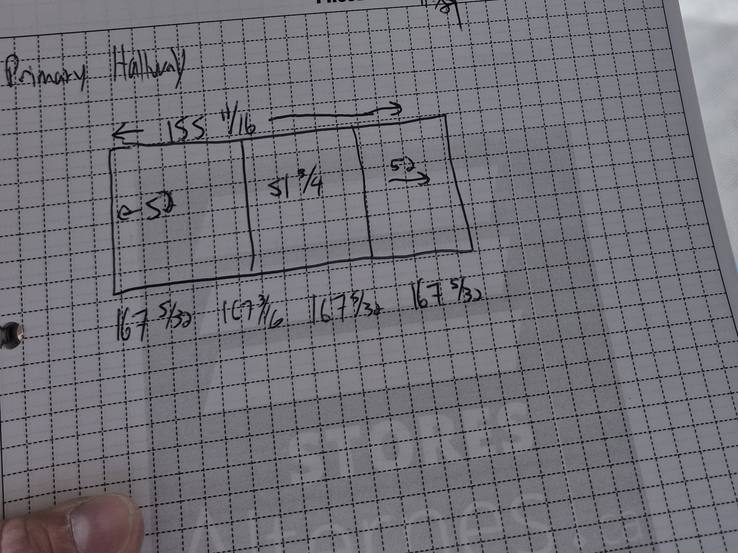
Cloth and plastic tapes stretch. Use a steel tape, a pencil and a step stool, and write every figure down as width by height (W x H) the moment you read it. Photograph each window with its number on a sticky note; it saves a second visit.
To the nearest 1/8 in, never rounded
Custom hardware is cut to the eighth. A reading that lands on a sixteenth is rounded down for widths and up for heights; never to the nearest half or whole inch, which is how a shade ends up rubbing the frame or leaving a slot of daylight.
Three places, every window
Frames are rarely square. Measure the width at the top, the middle and the bottom, and the height at the left, the center and the right. Two windows that look identical usually differ by a quarter inch, and the fabric is cut to the inch you give us.
Check the square
Measure the two diagonals of the opening. If they differ by more than 1/2 in the frame is out of square: an inside-mounted shade will show a wedge of light on one side, so that window goes outside mount or into side channels.
Do not deduct
Give us the exact opening. Every product has its own deduction for brackets, end caps and fabric roll, and the workroom applies it. Deducting yourself, then having the factory deduct again, is the most common cause of a shade that is too narrow.
Look for what is in the way
Crank handles, door handles, alarm sensors, tile lips at the sill, a light switch beside the frame and the swing of a door all decide the mount and the roll direction. Note them next to the numbers.
The South Florida wrinkle
Floor-to-ceiling glass has no frame, so inside versus outside becomes ceiling pocket versus surface fascia; concrete slabs and hurricane-impact frames limit where a screw can go; many condo frames are only about 3 in deep. That is why we measure every opening ourselves rather than mailing a bracket.
Or skip all of it
The free in-home measure is exactly that: we measure, check depth, square, power and the handle, and the written quote is priced from those figures. The rules below are for owners and designers who want to plan, budget and sanity-check first.
Inside mount or outside mount, then three measurements each
An inside mount sets the shade inside the frame, flush with the wall, and keeps the trim visible; it needs enough depth and a reasonably square opening. An outside mount fixes the bracket to the wall or ceiling above the opening and overlaps the frame, which is why bedrooms and media rooms usually go outside mount even when the depth exists: the overlap kills the light halo an inside mount always leaves. How we choose between them.
On floor-to-ceiling condo glass there is no frame, so the choice becomes a ceiling pocket or a surface fascia, measured wall to wall.
Inside mount
- Width. Measure the inside of the frame at the top, the middle and the bottom, edge to edge of the opening. Keep the smallest.
- Height. Measure from the top inside edge of the frame to the sill at the left, the center and the right. Keep the longest so the shade covers the tallest point.
- Depth. Measure from the front edge of the frame to the glass (or to the first obstruction: a crank, a lock, a tile return) at three points. Keep the smallest and compare it with the table below.
- Give the opening. Write W x H exactly as measured, no deductions. The workroom deducts for the brackets and the fabric, and tells you if the shade will sit flush or proud of the frame.
Outside mount
- Width. Decide what the shade should cover: the trim, the frame, a bare wall. Add 2 to 3 in each side of the opening, more for blackout so the fabric overlaps the light. On a wall of glass, wall to wall.
- Height. From where the bracket will sit, 2 to 3 in above the opening (or at the ceiling), to the sill or 2 in below it. Tile sills and baseboard heaters decide the bottom.
- Flat surface. The bracket needs about 2 in of flat surface above the opening and clearance for the roll or cassette; note crown moulding, a header beam or a soffit.
- Give the finished size. Outside-mount sizes are made as ordered, so the width you give is the width you get. If in doubt, give the opening and the overlap you want and we size it.
How deep the frame has to be, motor by motor
The measuring guides of the big retailers stop at "check the product page". The depth that matters is the one the motor system needs, and it is the reason a shade sits flush in one frame and proud in the next. Many South Florida window frames are about 3 in deep; these are the numbers we check them against.
| System | Depth it needs | What that means at the window |
|---|---|---|
| Most manual and cordless shades and blinds | about 2 to 3 in | Enough for a flush or near-flush inside mount on standard frames; shallower frames go outside mount. |
| Somfy Sonesse 30 motorized roller | 3 in | The 38 mm Sonesse 30 tube tucks inside a 3 in frame, which is why it is the roller behind most of our condo work. |
| Lutron Sivoia QS Roller 64 | about 3.5 in of projection | Lutron sizes its tubes for wide fabric; on a 3 in South Florida frame the shade sits proud unless it is outside-mounted or pocketed. |
| Lutron Sivoia QS Roller 100 | about 5 in of projection | Very wide single shades; usually a pocket or a fascia on the wall. |
| Lutron Triathlon WIDR battery roller | 4 in of jamb (4.5 in with a fascia) | Battery rollers to 144 in wide need the deeper jamb; standard Triathlon to 108 in is shallower. |
| Dual roller shade, 5 x 5 in Vertilux fascia | about 5 in of clear depth | Two tubes in one square fascia; shallower frames and sliders get an outside mount on the wall or ceiling. |
| Lutron dual rollers in a pocket | 5.5 x 7.5 in (two Roller 64) or 7 x 11 in (two Roller 100) | Lutron's published pocket sizes; drawn into the ceiling on a new build, a soffit in an existing one. |
| Blindspace recessed pocket, single shade | S100x100 = 3.94 in square; S130x130 = 5.12 in square | The 100 box takes rollers to about 94 in wide, the 130 box to about 157 in; blackout rooms move to the M Series with side boxes for channels. |
| Recessed drapery track (TrackTrim) | 90 mm (3.5 in) profile; 140 mm (5.5 in) for motorized tracks | Lutron Sivoia QS, Somfy Glydea and Crestron tracks each have their own end pieces; sized at framing, closed after paint. |
How wide one shade can be before it becomes two
to 124 in usable width in one piece (E Screen 120 in)
to 116 in
to 116 in
to 114 in
two coupled shades on one motor line, priced as two shades; Lutron Sivoia QS couples tubes from 20 in to 20 ft and holds every hembar within 1/8 in
Measuring for side channels and a dark room
A blackout shade only works as a system: an opaque fabric rated 0% light transmittance, side channels that trap the edges, a sealed top and a hembar at the sill. That system is measured, not added. An outside mount overlaps the opening by 3 in or more each side so the fabric covers the light (2 to 3 in is the everyday figure); channels add their own width to the order and their own depth to a pocket (Blindspace M Series side boxes take channels up to 60 mm deep); a hembar box at the sill hides the bottom bar.
Where the window cannot take channels, we size the deduction so the gap is the same on every window in the room and put a screen in front of it: a dual roller needs about 5 in of clear depth for an inside mount, or an outside mount on the wall or ceiling. Blackout draperies are measured with a return to the wall and a center overlap, so the finished panels are wider than the track. Blackout shades · blackout draperies.
Rod height, width, fullness and length
Draperies are measured from the hardware, not from the window: where the rod or track goes decides the length, and the track width decides the fullness and the price. Curtains bought to a standard length are cut to fit a rod; custom draperies are cut to fit the room, which on a 10 to 12 ft South Florida ceiling is the only way the panels reach the floor.
1. Where the rod or track goes
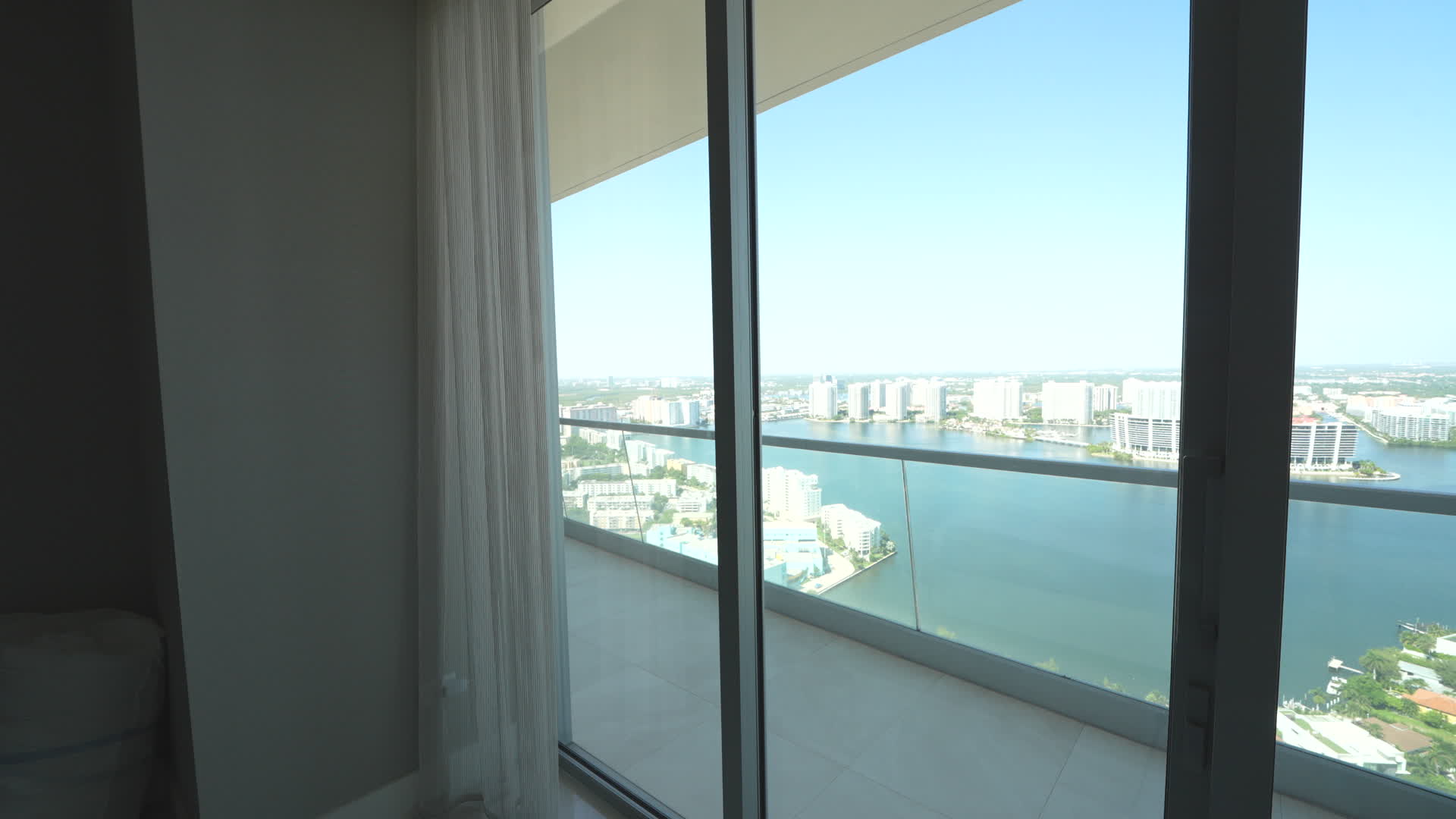
Height first. Mount the rod or track 4 to 6 in above the frame for a standard window, higher for a tall room, and at the ceiling on floor-to-ceiling glass, where the track runs wall to wall. Then the width: at least 6 in past the frame on each side so the open panels stack on the wall, not on the glass; a motorized track that has to clear a door handle or park a heavy stack gets more. Measure the width of the finished track or rod, end to end, finials not included.
2. Width and fullness
The fabric is always wider than the track. Ripplefold fullness is set by the snap-tape spacing: 80% for a shallow contemporary wave, 100% for the balanced standard (about double the track length in fabric), 120% for the deep folds we usually recommend on oceanfront sheers. Pinch pleat uses 2 to 2.5 times the finished width; sheers look right at 2.5 to 3 times. You give us the track width; the workroom cuts the fullness.
3. Length
Floor length is measured from the top of the rod or the underside of the track to the floor, at both ends and the middle, because floors are rarely level over 20 ft of glass. For rings and pinch pleats the drop starts at the pin hook, for ripplefold at the carrier, so tell us the hardware and we take the header into account. On a ceiling mount, measure ceiling to floor.
4. Stack, returns and overlap
Where do the panels go when they are open? Measure the wall beside the glass: a 120% sheer stacks deeper than an 80% wave, and a two-way draw splits the stack in two. Blackout draperies need a return that carries the panel back to the wall and a center overlap, so their finished width is wider than the track. We size all three at the measure.
Should curtains touch the floor? Yes, or nearly
Floor length is the standard for anything that is not over a counter. Which floor length depends on whether the panel moves every day and what is on the floor. All lengths are measured from the top of the rod (or the underside of a track) to the floor, at both ends and in the middle.
| Length | How it is measured | Where it belongs |
|---|---|---|
| Sill | rod to the sill, or 1/2 in above it | Kitchens, baths, over a counter or a radiator |
| Apron | 3 to 4 in below the apron (the trim under the sill) | Windows with furniture or a heater underneath |
| Float | rod to floor, minus 1/2 in (1 in on carpet) | Anything that opens and closes every day; the cleanest line on tile and wood |
| Break (kiss) | rod to floor, plus 1 to 2 in | Stationary panels and formal rooms; hides an uneven floor |
| Puddle | rod to floor, plus 3 to 6 in | Stationary panels only, in silk, linen or velvet, where nobody walks |
| Ready-made lengths | 63, 84, 96, 108 and 120 in | What a store sells; custom draperies are cut to your rod height instead |
The widest opening in the house is one measurement
A sliding glass door is the widest, tallest and most-used opening in a South Florida home, and it is where most window treatments fail: a shade that stops at the handle, drapes that stack on the wrong side, blinds that block the panel you slide. The door is not the problem; the measurement is. The sliding door guide.
Measure the whole span
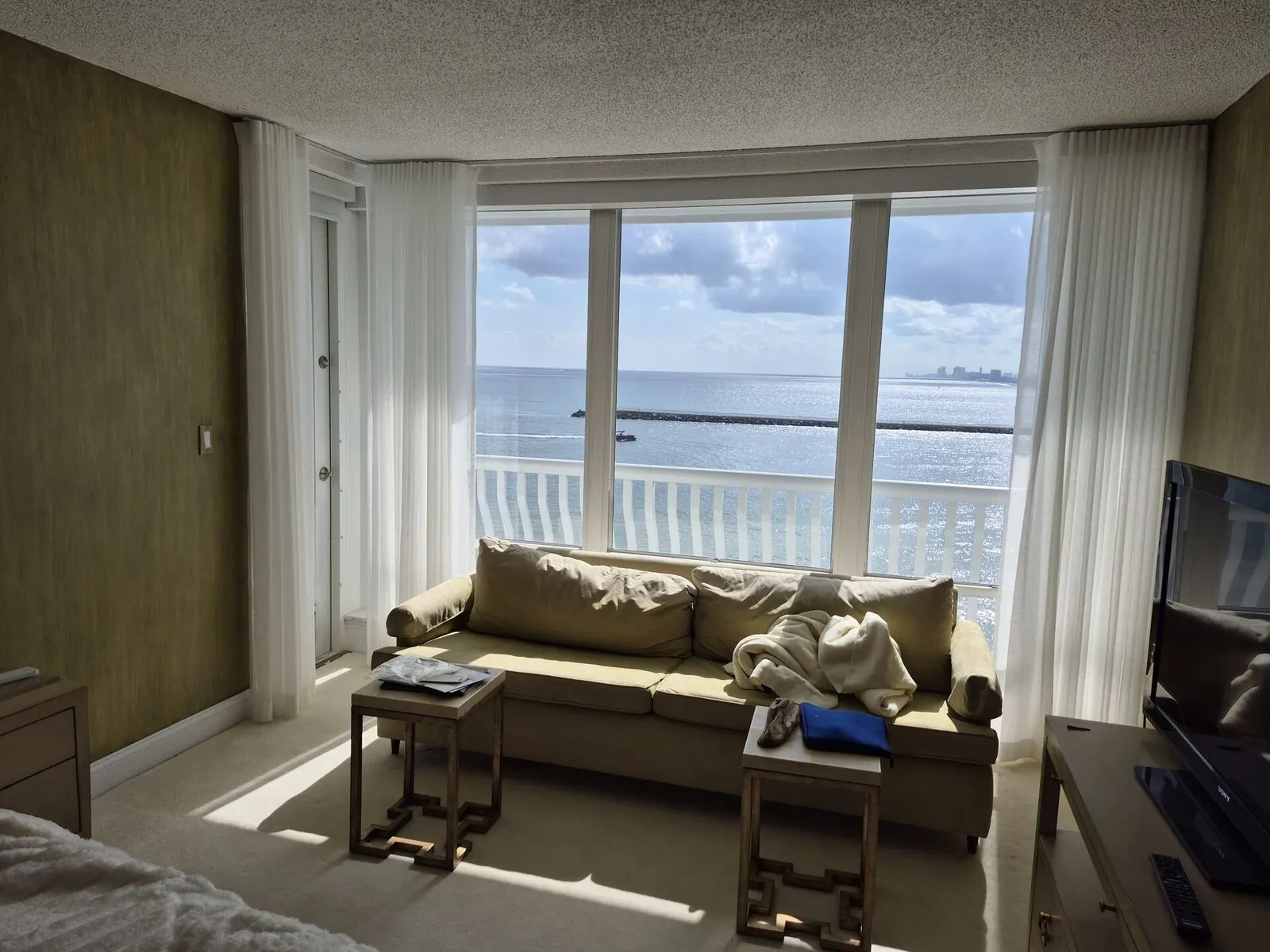
Wall to wall, or the full width of the door frame plus the overlap you want on each side, and floor to ceiling at both ends. A 12 to 14 ft slider is one measurement, never two windows.
Note the moving panel and the handle
Which panel slides, which is fixed, where the handle and the lock sit and how far they stand off the glass. A roller shade that stops at the handle, or a stack that parks in front of the panel you walk through, is the mistake we fix most often.
Plan the stack on the fixed side
Draperies, Allusion sheer verticals and panel tracks stack; the stack belongs on the fixed panel or on the wall beside the door. A bent track can carry the stack around a corner onto solid wall so the open window is all glass.
Coupled shades over 144 in
The widest single roller shade we make is 144 in; openings wider than that become two coupled shades on one motor line, sized so the hembars meet at a mullion. Solar screens run to 124 in in one piece, blackouts to 116 in, so the fabric width can force the split earlier than the hardware does.
What a motorized measure adds
Motorization changes four things about a measurement: which side the power arrives on, how much depth the tube needs, whether a pocket is drawn into the ceiling before the drywall, and how a track is sized. Pre-wiring guide · recessed and concealed treatments.
Power side and cable
Battery motors (Somfy WireFree, Lutron Triathlon, our Essential tier) need nothing but a charging point once or twice a year. Wired motors need low-voltage cable at the head of the window: at framing we pull one shielded Cat 6 plus one 16-2 low-voltage cable to each shade location, which satisfies or adapts to every system. Note which side of the window the power can arrive on; the motor goes there.
Pockets are measured before the drywall
A recessed pocket is sized from the shade that will live in it, not the other way round: an S100x100 box (3.94 in square) takes single rollers to about 94 in wide, an S130x130 (5.12 in square) to about 157 in; dual and blackout shades get bigger or side boxes for the channels. We measure on the live site at framing and come back after paint to fit and program.
Tracks have their own numbers
A motorized drapery track is measured as the finished track length, end to end. Somfy Irismo 45 WireFree carries up to 99 lb of drapery on up to 33 ft of track; Lutron Sivoia QS tracks and Somfy Glydea run in a 140 mm (5.5 in) recessed profile. The track price calculator prices by the foot of track width, drapery included.
Side channels and hembars
Blackout channels add width to the outside-mount measurement and depth to a pocket (M Series side boxes take channels up to 60 mm deep); a hembar box at the sill hides the bottom bar. Both are measured with the shade, never added after.
How the measurements become the number
Hardware prices by bracket
Shade hardware prices by width and drop brackets, not by the inch: a 71 in window and a 72 in window price the same; an 84 in window steps up a bracket. Measured to the eighth, your windows land in the right bracket and the number holds.
Draperies price by width
Custom sheers are $85 per linear foot of width on a manual track in a house and $95 in a condo unit, so the track width is the number that sets the price; a 20 ft glass wall is about $1,700 or $1,900. A 12 ft motorized track with a rechargeable motor, remote and installation is about $1,452 track only, about $2,833 with a smart-hub motor, ceiling mount and lined drapery.
Rough sizes give a range, exact inches give the price
The instant price tool turns a rough count and rough sizes into a range, and exact measurements into the bracket price; the track calculator does the same for draperies. Budgetary, before tax, no email needed.
The free in-home measure
We measure, check depth, square, power and the handle, confirm the mount per window and put it in writing. Measurement, fabrication, installation and programming are all our own team, and the quote you sign is the number you pay.
Frequently asked
How do I measure a window for blinds or shades?
With a steel tape, to the nearest 1/8 in, width first then height, three times each. For an inside mount measure the width at the top, middle and bottom of the opening and keep the smallest, the height at the left, center and right and keep the longest, and the depth at three points and keep the smallest; give the exact opening with no deductions. For an outside mount, add 2 to 3 in each side and 2 to 3 in above the frame, more for blackout.
Do I deduct anything for an inside mount?
No. Give the exact opening size. Every product has its own deduction for brackets, end caps and the fabric roll, and the workroom applies it. Deducting yourself and then having the factory deduct again is the most common reason a shade arrives too narrow.
How much bigger should an outside-mount shade be than the window?
2 to 3 in wider on each side and 2 to 3 in taller above the frame, to the sill or 2 in below it. For blackout, overlap 3 in or more each side or use side channels; on floor-to-ceiling glass, go wall to wall and ceiling to floor.
How deep does a window need to be for an inside mount?
About 2 to 3 in for most shades and blinds. A 38 mm Somfy Sonesse 30 motorized roller tucks inside a 3 in frame; a Lutron Sivoia QS Roller 64 projects about 3.5 in and a Roller 100 about 5 in; a Lutron Triathlon WIDR needs 4 in of jamb; a dual roller shade in its 5 x 5 in fascia needs about 5 in of clear depth. Many South Florida condo frames are about 3 in deep, which is why the motor system decides the mount.
How do I measure floor-to-ceiling glass that has no frame?
There is no inside mount, so the choice is a ceiling pocket or a surface-mounted fascia. Measure wall to wall and ceiling to floor at both ends, note the mullions, the handle and the moving panel, and whether the ceiling is concrete or a drop. Openings wider than 144 in become two coupled shades that meet at a mullion.
What if my window is out of square?
Measure both diagonals. If they differ by more than 1/2 in, an inside mount will show a wedge of daylight on one side; that window goes outside mount, or into side channels if it needs to be dark.
How high should a curtain rod or track be hung?
4 to 6 in above the frame on a standard window, higher in a tall room, and at the ceiling on floor-to-ceiling glass, where the track runs wall to wall. Measure the length from the top of the rod or the underside of the track, not from the window.
How far past the window should curtains extend?
At least 6 in past the frame on each side, so the open panels stack on the wall and the whole window shows. A motorized track that has to clear a door handle or park a heavy lined stack gets more; we measure the wall beside the glass for the stack.
How wide should curtains be?
Wider than the track, always. Ripplefold fullness is set by the snap-tape spacing: 80%, 100% or 120%, where 100% is about double the track length in fabric and 120% is our usual call for oceanfront sheers. Pinch pleat uses 2 to 2.5 times the finished width; sheers 2.5 to 3 times.
Should curtains touch the floor?
Yes, or nearly: floor length is the standard. Panels that open and close every day float 1/2 in off the floor (1 in on carpet); stationary panels can break 1 to 2 in onto the floor; a 3 to 6 in puddle is for stationary silk, linen or velvet where nobody walks. Measure to the floor at both ends and the middle, because floors are rarely level.
What are standard curtain lengths?
Ready-made curtains come in 63, 84, 96, 108 and 120 in. Custom draperies are cut to your rod height instead, which is what a 10 to 12 ft South Florida ceiling needs; the length is measured from the rod or track to the floor, not from the window.
How do I measure for a sliding glass door?
Measure the full span wall to wall and the height floor to ceiling at both ends, note which panel slides, where the handle and lock sit and how far they stand off the glass, and plan the stack on the fixed side. One wide shade or a coupled pair on one motor for anything over 144 in; draperies, Allusion sheer verticals and panel tracks stack clear of the moving panel.
Can you just measure for me?
Yes, and most clients do: the free in-home measure covers every opening, the depth, the square, the power and the handle, and the written quote is priced from those figures. The rules on this page are for planning, budgeting and checking a quote before we visit.
Measuring practice as used by our own team at the in-home measure. System figures: Lutron published projections, jamb depths and pocket sizes (lutron.com specifications, retrieved September 2026), Somfy Systems (Sonesse 30, Irismo 45 WireFree), Vertilux dual fascia, Blindspace S, M and C Series box data, TrackTrim profiles; fabric widths are Lutron's published usable widths (lutronfabrics.com). Prices are our published quote-engine figures, budgetary and before tax, September 2026. Written by David Martineau, owner of Exotic Shades & Draperies, Lutron certified dealer, Somfy Expert, Crestron and SDN certified. Updated September 13, 2026.
Would you rather we measured?
One free hour with our team routinely saves owners thousands in avoidable mistakes - wrong fabrics, bad mounts, missed motorization. Book a private, complimentary consultation: we measure every opening, check the depth, the square and the power, and the quote you sign is the number you pay. Start with the free guide: the 5 costly mistakes.