

Blackout Shades
A blackout shade only works as a system: an opaque fabric rated 0% light transmittance, side channels that trap the edges, a sealed top and a hembar at the sill. Exotic Shades & Draperies builds that system in Fort Lauderdale and installs it in bedrooms and media rooms across Miami Beach, Fort Lauderdale and Boca Raton.
Darkness is an engineering problem
A blackout fabric alone does not make a dark room - light leaks around the edges. True blackout is a system: an opaque coated fabric, side channels that capture the fabric edge, a fascia or pocket sealing the top, and a hembar that meets the sill. We engineer all four, window by window.
Recently: Turnberry Ocean Club, Sunny Isles Beach - Sparta Twilight blackout rollers in side channels, so the bedrooms go properly dark on a wall of ocean glass. Also: The Hemispheres, Hallandale Beach - Mermet Elba Twilight blackout in the bedroom, the twin of the Elba Daylight in the living areas, caulked at every edge for true dark. Also: a traditional oceanfront mansion on Bay Drive, Pompano Beach - Phifer SheerWeave 7700R TB2 Sand blackouts through the living areas and 7400 U82 Sesame in the bedrooms, every window motorized against the sun.
In South Florida that matters twice: for sleep against 6:30am summer sun, and for media rooms fighting all-day brightness. Every blackout shade is fabricated in our own workroom and, when motorized, closes silently on schedule - the room is dark before you are tired.
Blackout by the numbers
Light transmittance
Lutron's blackout fabrics are rated 0% visible transmittance where a value is published (85 colourways); the rest are coated opaque weaves. Darkness in the room then depends on the side channels and the hembar, not the fabric.
Width in one piece
Blackout roller fabrics run to 116 in usable width in the Lutron library; larger openings are coupled shades with a shared fascia.
Fire-rated options
Blackout families such as Luna Blackout FR carry NFPA 701 and California Title 19 ratings for commercial and hospitality work; 526 of the 921 Lutron colourways carry an NFPA 701 rating.
Alternative for bedrooms
A double-cell blackout honeycomb is rated R 4.4 by Lutron and seals the edges better than a flat fabric; a dual roller pairs a blackout with a solar screen for the daytime view. See roller vs honeycomb.
A blackout passes no light. Colour still decides the heat.
Every blackout fabric passes no light, so the numbers that separate one from another are about heat and about the edges. Colour matters on the side that faces the glass: a white back reflects most of the sun's energy, a dark back absorbs it and turns the shade into a warm panel on a west window. Dual-sided blackouts exist for exactly this reason, white to the street and the room's colour inside. Where insulation matters, a honeycomb adds an air pocket that a flat roller cannot.
Figures: Lutron fabric specifications for Luna Blackout FR RF-LFR0-WH, Blackout Screen RF-BOSC-CH to RF-BOSC-GR and the honeycomb fabrics; Mermet USA spec sheets for Sparta Twilight and Elba Twilight. Retrieved September 2026.
Read next: Dark or light solar shade fabric? · Openness 1% vs 3% vs 5% vs 10% · Lutron blackout fabrics
Fabrics, channels & systems
Coated Blackout Fabrics
Acrylic and foam-backed weaves that are fully opaque - in textures and colors that look nothing like a hotel shade.
Side Channels & Seals
Aluminum side channels capture the fabric edge and kill the light gap - the difference between dim and dark.
Blackout Honeycombs
Cellular blackout shades add insulation to darkness - the quiet choice for bedrooms. See honeycomb shades.
Dual Day-Night Rollers
Solar or light-filtering front, blackout behind - one bracket, one 5 x 5 in fascia, two moods. Explore dual roller shades.
Blackout Drapery Pairing
Interlined blackout drapery over a blackout shade is the couture route to total darkness - and better acoustics. See draperies.
Motorized & Scheduled
Lutron and Somfy motors close every bedroom shade at your goodnight scene - silently.
Recent installations

Bedroom Blackout
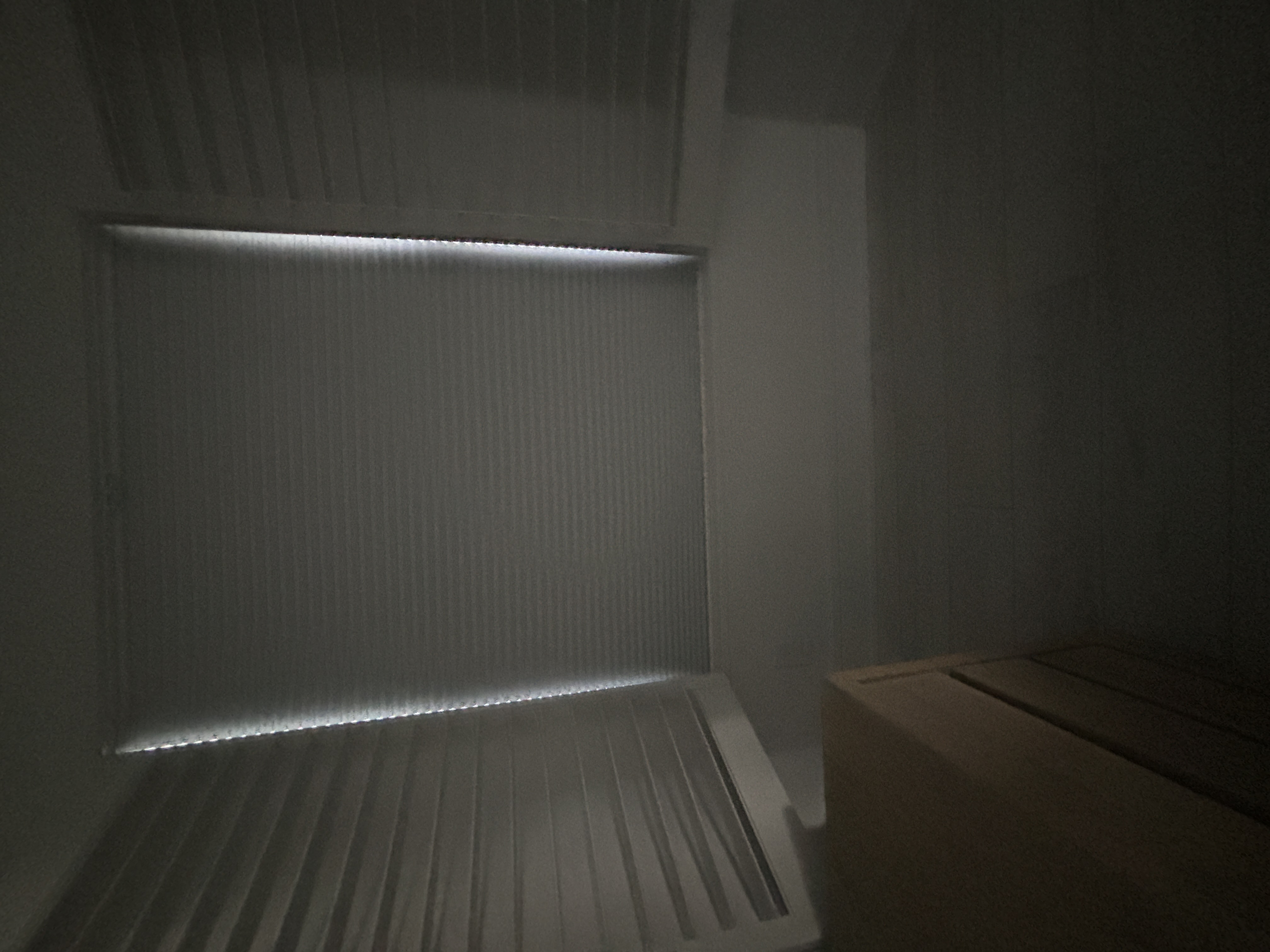
Blackout Honeycomb
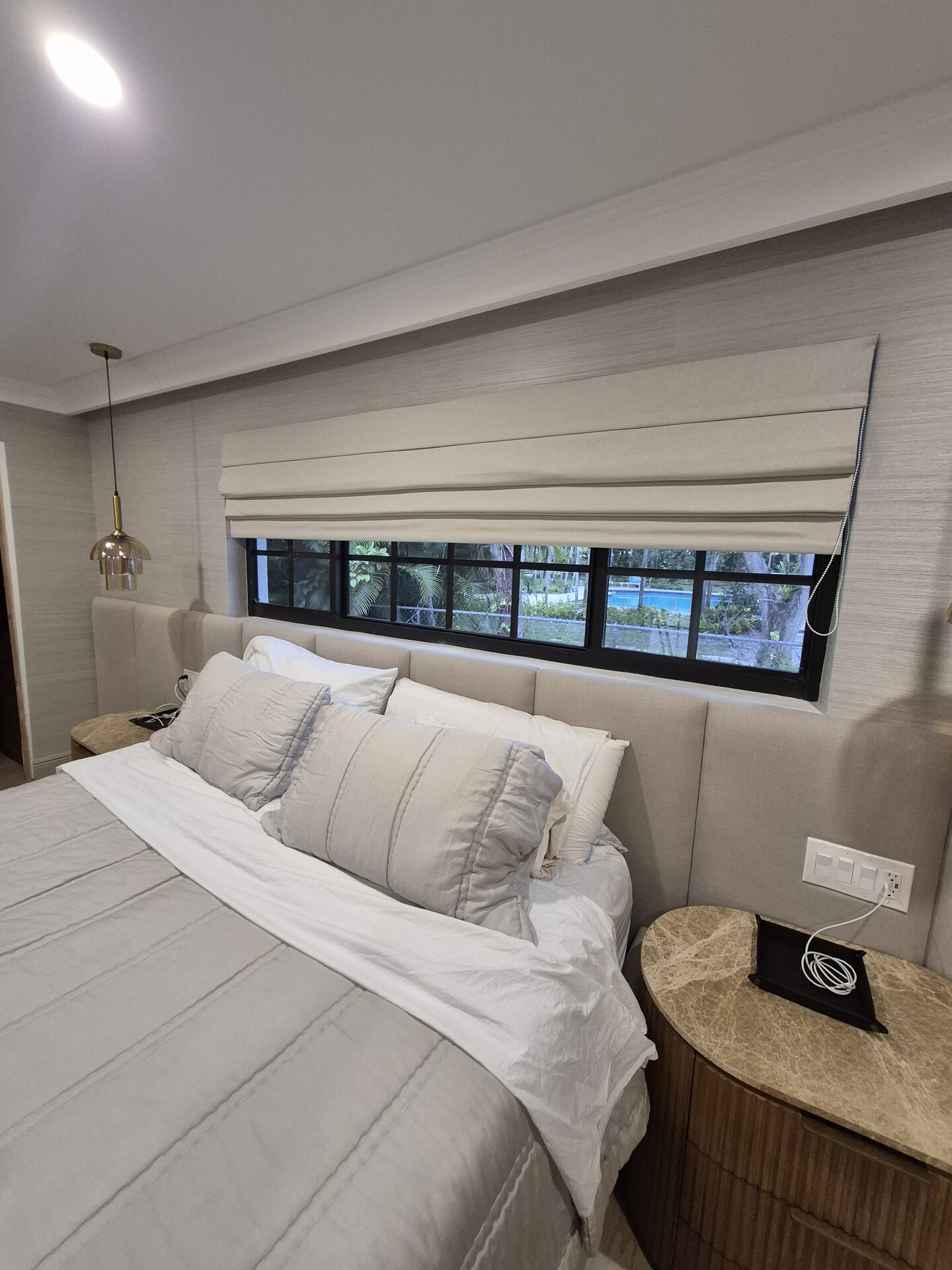
Sleep-First Bedroom
How we engineer a blackout shade
We treat blackout as a system with four parts and measure for all of them: an opaque coated fabric with no pinholes; aluminum side channels that capture the fabric edge and kill the light gap; a fascia, cassette or pocket that seals the top; and a hembar that meets the sill. Skip any one of them and the room reads dim, not dark. Motorized on Lutron or Somfy, the shade closes silently at your goodnight scene and stops at the exact bottom position we program.
Where the light gets in, and what each remedy really does
A roller shade is narrower than the opening it covers. Lutron's own spec sheet for the Sivoia QS Triathlon lists the light gap beside the fabric at 1/2 in to 11/16 in, depending on the fascia and on whether the shade mounts inside or outside the frame. Multiply that by two sides, add a sliver under the hembar, and a bedroom at 7 am has a glowing outline. Here is what each fix does, where we have used it, and what it will not do.
| Remedy | What it does | Where we used it | Its limit |
|---|---|---|---|
| Side channels | Aluminum channels at each jamb capture the fabric edge, so the side gap is inside the channel, not in the room. | Turnberry Ocean Club, Sunny Isles Beach: Sparta Twilight blackout rollers travel inside side channels on both the ocean and the Intracoastal bedrooms, so there is no glowing outline at 7 am. | They need a square opening with a flat return at each side, and they add hardware at the jambs. On an opening out of square they show the gap they were meant to hide, which is why we check squareness at the measure. |
| Sealing the top | A fascia, cassette, valance or ceiling pocket closes the gap between the roll and the head of the window, where most of the light comes from. | The Hemispheres, Hallandale Beach: two and a half inches above the glass left no room for a fascia, so a custom basswood valance covers the roll and every window edge was sealed with caulking. Landmark Ranch Estates: every roller sits in a ceiling pocket framed before the drywall closed, and the fabric begins at the ceiling line. | A pocket is decided at framing; we issue the dimensions to the builder before drywall. Caulking takes longer than hanging the shades and belongs on a finished opening. |
| Outside mount with overlap | The shade mounts on the wall or ceiling past the frame, so the side gap falls on the wall instead of the glass. | Where a frame is too shallow for a channel; the overlap is set at the measure. | It needs flat wall at each side and it shows the hardware unless a fascia or cassette covers it. The gap is moved, not removed: look along the wall and a thin line remains. |
| Setting the lower limit at the sill | The motor's bottom stop is programmed so the hembar meets the sill rather than hovering above it. | Every motorized blackout we install; it is part of the programming on installation day. | A sill that is not level still leaves a wedge of light at one end; the fabric cannot follow a slope. |
| A drapery in front | An interlined blackout drapery closes over the shade and its gaps, and quiets the room. | Ritz-Carlton Residences, Miami Beach: ripplefold sheer and blackout in all four bedrooms, tracks set level over ten-foot openings. Luxury home, Boca Raton: on angled glass a blackout roller alone could not get there, so blackout drapery on two bent motorized tracks closes as one line around the corners. Landmark Ranch Estates: Como blackout always behind a drapery or a Roman. | It needs stack space beside the glass and, for a hidden track, a pocket: see how much wall the open drapery takes. |
| Blackout honeycomb | A cellular shade seals its edges better than a flat fabric, in Lutron's words, and Lutron rates its double-cell blackout at R 4.4 for insulation. | Golf-course home, Boca Raton: Coulisse Edmonton dim-out honeycombs, 144 in wide, on Somfy CL32 battery motors recharged by solar panels, behind 18-foot shutters. | Edmonton is a dim-out rather than a blackout fabric, and a honeycomb darkens a room without a channel, but a sliver remains at each side on an inside mount. |
| Dual roller | A screen and a blackout on one bracket, so the daytime view stays and the night layer is already there. | Our condo default for a bedroom with a view: dual roller shades. | The blackout layer follows every rule above; the second fabric does not close the gap on its own. |
Light-gap figures: Lutron Sivoia QS Triathlon Architectural Fascia specification (document 3672656), by fascia and mount. Lutron's own guidance is that a roller gives full blackout only with a side channel, while Roman and honeycomb shades come close without one. Project details are as recorded in each case study. What we promise, with channels and a sealed top and sill, is a room that reads fully dark to the eye; no roller shade on its own is light-tight. Judge the blackout fabrics on a physical sample: request the sleep-dark set.
Blackout shades in South Florida
A 6:30 am summer sunrise over the ocean, a nursery on a west wall, a media room fighting all-day brightness - bedrooms and screening rooms from Miami Beach to Palm Beach are where blackout matters most. In condos with floor-to-ceiling glass we pair a blackout roller with a solar screen on a dual bracket, so the view stays by day; in houses we often layer an interlined blackout drapery over a channeled shade for total darkness and quieter rooms. The reference is Turnberry Ocean Club in Sunny Isles Beach, where Sparta Twilight blackouts run in side channels on a wall of ocean glass.
Frequently asked
Are blackout shades really 100% dark?
With side channels and a sealed top and sill, the room reads as fully dark to the eye. Without channels, expect a thin halo at the edges - we will show you both.
What is best for a bedroom?
A blackout honeycomb or channeled blackout roller for darkness, often layered with a sheer or drapery for daytime softness.
Can I have view by day and darkness by night?
Yes - a dual roller pairs a solar screen with a blackout on one bracket, or we layer a shade with blackout drapery.
Can they be motorized?
All of them - and scheduled, so darkness arrives with your goodnight scene. See motorized shades.
Do blackout shades need side channels?
For true darkness, yes - the channels capture the fabric edge and remove the halo of light you get with a plain roller. We show you both in your own room.
Can blackout shades be installed in a condo without wiring?
Yes - battery-powered Lutron and Somfy motors install without opening walls, and the channels mount to the window frame.
Woven in the USA. Specified by the numbers.
Blackout is a system, but it still starts with the fabric. For the solar or light-filtering layer of a dual shade we specify Mermet, woven in South Carolina, and Phifer SheerWeave, woven in Alabama; the blackout layer follows the same rule - a mill-branded, certified fabric rated 0% light transmittance, with the spec sheet in the quote.
Mermet
E Screen, M Screen, T Screen, Satiné and the GreenScreen weaves, with KOOLBLACK for dark screens that reflect heat - woven by Mermet USA in Cowpens, South Carolina and listed by the mill as Made in USA. Mermet fabrics
Phifer SheerWeave
The SheerWeave family, including PVC-free styles and Microban-protected weaves that resist mildew in Florida humidity - woven by Phifer in Tuscaloosa, Alabama, where the mill has made fabric since 1952. Phifer fabrics
Best grade only
A core chosen for the window - fiberglass-core screens that stay flat on 10-foot glass, polyester where its lighter weight or PVC-free construction serves the room - an openness woven to tolerance, and a published spec sheet for UV, heat and light in every colour, with GREENGUARD Gold and NFPA 701 listings behind it. Never anonymous screen.
On any system
The same fabric on a Lutron, Somfy or Crestron motor, or a manual chain. Both mills sell through distributors, and the ranges we specify are kept on the shelf by our authorized South Florida distributor, so the fabric is chosen for the window and its exposure, not for the motor brand - and it is ready to cut when the measurements are. Our shade fabrics
Discerning homeowners, designers, and developers across South Florida trust Exotic with their most important spaces.
“Alexandre was great to work with super responsive and kept us updated throughout the process. Our custom blackout shades for the master bedroom came out perfect. David handled the installation and did an outstanding job quick, clean, and professional. We’re thrilled with how everything turned out. The shades look amazing and the service was top-notch from start to finish!!”
“We had roller shades before, but too much light was still coming in from both sides. Exotic Shades & Draperies recommended adding motorized blackout drapes with Sonfy motor, and it was the perfect solution. They made the drapes wide enough so they could fully clear the window when opens. Very happy with the recommendation, the installation and the final result!!”
“The blackout blinds they put in my room help me sleep and for that I’m very grateful, excellent service would recommend 100% !!”
Control systems these shades answer to
Every motorized system we install runs from a remote, an app or the home's control system. Which one depends on the motor family, so we settle it before the shade is made.
Lutron
Sivoia QS, Triathlon, Serena and Palladiom shades: Pico remotes and the Lutron app, with native integration to Crestron, Control4, Savant, Apple Home, Amazon Alexa and Google Home through Caseta, RadioRA 3 or HomeWorks. Lutron motorized shades.
Somfy
Sonesse, Glydea and WireFree motors on Somfy RTS or Zigbee: Telis and Situo remotes, the TaHoma app for scenes and schedules, Amazon Alexa and Google Home through TaHoma, and Control4, Crestron and Savant through the TaHoma integration. Somfy motorization.
Crestron
Crestron shade motors and drapery tracks commissioned into the home's Crestron processor and keypads with your integrator, with the fabric, hems and hembars still made in our workroom. Crestron shades.
Exotic Shades & Draperies, Fort Lauderdale and Miami Beach
Exotic Shades & Draperies is a South Florida window-treatment company that designs, sews and installs its own work: Lutron and Somfy motorized shades, custom draperies sewn in our Fort Lauderdale workroom by five in-house seamstresses, plantation shutters and blinds. Established in South Florida in 2024, backed by more than 20 years of window-treatment manufacturing and installation experience. Lutron certified dealer, Somfy Expert, Crestron and Control4 integration. The same in-house team measures, installs and programs every project; when shading has to integrate with another control system, we bring in our smart-home partner Adom Smart Home.
Fort Lauderdale workroom and showroom
4539 Powerline Rd, Fort Lauderdale, FL 33309 · 954-881-9331
Miami Beach showroom
500 South Pointe Dr #150, Miami Beach, FL 33139 · 954-872-9007
Where we install
Miami-Dade, Broward and Palm Beach counties: Miami Beach, Sunny Isles and Aventura through Hollywood, Fort Lauderdale and Pompano Beach to Boca Raton, Delray Beach and West Palm Beach, with projects in the Caribbean and New York.
How a project runs
Free in-home measurement, a written quote from the same engine as our published prices, fabrication in our own workroom, installation and programming by our own team, and service on the systems we install.
Blackout shades in Fort Lauderdale, Miami, Boca Raton & Palm Beach
Blackout shades as a system - opaque fabric, side channels, sealed top and a hembar that meets the sill - for bedrooms and media rooms from Miami Beach to Palm Beach. Our workroom and showroom are at 4539 Powerline Rd in Fort Lauderdale, our second showroom is South of Fifth in Miami Beach, and the same in-house team measures and installs from Miami to Palm Beach.
True darkness, made to measure
One free hour with our team routinely saves owners thousands in avoidable mistakes - wrong fabrics, bad mounts, missed motorization. Book a private, complimentary consultation - we bring the fabrics, the samples, and honest answers. Start with the free guide: 10 costly window treatment mistakes.