

Best Window Treatments to Block Heat, Ranked: Every Product We Sell, by the Published Numbers
Clients ask us which shade keeps a room coolest, and most of what is written on the subject was written for Minnesota. This is the ranking we use in the showroom: every product we sell, placed by the makers', the laboratories' and the rating council's published numbers, read for South Florida glass and South Florida sun.
Outside the glass wins; inside it, the colour facing the sun decides
The short answer. An exterior solar screen is in a class of its own: the same fabric mounted outside the glass leaves 0.07 to 0.22 of the sun's energy in the room where it leaves 0.25 to 0.67 inside (Mermet), the AERC rating council's solar-screen fabric category tops its scale at 64 to 77, and PNNL measured about 20% less air-conditioning energy than bare glass. Inside the glass, the product category matters less than two things: the colour of the face toward the sun, and whether the fabric is opaque. A white-backed blackout roller, a room-darkening honeycomb with a white street side and a white 1% solar screen are effectively the same heat product (AERC 45 to 49, closed-position SHGC 0.15 to 0.25 on clear double glazing). A charcoal screen of any openness leaves 0.60 to 0.67 and is a glare product, not a heat product; KOOLBLACK recovers about a third of that gap; a dual-sided screen, white out and charcoal in, beats every KOOLBLACK at 0.31. The honeycomb's R-value is a winter number in a county with 113 heating degree days a year.
Three local facts change the sales conversation. Code impact glass (SHGC 0.25) already does three-quarters of the work the clear-glass studies credit to the shade. The problem is east and west-northwest glass, not south. And the same shade saves about three times as much on a schedule as it does left where people leave it.
We sell every product on this page, from exterior zip screens to sheers, so we have no reason to push one of them. The numbers are the mills' (Mermet, Phifer, TOP, Lutron), the laboratories' (LBNL, PNNL, the Florida Solar Energy Center), the Department of Energy's and AERC's, each linked under Sources; where a product has no published number, the card says so and places it by the nearest measured product. The glass, the exposure and the building's rules then pick the shade.
Every product we sell, best to worst at blocking heat #
Ranked by the share of the sun's energy that still reaches the room with the covering closed (the solar heat gain coefficient of glass plus covering, lower is better), with the AERC annual rating as the check. Each card separates what is published from what we see on our own jobs. The glass each number was computed on is named, because the mills and AERC do not share one: Mermet uses clear double glazing, Phifer single 1/4 in clear, AERC a double-clear window with a bare value of 0.60. The three lists agree on the order.
Tier 1: outside the glass
Tier 1 · Outside the glass
Exterior roller and zip solar screens #
Published figure The only treatment whose number does not depend on colour. Phifer's SunTex 95 mounted outside leaves a solar heat gain coefficient of 0.13 to 0.16 on 1/4 in clear glass at a 30 degree sun angle for every colour from White to Black, and 0.07 to 0.14 for the 95, 97 and 99 weaves on 1 in insulating clear glass. Mermet publishes an exterior-mount column for every screen it makes: 0.07 to 0.22, tracking openness only, so an E Screen 3% that leaves 0.62 inside the glass in charcoal leaves 0.11 outside it. The reason is physics, not fabric: FSEC's Florida design note says exterior devices save more because the heat they absorb stays outside, and PNNL measured black 1% exterior shades cutting air-conditioning energy by about 20% against bare glass and about 10% against interior blinds, with the inside glass surface 2 to 4 F cooler. PNNL's 2024 summary: exterior shading is 8 to 10% more effective than interior.
Rated AERC's solar-screen category, the fabric type exterior screens are made of, tops its scale: its certified screen fabrics rate 64 to 77 against a category ceiling of 90, the highest of any attachment type, with closed SHGC 0.13 to 0.24.
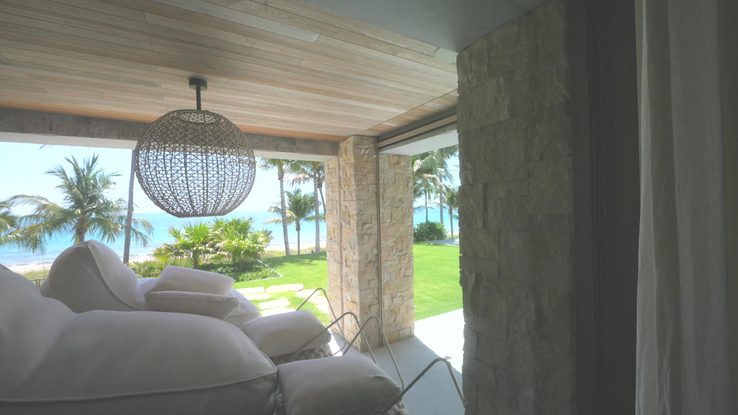
Our experience Our outdoor shades are Mermet and Phifer exterior mesh in zippered side channels on Somfy exterior motors, sharing the remotes and scenes of the interior shades; sun, glare and insect products, not storm protection. On a condo the exterior is a common element and needs the association's approval, which is why the condo answer is the next tier. See the exterior shades on the ocean terraces of the Fort Lauderdale oceanfront estate and the Phifer and Mermet exterior fabric pages.
Sources Phifer SunTex 95 card · Phifer SunTex 95/97/99 · Mermet E Screen sheet · FSEC design note · PNNL-30536 · PNNL 2024 summary · AERC certified products
Tier 2: the best interior products, effectively tied
Tier 2 · Best inside the glass
Blackout roller shades with a white backing #
Published figure The backing faces the glass, so the room colour stops mattering. Phifer SheerWeave 7100 scores 0.23 on 1/4 in clear glass whether the room face is White or Charcoal, and 7500 Ice and Midnight both score 0.24; Mermet's Flocké coated street face reflects 71 to 73% of the sun's energy in every colour for 0.22 on clear double glazing, and TOP's Orient Blackout White Backing is identical across all 17 colours. The trap is the colour-matched backing: Phifer 7700R runs from Crystal 0.24 through Chalk, Sand and Graphite 0.30 to 0.38 to Onyx 0.58, so a dark colour-backed blackout is no better than a charcoal screen for heat.
Rated AERC's white-backed room-darkening rollers rate 46 to 49 with closed SHGC 0.15 to 0.16, the top of the roller category (ceiling 55) and effectively tied with the best honeycomb.
Our experience The bedroom layer on most of our projects: Lutron Luna White at Hillsboro Mile, Sparta Twilight at Salato, SheerWeave 7200R Swan at Bay Drive, Coulisse Snow White in side channels in the Boca oceanfront condo. We write the backing colour into the quote. Fabric pages: SheerWeave 7100, Mermet Flocké, TOP Orient white backing.
Sources Phifer 7100 card · Phifer 7500 card · Phifer 7700R card · Mermet Flocké sheet · TOP Orient BO-WB datasheet · AERC certified products
Tier 2 · Best inside the glass
Room-darkening honeycomb (cellular) shades #
Published figure The best tested numbers of any interior product, and they come from the white street side and the tight fit, not from the cells. PNNL's lab homes measured double-cell honeycombs saving 24.8% of cooling energy against bare windows when kept down and 13.3% against white vinyl blinds; its 2024 summary gives cellular shades 5 to 25% cooling savings and calls them nearly twice as effective as vinyl blinds. The Department of Energy's guidance figure is up to 60% less solar heat gain with a tight fit. Lutron's fabric library lists R 2.8 to R 4.4 for its honeycomb fabrics; in Fort Lauderdale, with 113 heating degree days a year against 4,730 cooling degree days, that insulation is worth almost nothing, which the AERC label confirms: the best honeycomb scores 48 for warm climates and 9 to 10 for cold ones.
Rated AERC's best room-darkening honeycombs rate 47 to 48 (66 to 67 with automation) with closed SHGC 0.17 to 0.18; light-filtering cells rate 35 to 39. Category ceiling 50. Single versus double cell: 0.1 of R-value in Lutron's data and no published cooling difference.
Our experience Bedrooms, nurseries and media rooms where darkness and a soft look matter: the Coulisse Edmonton White honeycomb at the Boca Raton golf course home. For a view window we specify a white screen instead, since no honeycomb sees through. Roller or honeycomb, side by side: our comparison; the fabrics: Lutron honeycomb fabrics, TOP Chianti blackout.
Sources PNNL-27663 · PNNL 2024 summary · DOE Energy Saver (archived) · AERC certified products · NOAA 1991-2020 normals
Tier 2 · Best inside the glass
White solar screen roller shades, 1% to 3% #
Published figure A white screen is a heat product that keeps the view. Phifer SheerWeave 4001 Chalk 1% scores 0.18 and 2500 Brite White 1% 0.25 on 1/4 in clear glass; Mermet E Screen White/White scores 0.25 at 1%, 0.28 at 3% and 0.30 at 5% on clear double glazing, against about 0.76 for bare double-pane glass (DOE). The fabric does it by reflecting: a chalk-white weave sends 74 to 83% of the sun's energy back out and absorbs 9 to 16%. Mermet's guidance is to select a light colour to optimize heat management; Lutron's 2026 guide adds a lower openness for the best heat reflection. Mermet's E Screen LOWGLARE in Dove is the one single-colour fabric that scores like white for heat (0.24 to 0.28) while passing only 5 to 11% of visible light, like a charcoal.
Rated AERC: a white 1% screen rates 45 (SHGC 0.18); the same fabric at 3% 43, at 5% 42, at 10% 40; with a grey room side the 1% drops to 34.
Our experience The fabric behind most of our oceanfront work: E Screen 3% and 5% White/White at Salato, 5% White/White in the ceiling pockets of Trump Tower III, White/Linen at Turnberry Ocean Club, Basketweave 90 Bright White at Hillsboro Mile, T Screen 3% White at the Ritz-Carlton Sunny Isles. Openness, explained: 1% vs 3% vs 5% vs 10%.
Sources Phifer 4000-series card · Phifer 2500 card · Mermet E Screen sheet · Mermet LOWGLARE sheet · Mermet fabric guide · Lutron fabric guide 2026 · AERC certified products
Tier 2 · Best inside the glass
Dual roller shades (screen over blackout) #
Published figure Two layers on one window give two numbers, not one. Both down, the opening performs at the blackout's figure, 0.22 to 0.24 on the mills' glazings when the blackout is white-backed, the best interior value in the data; screen alone, it performs at the screen's figure, so the day layer should be white or dual-sided, not charcoal. No mill or rating program publishes a combined figure for the pair, and the two coefficients cannot be multiplied.
Rated Not rated as a system by AERC; each layer carries its own fabric figure.
Our experience Hillsboro Mile's primary suite: Bright White basketweave screen over Luna White blackout in one opening on Lutron Sivoia QS; the Salato residences pair E Screen with Sparta Twilight blackouts. We build dual shades on the Vertilux system with the 5 x 5 in fascia; see dual roller shades.
Sources Phifer 7100 card · Mermet Flocké sheet · Mermet E Screen sheet
Tier 3: good, with a condition
Tier 3 · Good, with a condition
Dual-sided screens: white out, charcoal in #
Published figure The honest answer to a dark room side in a condo that wants white to the street. Mermet's T Screen with White toward the glass and Charcoal toward the room scores 0.31 at 1% and 3% on clear double glazing, and 0.51 to 0.52 if hung the other way; Phifer's 4901 Chalk/Black scores 0.33 against 0.50 reversed and 2701 Oyster/Charcoal 0.46 against 0.66. A white-out T Screen beats every KOOLBLACK colourway (0.46 to 0.55) while showing the same charcoal room side.
Rated Not individually rated by AERC in the fabrics we carry; AERC's data on one white screen fabric show the room-side colour alone moving the rating 11 points.
Our experience The condition is the orientation: the white face must be toward the glass, which we check on every dual-sided shade at installation. Fabric pages: Mermet T Screen, SheerWeave 4901/4903, SheerWeave 2701 to 2710.
Sources Mermet T Screen sheet · Phifer 4901 card · Phifer 2701 card · AERC certified products
Tier 3 · Good, with a condition
Light-filtering roller shades and light-filtering honeycombs #
Published figure Translucent fabrics sit in the middle and their colour still decides. Mermet's GreenScreen Evolve 3% runs 0.30 to 0.46 on clear double glazing by colour; even its darkest colour reflects 41%, so it beats any charcoal screen. Light-filtering honeycombs rate below their room-darkening siblings because the street side is not opaque. The Department of Energy's one sentence on the category is that roller and roman shades offer only a small amount of insulation and are most effective for privacy, room darkening and blocking sunlight.
Rated AERC: light-filtering honeycombs 35 to 39 (closed SHGC 0.22 to 0.28); light-filtering rollers 9 to 27 by colour, white 27 (SHGC 0.34), black 9 (0.47).
Our experience Living rooms and kitchens where privacy by day matters more than the view; we specify the lightest colour the room will take. The light-filtering rooms at Hemispheres run a light-filtering fabric with its blackout twin in the bedroom. Fabric: GreenScreen Evolve.
Sources Mermet Evolve sheet · AERC certified products · DOE Energy Saver (archived)
Tier 3 · Good, with a condition
Lined and blackout-lined draperies #
Published figure Draperies have exactly one published solar figure and it is unreferenced: the Department of Energy's 'medium-colored draperies with white-plastic backings can reduce heat gains by 33%'. No study is named; LBNL's 2013 attachment program excluded drapes and roman shades for lack of reliable models; no lining maker publishes a solar heat gain figure. What the physics supports is that the reflectance of the face toward the glass and the openness of the weave govern, so a blackout or white-faced lining is the right specification and an unlined dark fabric is a glare product. The mounting is the one lever with a measured size, all of it winter: an unsealed drapery saves no more than 10% because of the air loop between fabric and glass, a lined one sealed at the top with a closed cornice and returned to the wall up to 25% (Cornell); a pelmet alone added only 2% in a New Zealand chamber test. We found no cooling-season test of cornices, returns or ceiling pockets.
Rated Drapes cannot be AERC-rated yet. Pinch pleat versus ripplefold, 2x versus 2.5x fullness: studied, no published comparison, so we do not claim a heading is more efficient.
Our experience Blackout drapery on bent motorized tracks in the Boca Raton luxury home (Villa Nova Toronto FR in Chalk); blackout drapery on Sivoia QS tracks at the Ritz-Carlton Residences Miami Beach. Lining choices: the drapery lining guide; the top of the window: valances and cornices, recessed tracks.
Sources DOE Energy Saver (archived) · LBNL 2013 attachment study · Cornell Cooperative Extension · Consumer NZ curtain test · AERC certification program
Tier 3 · Good, with a condition
Roman shades, lined or blackout-lined #
Published figure AERC can rate roman shades but no figure for one could be retrieved, and the only measured data are winter: a sealed roman with side clamps is as high as 60 to 75% effective with an R-value of about 4 (Cornell), and romans were the best covering after honeycombs and secondary glazing in New Zealand's chamber test because of their close fit. A blackout-lined, inside-mounted flat roman is physically a zero-transmittance, light-backed, close-fitting covering, which places it near the white-backed blackout roller; an unlined or sheer roman belongs with the sheers.
Rated AERC category ceiling 50; no roman shade in AERC's residential database on 10 October 2026. Hobbled and teardrop folds add fabric and trapped air with no published effect.
Our experience Roman shades across the oceanfront villas at the Ritz-Carlton Residences Miami Beach and flat Romans at Landmark Ranch Estates. A motorized top-down bottom-up roman keeps the top open for light and the bottom closed for privacy; for heat the lining colour is the specification.
Sources Cornell Cooperative Extension · Consumer NZ curtain test · AERC category ceilings
Tier 3 · Good, with a condition
Pleated shades #
Published figure A single layer, so the colour is the whole story. TOP's Orient pleated fabric publishes a total solar factor (EN 410 and EN 13363) of 0.34 in White and Antique White rising to 0.52 in Dark Gray and Pure Gray on an unstated glazing: a light pleated shade performs like a white screen and a dark one like a dark screen. Manufacturers say only that cellular shades surpass the insulating power of pleated shades.
Rated AERC category ceiling 40, the lowest of the shade categories; no pleated shade certified.
Our experience We offer pleated fabrics where a crisp fold suits the room; for a heat problem we point to the honeycomb or the white screen. Pleated vs cellular; fabric: TOP Orient pleated.
Sources TOP Orient pleated datasheet · AERC category ceilings
Tier 3 · Good, with a condition
Horizontal wood, faux-wood and aluminium blinds #
Published figure Good laboratory data, no certified product, and the slat colour is the condition. LBNL measured 1 in slat blinds behind 1/4 in clear glass: closed white glossy 0.55 and polished aluminium 0.56 shading coefficient, dark brown and black 0.83; at 45 degrees the light colours rise to 0.66 to 0.71 and fully open to 0.80 to 0.92. The Department of Energy's older text, 'highly reflective blinds can reduce heat gain by around 45%', is the white closed case; UF/IFAS puts a 45-degree blind at about half as effective as a closed one. Wood, faux wood and aluminium differ by colour, not material: a white faux-wood blind performs near the white case, a dark-stained wood blind near 0.83.
Rated AERC blinds ceiling 50; no blind certified. PNNL's one cross-category test found cellular shades nearly twice as effective as white vinyl blinds.
Our experience Our Lutron wood blinds tilt on a schedule, which answers the 45-degree problem: closed when the sun is on the glass, open when it is not. For a west window we still put the white screen or the blackout ahead of a blind.
Sources LBNL LBL-14369 (1982) · LBNL-39248 (Klems and Warner) · DOE text, archived 2015 · UF/IFAS FCS3091 · PNNL 2024 summary
Tier 3 · Good, with a condition
Plantation shutters #
Published figure No maker and no laboratory has published a cooling figure for interior shutters, and AERC lists louvered shutters as a longer-term consideration, so the honest placement rests on the nearest measured product: a closed white louver behaves like the closed white 1 in slat blind (shading coefficient 0.55), less what leaks at the tilt rod, the louver overlap and the frame. Louver colour governs; polymer versus wood changes winter U-factor, not Miami solar gain. Retail claims such as 'SHGC under 0.3' and 'three times better than wood' name no test.
Rated Not ratable by AERC today; any 'AERC-rated shutter' claim is wrong.
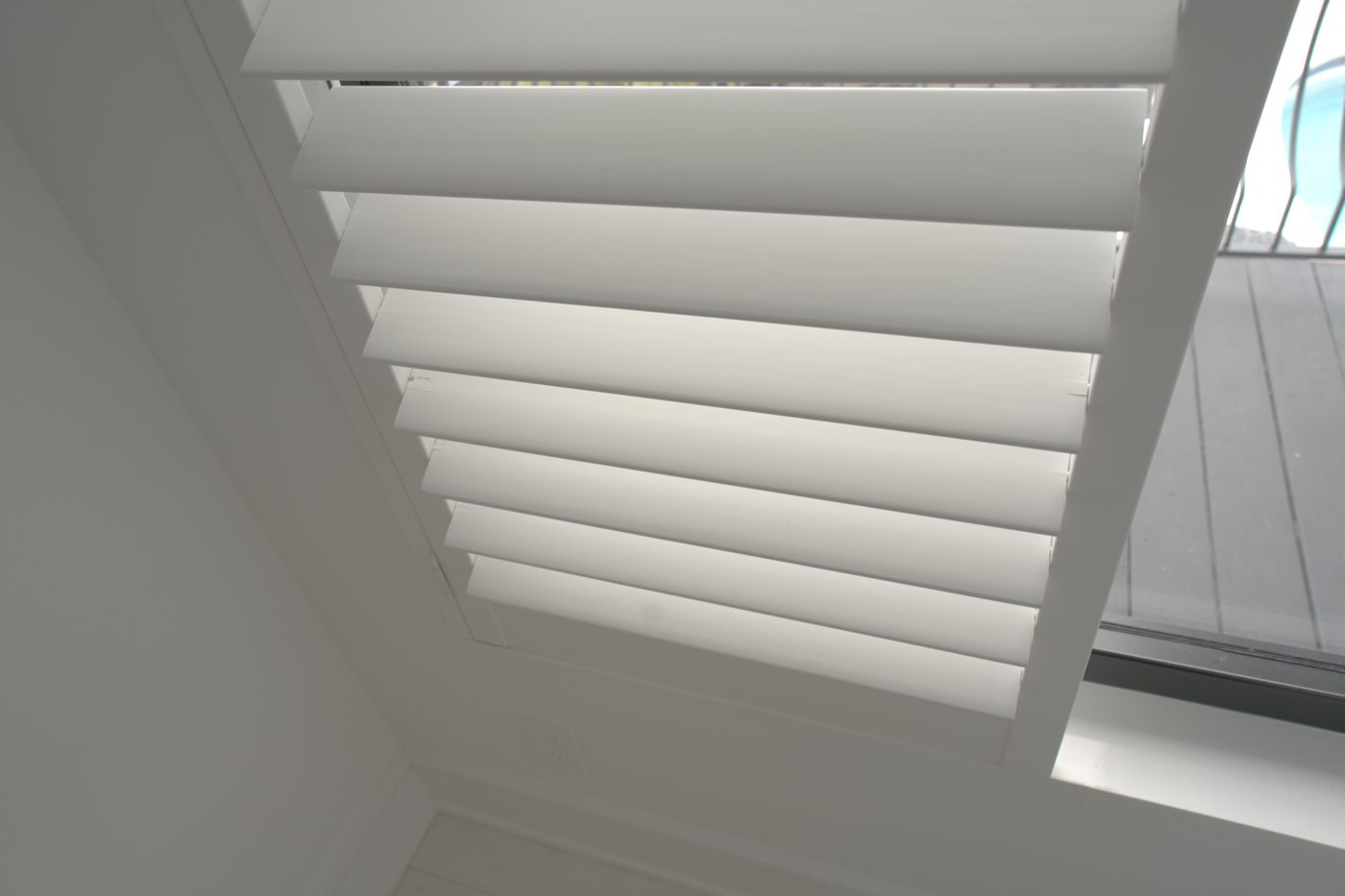
Our experience Shutters earn their place on durability, light control and look, and they hold up in a coastal house: the Boca Raton golf course home runs shutters in the guest house with honeycomb shades behind them. For the hottest exposure we add a screen or a blackout behind the louvers or outside the glass.
Sources AERC certification program · LBNL LBL-14369 (1982) · Vitro TD-109
Tier 3 · Good, with a condition
Skylight shades #
Published figure No rating category and no primary-source figure, on the opening that needs it most: a roof receives three to four times the midsummer radiation of a wall (PNNL Building America), UF/IFAS says Florida skylights require aggressive shading devices, and the Florida Energy Code caps skylight SHGC at 0.25, or 0.30 for a skylight excluded from the whole-house calculation (0.28 from the 9th Edition on 31 December 2026). A honeycomb skylight shade with a white exterior face performs by analogy with the vertical-window honeycomb; a retail claim of 'about 70% less heat' names no test.
Rated No AERC category for skylight attachments.
Our experience Honeycomb and roller skylight shades on Lutron and Somfy motors; see skylight shades and the Lutron skylight fabrics. Where the skylight can be shaded outside, that is the first answer.
Sources PNNL Building America shading guide · UF/IFAS FCS3276 · FBC 2023 Form R402 · FBC 9th Edition analysis
Tier 4: glare and privacy products, not heat products
Tier 4 · Glare products, not heat products
Charcoal, black and bronze solar screens, any openness #
Published figure The best-selling fabric in South Florida and the one most often sold as a heat product by mistake. Mermet E Screen Charcoal/Charcoal leaves 0.60 at 1%, 0.62 at 3%, 0.64 at 5% and 0.67 at 10% on clear double glazing, against about 0.76 for bare double-pane glass (DOE); Phifer's 2500 Charcoal 0.60 to 0.62 and the 2701 and 2710 charcoal twills 0.69 to 0.72 on single clear. The weave reflects 4 to 6% and absorbs 90 to 95%, and LBNL measured, on an interior blind, 86% of what the layer absorbs flowing into the room. KOOLBLACK narrows the gap, not closes it: Mermet's KOOLBLACK Charcoal lifts solar reflectance from 4 to 6% to 32 to 35% and brings 0.60 to 0.67 down to 0.48 to 0.54, still roughly double a white screen; its 'up to 15 degrees cooler' line carries no unit or method. What charcoal does better than anything is glare and view: Purdue measured a charcoal 1% passing 1.3% of the sun's energy straight through against 10.5% for a white and linen weave, and the view out is sharper.
Rated AERC rates the darkest screen and light-filtering fabrics 9 to 15 (closed SHGC 0.42 to 0.49) against a bare-window figure of 0.60.
Our experience We install charcoal where the client is buying the view and the glare control, as in the guest house of the Boca Raton golf course home (SheerWeave 2500 1% in Charcoal), and we say in the showroom that it is not the heat fabric. When the client wants both, the answer is the dual-sided T Screen above or a dual shade. Mermet KOOLBLACK fabrics.
Sources Mermet E Screen sheet · Mermet KOOLBLACK sheet · Mermet KOOLBLACK page · Phifer 2500 card · Phifer 2701 card · LBNL-39248 · Purdue, Chan et al. 2014 · AERC certified products
Tier 4 · Glare products, not heat products
Zebra (dual-banded) shades #
Published figure No mill publishes a closed-position heat figure for a zebra shade. TOP's Twinlight datasheet gives one blended EN 410 value per colour (solar transmittance 15 to 24%) with no split between the solid and sheer bands and no total solar factor, and because the sheer band is far more open than a 3 to 5% screen, a closed zebra passes more sun than a screen of the same colour. A light colour helps for the same reason it helps everywhere.
Rated No AERC category.
Our experience A light-control and privacy product with a clean modern look; for a west window we pair it with a blackout or put a white screen in its place. Fabric: TOP Twinlight Dixie, all TOP zebra fabrics.
Sources TOP Twinlight Dixie datasheet
Tier 4 · Glare products, not heat products
Sheer draperies, sheer shades and horizontal sheer shades #
Published figure The open-weave class, 25% or more open in the ASHRAE drapery classification, and no accessible source publishes a measured solar transmittance or heat gain figure for any of them; LBNL excluded sheer shades from its modelling. Makers of horizontal sheer shades publish UV figures only (up to 88% with the vanes open, 99% closed), and UV is about 3% of the sun's energy, with visible light 44% and infrared 53%, so a UV figure says something about fading and nothing about heat. White vanes closed behave like a white light-filtering fabric.
Rated Not ratable by AERC.
Our experience Sheers soften the light and the view and they are on nearly every oceanfront project we do, usually in front of a screen or a blackout that does the heat work: the Fort Lauderdale estate, Turnberry, the Boca oceanfront condo. See sheer shades and Allusion blinds.
Sources LBNL 2013 attachment study · IWFA solar control guide 2026
Tier 4 · Glare products, not heat products
Woven wood and bamboo shades #
Published figure No published transmittance, heat gain figure, R-value or rating from any maker; the one retailer that addresses it says only that unlined woven woods filter the light and that liners are added for privacy or blackout. Unlined, a woven wood is a dark semi-open weave with a dark face to the glass, which is the worst case in every mill table above; with a white-backed liner it becomes a lined roman shade for heat purposes.
Rated No AERC category.
Our experience We specify woven woods for texture, with a liner when the exposure asks for one. See woven wood shades.
Tier 4 · Glare products, not heat products
Vertical blinds #
Published figure No product has been rated or tested; AERC models vertical louvers as rotated slat shades, and LBNL's generic model spans 0.12 to 0.46 closed on double clear glazing depending on slat reflectance, the same span as horizontals. Vanes hang free of the sill and jambs and leak beam sun through the overlaps as the sun moves, so in practice a vertical sits below a framed horizontal blind of the same colour: white PVC near the white case, dark fabric near the dark one.
Rated AERC blinds ceiling 50; no vertical blind certified.
Our experience The practical sliding-door cover for a rental or a budget; where the door faces west we recommend a motorized screen or a drapery instead. See vertical blinds.
Sources AERC 2 Rev 2 · LBNL 2013 attachment study
The multiplier Motorization and a schedule, on any of the above. A DOE survey found 75 to 84% of window coverings never move during the day. PNNL measured the same honeycomb shades saving 5.8% of cooling energy against vinyl blinds when left in typical positions and 15.1 to 15.2% on a solar-calendar or occupancy schedule; LBNL's four-climate simulation found manual operation had on average no effect on site energy while automated control cut it 11.6 to 13%. AERC prints an automation rating beside the typical-use one, and the best honeycomb goes from 48 to 66 or 67. Details under automation; the systems on motorized shades and automation.
What colour and mounting do to the same screen #
One mill, one glazing, one method, so the fabric bars compare. Mermet computes the solar heat gain coefficient of glass plus fabric in LBNL's WINDOW software on residential clear double glazing, and publishes a second column for the same fabric mounted outside the glass; the bare-glass bar is the Department of Energy's figure for standard double-pane glass. Lower is better: 0.28 means 28% of the sun's energy on the glass ends up in the room.
Our experience The sentence we say most often. If the room is buying the view and the glare control, charcoal, and we add a white-backed blackout or a dual shade for the afternoon. If the room is buying a cooler afternoon, white toward the glass, in a 1 to 3% weave, and the client is surprised how much of the view a white 3% keeps. If the client wants both on one shade, the dual-sided T Screen, white out and charcoal in. Dark or light, side by side.
How we ranked, and the numbers we ignore #
1. The number we rank by
The solar heat gain coefficient of the glass plus the covering, with the covering closed: the share of the sun's energy on the glass that ends up in the room, counting both what passes through and what the fabric absorbs and releases inward. It is the number the mills compute on stated glazings (Mermet in LBNL's WINDOW software on clear double glazing, Phifer on single 1/4 in clear glass) and the number printed on every AERC certified record. A percentage "blocked" is the same fact stated against a bare-glass value that the page quoting it rarely names.
2. Why the face toward the glass decides
LBNL measured, on an interior blind, that 86% of the solar energy the layer absorbs flows into the room, and the Florida Solar Energy Center's design note says exterior devices save more because the heat they absorb stays outside. An interior covering can only reflect energy back out or absorb it and heat the room: a charcoal screen reflects 4 to 6% and absorbs 90 to 95%, a chalk-white one reflects 74 to 83%. That one fact ranks the whole page.
3. What the AERC rating is
The Attachments Energy Rating Council certifies attachments on one double-clear wood window in a 2,400 sq ft Houston house, with an operable shade closed 57 to 65% of the time, and prints a Warm Climate rating (cooling) and a Cool Climate rating (heating). Its category ceilings are themselves a ranking: solar screens 90, awnings 85, roller shutters 70, roller shades 55, cellular shades, blinds and roman shades 50, pleated shades 40. On 10 October 2026 the residential database held 238 products and not one blind, pleated shade, roman shade or roller shutter; louvered shutters, drapes, films and sheers cannot be rated yet. A rating of 36 is the floor Minnesota's utility program uses for a rebate.
4. The numbers we do not use
"Blocks up to 90% of heat" traces back to exterior shading or to a fabric's own shading figure against bare glass. "99% UV" speaks to fading, not heat: UV is about 3% of the sun's energy, visible light 44%, infrared 53%. R-values without a test method, and a cold-climate metric in any case. The Department of Energy's figures, including "up to 60%" for cellular shades and "33%" for white-backed draperies, are guidance with no test cited, and the page itself has been offline since August 2026, so we quote the archived copy and label it guidance.
All of it in one table #
Closed-position figures with the glass they were computed on; AERC Warm Climate rating for typical use; the kind of evidence; what the product is for. Within a tier the order is not a ranking.
| Treatment | Closed-position SHGC (glass basis) | AERC Warm Climate | Evidence | Best for |
|---|---|---|---|---|
| Tier 1: outside the glass | ||||
| Exterior solar screen, 1 to 5% open | 0.13 to 0.16 any colour (SunTex 95, 1/4 in clear); 0.07 to 0.22 (Mermet exterior column, clear double) | 64 to 77 (solar-screen fabric category; ceiling 90) | Mill-published; AERC-certified; PNNL lab-homes test | West and east glass on a house, terraces, skylights |
| Tier 2: best inside the glass (effectively tied) | ||||
| Blackout roller, white backing | 0.23 to 0.24 (Phifer 7100/7500, 1/4 in clear); 0.22 (Mermet Flocké, clear double) | 46 to 49 (ceiling 55) | Mill-published; AERC-certified | Bedrooms; the dark layer of a dual shade |
| Room-darkening honeycomb, white street side | 0.17 to 0.18 (AERC, double clear) | 47 to 48; 66 to 67 automated (ceiling 50) | AERC-certified; PNNL lab-homes test; DOE guidance | Bedrooms, media rooms, soft look |
| White screen, 1 to 3% | 0.18 to 0.20 (Phifer 4001 and 4400 Chalk, 1/4 in clear); 0.25 to 0.28 (E Screen White/White, clear double) | 43 to 45 | Mill-published; AERC-certified | View windows on the sun side |
| Dual roller, white-backed blackout plus white screen | Blackout's figure with both down; screen's figure by day | Not rated as a pair | Mill-published per layer | One window, day and night |
| Tier 3: good, with a condition | ||||
| White screen, 5 to 10% | 0.23 to 0.25 (Phifer 4600 and 4100 Chalk); 0.30 to 0.35 (E Screen White/White, clear double) | 40 to 42 | Mill-published; AERC-certified | View windows; openness for the view |
| Dual-sided screen, white out / charcoal in | 0.31 (T Screen 1 to 3%, clear double); 0.33 (Phifer 4901 Chalk/Black, 1/4 in clear) | Not rated | Mill-published | Condo white-street-side rules; dark room side |
| Light-filtering roller or honeycomb | 0.30 to 0.46 (GreenScreen Evolve, clear double); 0.22 to 0.28 (AERC LF honeycomb) | 9 to 27 rollers by colour; 35 to 39 honeycomb | Mill-published; AERC-certified | Daytime privacy, soft light |
| Lined drapery, white backing | DOE guidance: 33% less heat gain, no test cited | Not ratable | Agency guidance | Bedrooms, living rooms; close the top and the sides |
| Roman shade, blackout-lined, inside mount | No cooling figure; winter R about 4 when side-sealed | Ceiling 50; none certified | Winter test only | Bedrooms, fabric look |
| Pleated shade, light colour | 0.34 (TOP Orient White; glazing unstated) | Ceiling 40; none certified | Mill-published (EN 410) | Crisp fold, light colour only |
| Horizontal blind, white or aluminium, closed | Shading coefficient 0.55 to 0.56 (LBNL, 1/4 in clear); 0.66 to 0.71 at 45 degrees | Ceiling 50; none certified | Lab-tested (LBNL 1982, 1996) | Light control; tilt on a schedule |
| Plantation shutters, white louvers closed | None published; by analogy with the closed white blind, less the gaps | Not ratable | None | Durability, light control, look |
| Skylight shade, honeycomb, white exterior face | None published; roof receives 3 to 4 times the radiation of a wall | No category | Code and guidance only | Any skylight; shade outside where possible |
| Tier 4: glare and privacy products, not heat products | ||||
| Charcoal, black or bronze screen, any openness | 0.60 to 0.67 (E Screen Charcoal, clear double); 0.60 to 0.72 (Phifer, 1/4 in clear); KOOLBLACK 0.48 to 0.54 | 9 to 15 (darkest certified fabrics) | Mill-published; AERC-certified | Glare and view; pair with a blackout for heat |
| Zebra (dual-banded) shade | None closed-position; blended Ts 15 to 24% (TOP Twinlight) | No category | Partial mill data | Light control, privacy |
| Sheer draperies, sheer and horizontal sheer shades | None; UV figures only (UV is 3% of solar energy) | Not ratable | None | Softening light; layer with a heat product |
| Woven wood, unlined | None; dark semi-open weave | No category | None | Texture; add a white-backed liner |
| Vertical blind | None; generic model 0.12 to 0.46 closed by slat colour | Ceiling 50; none certified | Model only | Sliding doors on a budget |
What changes between the test house and your windows
Every percentage above was computed or measured on clear glass in a test house. Four things are different here, and one of them makes the ranking matter more, not less.
Your glass already does three-quarters of the work #
The 2023 Florida Energy Code caps window SHGC at 0.25 in climate zones 1 and 2, and impact packages land there: Ply Gem's 1500 impact single-hung runs 0.21 to 0.27, Vitro's laminated high-rise glass 0.25 to 0.45 by coating. The studies behind the famous percentages used clear double glazing that admits about 76% of the sun. Take 100 units on the glass: old clear double glazing admits 76 and a tight white-backed shade credited with the DOE's 60% removes about 46; code glass admits 25 and the same shade removes about 15. The glass did three-quarters of the work and the shade's absolute contribution fell roughly three times. That is arithmetic, not a field test, and no study has measured an interior shade on 0.25 impact glass. Behind pre-2000 clear or lightly tinted glass, common in older Broward and Palm Beach condos, the heat case is two to three times stronger; behind 2023 glass the honest reasons to buy are glare, UV, comfort at the glass line and the late-afternoon west peak. The rigorous version is free: Mermet runs a project-specific SHGC report for any glass plus fabric, and that is the number we put on a quote once the glass is known.
It is the east and west-northwest glass, not the south #
At 26 degrees north the June sun stands about 87 to 88 degrees overhead at noon, within 2 to 3 degrees of vertical, and rises and sets about 26 degrees north of east and west. Any balcony slab, overhang or recessed frame shades south glass in summer, while "west" exposure is really west-northwest from 4 to 7 PM, when the outdoor temperature is near its peak. PNNL's Building America guide puts unshaded east and west windows at up to twice the solar heat per square foot of south windows; FSEC says east and west devices must intercept sun 10 to 55 degrees above the horizon, with nearly half of that radiation diffuse, which is why a vertical screen beats an awning on the exposures that matter; UF/IFAS says east and west windows need greater protection than north and south. We apply the ranking by exposure: west-northwest and east glass and skylights first, south glass last.
The condo white-street-side rule is physics, not a compromise #
Uniformity rules live in each association's declaration, not in statute; the typical clause reads "white as seen from the exterior", with a white liner or a white-backed blind offered as compliant. The rule and the data point the same way: the products that satisfy it are the best interior heat blockers. A dual-sided screen with white toward the glass (T Screen 0.31), a white-backed blackout in any room colour (0.23), a drapery with a white-backed lining (the DOE's 33% assumes exactly that) and a honeycomb with a white street side (AERC 47 to 48). Check your own documents for the wording; we read them before we quote a building.
Keep the gap: the best heat blockers are the ones that stress the glass #
Glass makers agree that an interior shade raises the centre-of-glass temperature by reflecting energy back through the glass and trapping heat against it. Vitro ranks indoor shading by the stress it causes, from none through dark then light open-weave drapes to light closed venetian blinds as the worst case, and asks for a glass-to-shade space of at least 2 in, vented, with 6 in preferable, 1 in open at the sill and 2 in at the head; the 2008 GANA guideline is 1.5 in at the bottom, 1.5 in at the top or one side and 2 in to the glass; Pilkington wants blinds and draperies 2 in from the glass and vented top and bottom; Viracon puts a 50 F difference between the centre and the edge of a lite as enough to break annealed glass. None of the four bulletins addresses laminated impact glass, and AERC's own simulation places an inside-mounted attachment only 1.5 in off the glazing. The implication cuts against two instincts at once: the reflective white products at the top of this page are the ones that most need the vented gap, and a sealed light-gap channel is the configuration every bulletin warns against on annealed, tinted or inboard-low-e glass. So on an inside mount we keep the gap, we check the glass type before specifying sealed side channels on tinted or annealed laminated glass, and we put the supply register on the room side of the shade.
Automation roughly triples the same shade's benefit #
The DOE-funded survey behind AERC's schedule found 75 to 84% of window coverings stay in one position all day. PNNL's 2018 Lab Homes test is the cleanest comparison on record: the same honeycomb shades on the same glass saved 5.8% of cooling energy against vinyl blinds in typical positions, 15.1% on a solar-calendar schedule and 15.2% on an occupancy schedule, and against bare windows 4.7% typical versus 24.8% kept down. A schedule that opens the shades when the sun is off the glass cost almost nothing: PNNL's 2015 test found a daylighting schedule statistically the same as shades kept shut. LBNL's peer-reviewed simulation found manual operation had on average no effect while automated control cut site energy 11.6 to 13%, more in cooling climates. The demand-response result is the west window: shades plus a 4 F thermostat setup from 3 to 7 PM cut peak demand by 1,600 W, with the shades estimated to contribute over two-thirds. Lutron's Natural Light Optimization moves its shades through direct-sun, no-direct-sun and night positions from the home's coordinates and each window's orientation; Somfy's Sunis sensor drives exterior and interior products from light thresholds. Neither publishes an energy figure, and we found no automated-versus-manual study in a hot-humid climate, so we say "about three times" and cite PNNL, not a percentage of your bill.
The ranking, installed
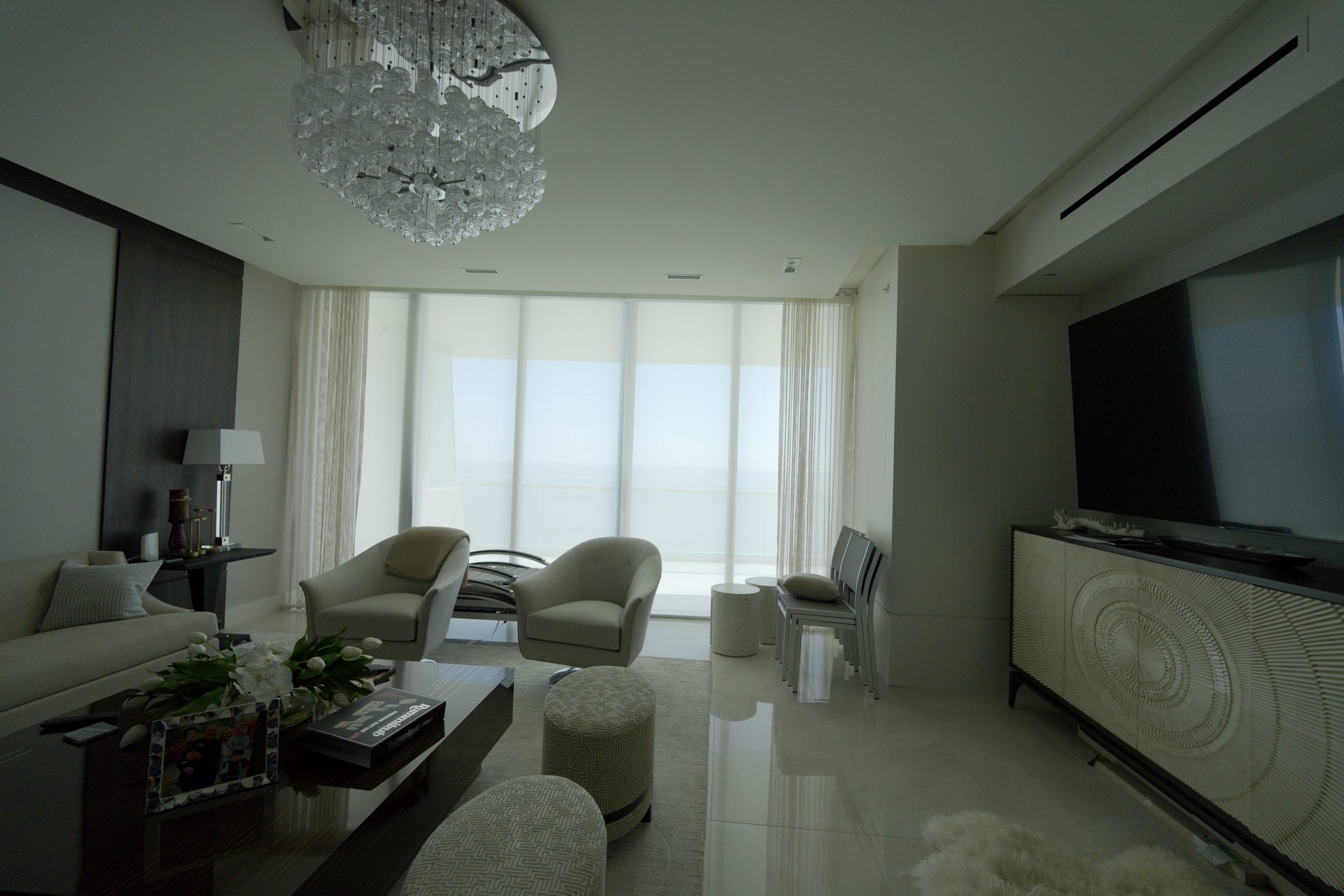
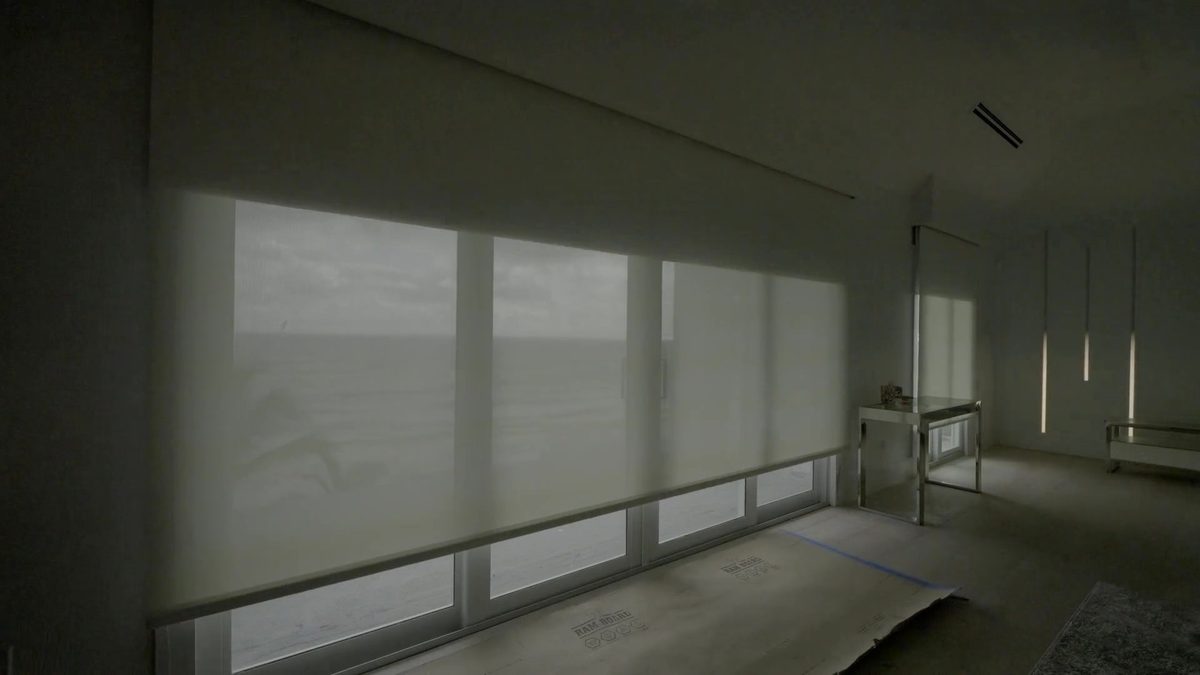
Four South Florida projects, four places on the list: exterior screens on the terraces, a white screen on the ocean wall, a dual shade in the primary suite, shutters with honeycombs behind them.
Ask for the number, not the adjective
"Energy-efficient" on a quote tells you nothing. Ask which face of the fabric is toward the glass, what its solar heat gain coefficient is on your glass, whether the backing is white, what the shade will do at 5 PM on the west wall and who programs the schedule. We write the fabric, the colour and the backing into every quote, we ask the mill for the glass-specific figure when the glass is known, and we have installed every product on this page, so the one we recommend is the one the window needs.
Frequently asked
Do solar shades keep heat out? #
Only if the face toward the glass is light. On Mermet's own figures for E Screen 3% on clear double glazing, the White/White colourway leaves 0.28 of the sun's energy in the room and the Charcoal/Charcoal colourway 0.62, against about 0.76 for the bare double-pane glass (DOE). A white screen stops most of the heat; a charcoal screen stops the glare and most of the view in, and passes most of the heat, because the fabric absorbs 90 to 95% of the sun's energy and, by LBNL's measurement on an interior blind, most of what an interior layer absorbs ends up in the room.
Which colour solar shade blocks the most heat? #
White on the side toward the glass, in every mill's data. Mermet E Screen 3% on clear double glazing: White/White 0.28, White/Linen 0.34, Pearl/Pearl 0.47, KOOLBLACK Charcoal 0.53, standard Charcoal 0.62. Phifer SheerWeave 4400 3% on single clear glass: Chalk 0.20, Ebony 0.60. The dual-sided Mermet T Screen, white toward the glass and charcoal toward the room, scores 0.31; hung the other way round it scores 0.51. Charcoal wins on glare: Purdue measured a charcoal 1% fabric transmitting 1.3% of the sun's energy against 10.5% for a white and linen one at the same openness, so charcoal is the glare and view fabric and white is the heat fabric.
Does 1% openness block more heat than 3%, 5% or 10%? #
A little. Mermet E Screen White/White on clear double glazing runs 0.25 at 1%, 0.28 at 3%, 0.30 at 5% and 0.35 at 10%; the charcoal colourway runs 0.60 to 0.67 across the same range. Colour moves the number by 0.32 to 0.35, openness by 0.05 to 0.10. In AERC's certified data for one white screen fabric, going from 1% to 10% openness costs 5 rating points and switching the room side from white to grey costs 11. Choose openness for view and glare, and colour for heat.
Are honeycomb (cellular) shades worth it in South Florida? #
For heat, a room-darkening honeycomb with a white street side is one of the three best interior products: AERC rates the best ones 47 to 48 with a closed SHGC of 0.17 to 0.18, and PNNL measured double-cell honeycombs saving 24.8% of cooling energy against bare windows when kept down and 13.3% against white vinyl blinds. The R-value the retail pages lead with is a winter number: Lutron's fabric library lists R 2.8 to R 4.4 for its honeycomb fabrics, and Fort Lauderdale has 113 heating degree days a year against 4,730 cooling degree days. Buy a honeycomb for darkness, softness and a tight fit, not for insulation.
What is the best window treatment for a west-facing window in Florida? #
On a house, an exterior screen: the same fabric mounted outside the glass leaves 0.07 to 0.22 of the sun's energy instead of 0.25 to 0.67, and PNNL measured about 20% less air-conditioning energy than bare glass. In a condo, a white-backed blackout roller, a room-darkening honeycomb or a white 1% screen, on a schedule that has it down from early afternoon until the sun is off the glass. At 26 degrees north the June sun stands 87 to 88 degrees overhead at noon, so balconies and overhangs shade south glass; the heat problem is east glass in the morning and west-northwest glass from 4 to 7 PM, which receives up to twice the solar heat per square foot of south glass.
Do blackout curtains keep heat out? #
Yes when lined with a white backing, though the only published figure is the Department of Energy's 'medium-colored draperies with white-plastic backings can reduce heat gains by 33%', which cites no test. No lining maker publishes a solar heat gain figure. A blackout lining passes no light and shows a light face to the glass, which puts it in the best drapery class; a closed cornice or ceiling pocket, returns to the wall and a floor-length hem close the air loop between fabric and glass (in winter tests an unsealed drapery saves about 10% and a sealed one up to 25%; we found no cooling-season test). Pinch pleat or ripplefold, 2x or 2.5x fullness: no published figure separates them.
Do plantation shutters block heat? #
No maker or laboratory has published a cooling figure for interior shutters, and the AERC rating program lists louvered shutters as a longer-term consideration, so any 'AERC-rated shutter' claim is wrong today. The nearest measured product is the closed white 1 in slat blind, which LBNL measured at a shading coefficient of 0.55 behind clear glass (about 45% of the heat stopped), less whatever leaks at the tilt rod, the louver overlap and the frame. Louver colour governs; polymer versus wood is a winter insulation difference, not a solar one. Shutters earn their place on durability, light control and look.
My condo requires white from the outside. What blocks the most heat and still complies? #
The rule and the physics point the same way. The products that show white to the street are the best interior heat blockers: a dual-sided screen with white toward the glass and charcoal toward the room (Mermet T Screen 0.31 on clear double glazing), a white-backed blackout roller in any room colour (Phifer 7100: 0.23 whether the room face is White or Charcoal), a drapery with a white-backed lining, or a honeycomb with a white street side. Check your association's documents for the exact wording; most read 'white as seen from the exterior'.
Can a shade or blind crack my glass? #
It can stress it. Glass makers warn that an interior shade raises the centre-of-glass temperature by reflecting energy back through the glass and trapping heat against it; Vitro ranks light-coloured closed venetian blinds as the worst case and asks for at least 2 in between glass and shade, vented, with 1 in open at the sill and 2 in at the head; the 2008 GANA guideline is 1.5 in at the bottom, 1.5 in at the top or one side and 2 in to the glass. Viracon puts a 50 F difference between the centre and the edge of a lite as enough to break annealed glass. None of the bulletins addresses laminated impact glass specifically, so we check the glass type before specifying sealed side channels on tinted or annealed laminated glass and keep the gap on inside mounts.
Does motorizing shades save energy? #
The motor does nothing; the schedule does. In PNNL's lab homes the same honeycomb shades saved 5.8% of cooling energy against vinyl blinds when left where people leave them, and 15.1 to 15.2% on a solar-calendar or occupancy schedule; against bare windows, 4.7% in typical use and 24.8% when kept down. LBNL's four-climate simulation found manual operation had on average no effect on site energy while automated control cut it 11.6 to 13%, more in cooling climates. A DOE survey found 75 to 84% of window coverings never move during the day. AERC publishes automation ratings beside typical-use ones: the best honeycomb goes from 48 to 66 or 67. We found no automated-versus-manual study in a hot-humid climate.
How much of my electric bill comes through the windows? #
Chaining the public numbers: air conditioning is 30% of a Florida household's electricity (EIA, 2020 survey) and FPL says cooling can be up to 60% of a summer bill; windows are 20 to 30% of a Florida home's cooling load (Florida Solar Energy Center). Chained, that puts the windows at roughly 6 to 9% of the year's electricity and 12 to 18% of a summer bill, and a covering addresses most of that only while it is down. FSEC measured 14.7% less cooling energy in a side-by-side Florida house when the glass SHGC dropped from 0.77 to 0.36.
Are exterior shades allowed on a condo? #
Usually only with the association's approval: the outside of the building is a common element, and a Florida arbitrator has ordered an owner to replace unapproved exterior work on the principle that a better or more efficient product does not exempt the owner from the approval requirement. Florida Statute 718.113(5) covers hurricane protection, not shading. Our outdoor shades are sun, glare and insect comfort products, not storm protection. On a house, a zip screen in side rails on the east and west-northwest glass is the single most effective thing we install for heat.
What about zebra shades, sheers and woven woods? #
They are light, glare and privacy products. No mill publishes a closed-position heat figure for a zebra shade, and its sheer band is far more open than a 3 to 5% screen, so it belongs below a screen of the same colour. Sheer draperies, sheer roller fabrics and horizontal sheer shades are the open-weave class, 25% or more open; makers publish UV figures only, and UV is about 3% of the sun's energy. Woven wood shades have no published figure from any maker; a white-backed liner turns one into a lined roman shade for heat purposes.
What do dual roller shades do for heat? #
Both layers down, the window performs at the blackout's figure, 0.22 to 0.24 on the mills' glazings if the blackout is white-backed, which is the best interior value in the data; screen alone, it performs at the screen's figure, so choose a white or dual-sided screen for the day layer. No mill rates the pair as a system. At Hillsboro Mile the primary suite runs a Bright White basketweave screen over a Luna White blackout in one opening on Lutron Sivoia QS.
Every number on this page, by document #
All documents accessed 10 October 2026. The Department of Energy's Energy Saver page is cited from the Internet Archive's copy of 2 July 2026 because the live page has returned "page not found" since August 2026. The Mermet figures are the Residential SHGC columns (Interior and Exterior mounting, 3 mm clear / air / 3 mm clear glazing) of the 04.25 grouped spec sheets, checked against the printed pages.
- U.S. Department of Energy, Energy Saver: Energy Efficient Window Coverings (archived copy of 2 July 2026; the live page has returned 'page not found' since August 2026)
- U.S. Department of Energy, Energy Efficient Window Treatments (archived 2015 text with the 'around 45%' blinds figure)
- AERC 2, Revision 2: Procedures for Determining Heating and Cooling Annual Energy Performance Ratings of Fenestration Attachments
- AERC residential certified product search (238 products on 10 October 2026)
- AERC certified product database, category ceilings
- AERC certification program: categories open, in development and longer-term
- DOE, Minnesota adds cellular shades to its Technical Reference Manual (Warm Climate rating of at least 36)
- Klems and Warner, LBNL-39248: measured solar heat gain of a venetian blind, 86% inward-flowing fraction
- LBNL LBL-14369 (1982): shading coefficients of 1 in slat venetian blinds by colour and tilt
- LBNL for DOE (2013): Energy Savings from Window Attachments
- Yazdanian et al., LBNL (2015): control algorithms for dynamic windows, manual versus automated shading
- D&R International for DOE (2013): residential window coverings survey, 75 to 84% never moved
- PNNL-30536 (2020): exterior shades in the Lab Homes, about 20% A/C savings
- PNNL-27663 (2018): cellular shades in the Lab Homes, typical use versus schedule
- PNNL-24857 (2015): cellular shades, static versus daylighting schedule
- PNNL, ACEEE 2024 poster: exterior shading 8 to 10% more effective than interior
- PNNL Building America Solution Center: shading and solar control for windows and skylights
- Florida Solar Energy Center, FSEC-DN-8-86: exterior shading design note
- Anello, Parker, Sherwin and Richards, FSEC, ACEEE 2000: side-by-side Florida homes, windows and cooling load
- UF/IFAS FCS3091: window shading guidance for Florida homes
- UF/IFAS FCS3276: skylights in Florida
- NOAA 1991-2020 climate normals, Fort Lauderdale, Miami and West Palm Beach
- EIA Residential Energy Consumption Survey 2020, Florida electricity end uses
- FPL summer cooling guidance as reported by NBC Miami (2025)
- Florida Building Code, Energy Conservation, 8th Edition (2023), prescriptive form R402
- Florida Building Commission, analysis of changes, 9th Edition (2026) Energy, Residential
- Ply Gem 1500 impact single-hung specification sheet (SHGC 0.21 to 0.27)
- Vitro monolithic laminated glass brochure (Solarban SHGC)
- Vitro TD-109: thermal stress and interior shading
- Viracon VTT-011: thermal stress breakage
- Pilkington ATS-136: thermal stress guidelines
- Cardinal IG07: thermal stress in insulating glass
- Mermet USA, E Screen grouped spec sheets 04.25
- Mermet USA, E Screen with KOOLBLACK grouped spec sheets 04.25
- Mermet USA, T Screen grouped spec sheets 04.25
- Mermet USA, E Screen LOWGLARE grouped spec sheets
- Mermet USA, Flocké blackout spec sheet
- Mermet USA, GreenScreen Evolve 3% spec sheet
- Mermet USA, Natté grouped spec sheets (test methods and glazing make-ups)
- Mermet USA, KOOLBLACK technology page
- Mermet USA, fabric selection guide
- Mermet USA, project-specific complex glazing report
- Mermet Satiné 5500 catalogue (external blind gtot)
- Phifer SheerWeave 2500/2410/2390/2360 swatch card
- Phifer SheerWeave 2701 to 2710 swatch card
- Phifer SheerWeave 4000/4001/4100/4400 card
- Phifer SheerWeave 4901/4903 swatch card
- Phifer SheerWeave 7100 sample card
- Phifer SheerWeave 7500 sample card
- Phifer SheerWeave 7700R/7750R swatch card
- Phifer SunTex 95 sample card
- Phifer SunTex 95/97/99 product page
- Phifer SunTex 80/90 product page
- Lutron quick fabric reference guide, summer 2026
- TOP Window Covering, Orient Blackout White Backing datasheet 2026
- TOP Window Covering, Chianti blackout honeycomb datasheet 2026
- TOP Window Covering, Orient pleated datasheet 2026
- TOP Window Covering, Twinlight Dixie datasheet 2026
- Chan et al., Purdue (2014): measured transmittance of roller shade fabrics by colour
- IWFA Advanced Solar Control Education Guide 2026 (solar spectrum shares)
- Cornell Cooperative Extension: energy-saving window treatments
- Consumer NZ: curtain and blind chamber tests
- BBSA and University of Salford (2023): blinds and heat loss
- YourHome (Australian Government): glazing and window coverings
- University of Brighton: external roller blind office trial
- Florida Statutes 718.113 (condominium common elements and hurricane protection)
- Sea Ranch Villas v. Reinhardt, Florida DBPR arbitration order
- CE Pro (2024): Lutron Natural Light Optimization
- Somfy Sunis outdoor sun sensor
- PVEducation: solar elevation angle formula
Discerning homeowners, designers, and developers across South Florida trust Exotic with their most important spaces.
“I’m absolutely blown away and in love with my ripple food curtains !! Everything about them from the install to the fabric and quality . My house feels so much more like a home I couldn’t have asked for anything better . I recommend to everybody !”
“I couldn’t believe how much of a change these new drapes could make! This company upgraded my apartment overlooking the water and it now has a fresh, art deco’ish vibe I can only picture in my head. The space feels modern and elegant without losing its at home feeling. From start to finish top notch work. I highly recommend them if you want your place to look like something out of a magazine.”
“I’m really happy with my new curtains! The team from Exotic Shades came to my place helped me choose the right fabric, and guided me through the whole process. Everything happened exactly as it was supposed to. Great service and beautiful results. Highly recommend A+”
Exotic Shades & Draperies, Fort Lauderdale and Miami Beach
Exotic Shades & Draperies is a South Florida window-treatment company that designs, sews and installs its own work: Lutron and Somfy motorized shades, custom draperies sewn in our Fort Lauderdale workroom by five in-house seamstresses, plantation shutters and blinds. Established in South Florida in 2024, backed by more than 20 years of window-treatment manufacturing and installation experience. Lutron certified dealer, Somfy Expert, Crestron and Control4 integration. The same in-house team measures, installs and programs every project; when shading has to integrate with another control system, we bring in our smart-home partner Adom Smart Home.
Fort Lauderdale workroom and showroom
4539 Powerline Rd, Fort Lauderdale, FL 33309 · 954-881-9331
Miami Beach showroom
500 South Pointe Dr #150, Miami Beach, FL 33139 · 954-872-9007
Where we install
Miami-Dade, Broward and Palm Beach counties: Miami Beach, Sunny Isles and Aventura through Hollywood, Fort Lauderdale and Pompano Beach to Boca Raton, Delray Beach and West Palm Beach, with projects in the Caribbean and New York.
How a project runs
Free in-home measurement, a written quote from the same engine as our published prices, fabrication in our own workroom, installation and programming by our own team, and service on the systems we install.
Heat-blocking shades, screens and draperies from Miami to Palm Beach
Exterior screens, solar screens in the right colour, white-backed blackouts, honeycombs, draperies and shutters, measured in Fort Lauderdale and Miami Beach and installed from Miami Beach, Sunny Isles and Aventura through Hollywood, Fort Lauderdale and Pompano Beach to Boca Raton, Delray Beach and West Palm Beach.
Bring us the exposure; we bring the fabrics and the numbers
One free hour with our team routinely saves owners thousands in avoidable mistakes. Book a private, complimentary consultation - we bring white and charcoal samples, a working motorized shade and honest answers about your glass.