

Motorized Top-Down Bottom-Up Roman Shades
A Roman shade that lowers from the top as well as rising from the bottom: privacy at eye level, daylight and sky above, on a motor. Sewn in our Fort Lauderdale workroom in hobbled folds, in any of our Roman fabrics, and installed by our own team from Miami Beach to Palm Beach. As far as we know, Exotic Shades & Draperies is the first South Florida workroom to offer a motorized top-down bottom-up Roman shade.
The Roman shade that opens from the top
A conventional Roman shade has one move: the bottom rises and the folds stack under the headrail. A top-down bottom-up Roman has two. The bottom still rises the way it always has, and the top can also lower away from the headrail, carrying the folded stack down with it. Lower the top a third of the way and the upper third of the window is open glass, with the shade still covering everything below it.
That is the whole point in a South Florida room: a living room on a walkable street, a bath, a ground-floor bedroom facing the pool deck, an office where the glare comes off the lower half of the window. You keep the light and the sky and lose the view in. The film shows the system in its three positions; the shade you order is sewn in our own workroom, in the fabric you choose, and hung on the same mechanism.
Cordless top-down bottom-up Romans exist. What we have not found anywhere in South Florida is one on a motor, moving to programmed positions from a remote, an app or a schedule, in a workroom-sewn fabric. As far as we know this is a first for the region, and we would rather say it that way than claim more.
One Roman shade, every position between the headrail and the sill
The top edge and the bottom edge travel independently. Each stop below is a limit the motor returns to on one press, and any height in between is available.


Frames from the film above. The white shade on the test wall is the demonstration unit; yours is sewn to order in the fabric, lining and size of your window.
Top-down bottom-up Roman shades, in brief
Two moves, one shade
The top edge and the bottom edge travel independently. Fully down, the shade covers the window like any Roman. Raise the bottom and the folds stack under the valance. Lower the top and the stack rides down to the sill, leaving open glass above it. Every position in between is a stop the motor can be set to find, so the shade you use most is one press away.
Hobbled folds that keep their shape
We build it in the hobbled fold, the one in the film: permanent, overlapping folds that hold their line whether the stack sits at the top, at the sill or halfway. Fold depth is set for the fabric weight and the drop, and pattern repeats are matched across every fold. More on the folds in our guide to every Roman shade fold type.
Motorized, two ways
Somfy motors, which put the shade on the same Telis or Situo remotes and TaHoma scenes as the rest of a Somfy home, or the motor built into the top-down bottom-up system itself. Either way there is no operating cord or chain at the window. We settle the motor per window before the shade is made.
Any Roman fabric, any lining
The shade is sewn in our Fort Lauderdale workroom, so it takes any fabric we make Romans from: the Alendel Roman shade fabrics in our library, or a linen, weave or print from the fabric houses we work with. Lined, interlined or blackout-lined, with a valance wrapped in the same fabric over the headrail.
Where a top-down bottom-up Roman earns its place
Most windows are best served by a shade that covers all or nothing. These are the ones that are not.
Living rooms on a walkable street
Townhouses and low floors in Victoria Park, Rio Vista, Coral Gables or Mizner Park: lower the top a foot or two and the sidewalk view is gone while the room stays bright. At night the shade comes fully down on the remote.
Baths and powder rooms
A window beside a tub or over a vanity wants privacy at body height and daylight above it. Sewn in a moisture-tolerant weave with a lining to match, the shade sits open at the top all day and closes at night.
Bedrooms on low floors
A ground-floor or pool-deck bedroom: sleep with the shade fully down and blackout-lined, wake with the top lowered so the morning light comes in over the stack without a view in from the deck. See our bedroom window treatments.
Home offices
Screen glare usually comes off the lower half of the window, at desk height. Cover the lower half and keep the upper half for daylight, and the room stays lit without a lamp on at noon.
Waterfront glass under an overhang
Under a terrace, the bright band is the reflection off the water at eye level. A top-down shade blocks it and leaves the horizon and the sky open above, where a bottom-up shade does nothing.
Kitchens
Over a counter, the lower part of the window looks straight into the neighbour's kitchen; the upper part brings in the light you cook by. One stop covers the first and keeps the second, and there is no cord over the sink.
Somfy, or the system's own motor
The shade and the valance are the same whichever motor drives it. What changes is how it is controlled and where the power comes from, so we settle it before the shade is made.
Somfy
Sonesse motors on Somfy RTS: Telis and Situo remotes, the TaHoma app for scenes and schedules, Amazon Alexa and Google Home through TaHoma, and Control4, Crestron and Savant through the TaHoma integration. The right choice when the home already runs on Somfy, or when the shade needs to join a scene with the rollers, sheers or drapery tracks we also install. Somfy motorization · TaHoma controls.
The system's own motor
The top-down bottom-up mechanism was designed around its own motor, which is what moves the shade in the film. It is the simpler route for a window or two that are not part of a control system. Ask us which of the two suits the window; the answer usually depends on what else in the home is motorized.
Limits and positions
Set at installation on the finished window: fully down, fully up, and where the top stops when it lowers. From a remote or an app each becomes one press; on Somfy, TaHoma adds a favourite position, schedules and scenes shared with the rest of the home.
No cord at the window
Nothing hangs at the side of the window: no pull cord, no chain, no wand, which matters in a nursery, a child's room and on any window over a tub or a counter. On Somfy, battery or wired power is decided per window at measurement.
Motor families and control paths are those we install and program ourselves. Which system fits which home: automation and integration · Lutron vs Somfy.
Sewn in our workroom, hung on the top-down bottom-up system
A top-down bottom-up Roman starts where every Roman of ours starts: face fabric cut on grain and pattern-matched, a lining chosen for the room, hobbled folds sewn to a depth that suits the fabric weight and the drop, hems weighted to hang straight. The difference is at the head. The shade hangs on the top-down bottom-up mechanism, which carries the top edge on its own lift so the folded stack can travel down the window as well as up, and the headrail is covered by a valance wrapped in the same fabric.
Motor, limits and mount are settled per window at measurement: inside the frame where the depth allows, on the wall or ceiling where it does not, or where you want the glass fully clear when the shade is raised. The shade is set up in the shop before it goes to the window, and the limits are programmed on the finished window before we leave. It comes out of the same workroom as our draperies, so a top-down Roman in the bath can match the panels in the bedroom bolt for bolt.
Top-down bottom-up Roman vs the alternatives
Privacy at eye level with daylight above is a specific problem. These are the ways it is usually solved, and what each one gives up.
| Option | What it gives you | What it gives up |
|---|---|---|
| Top-down bottom-up Roman, motorized | Privacy at eye level with open glass above, the soft tailored face of a Roman, one shade and one motor, programmed stops. | Costs more than a plain Roman. Lowered from the top, the folded stack sits at the sill in view. |
| Conventional Roman shade | The same fabric, folds, linings and valance; the same workroom. | One move only. To cover the lower half of the window you cover all of it. |
| Dual roller shade | A view-through screen by day and a blackout by night, two fabrics on one bracket. | Both layers are full height; neither opens from the top. A roller face, not fabric folds. |
| Sheer or light-filtering shade | Softened daylight and a diffused view all day, on every window. | No selective privacy at eye level, and after dark a lit room shows through. |
| Café curtain | Covers the lower half of the window at a fixed height. | Fixed and manual: it never covers the top, never clears the glass, and never moves on a schedule. |
Romans from the same workroom
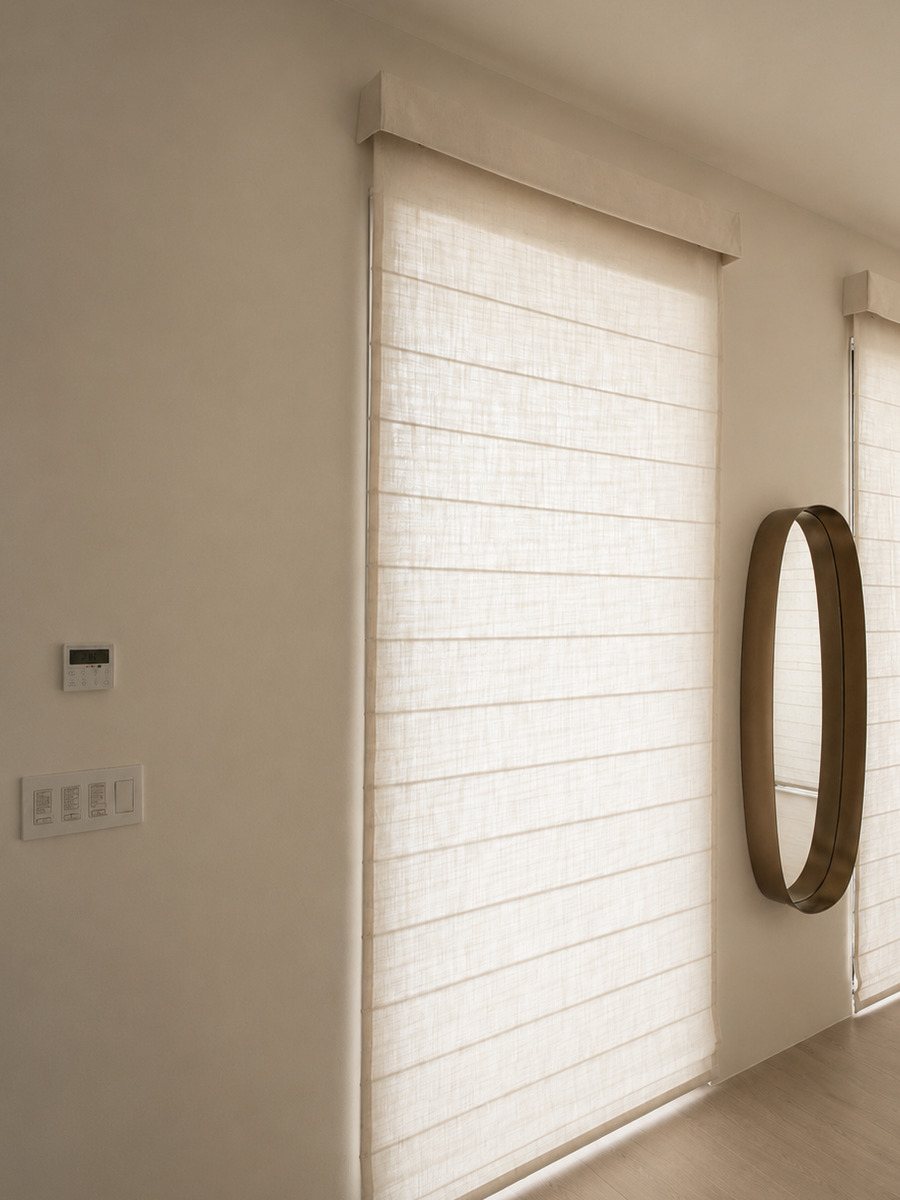
Six Villas, Big Ambergris Cay
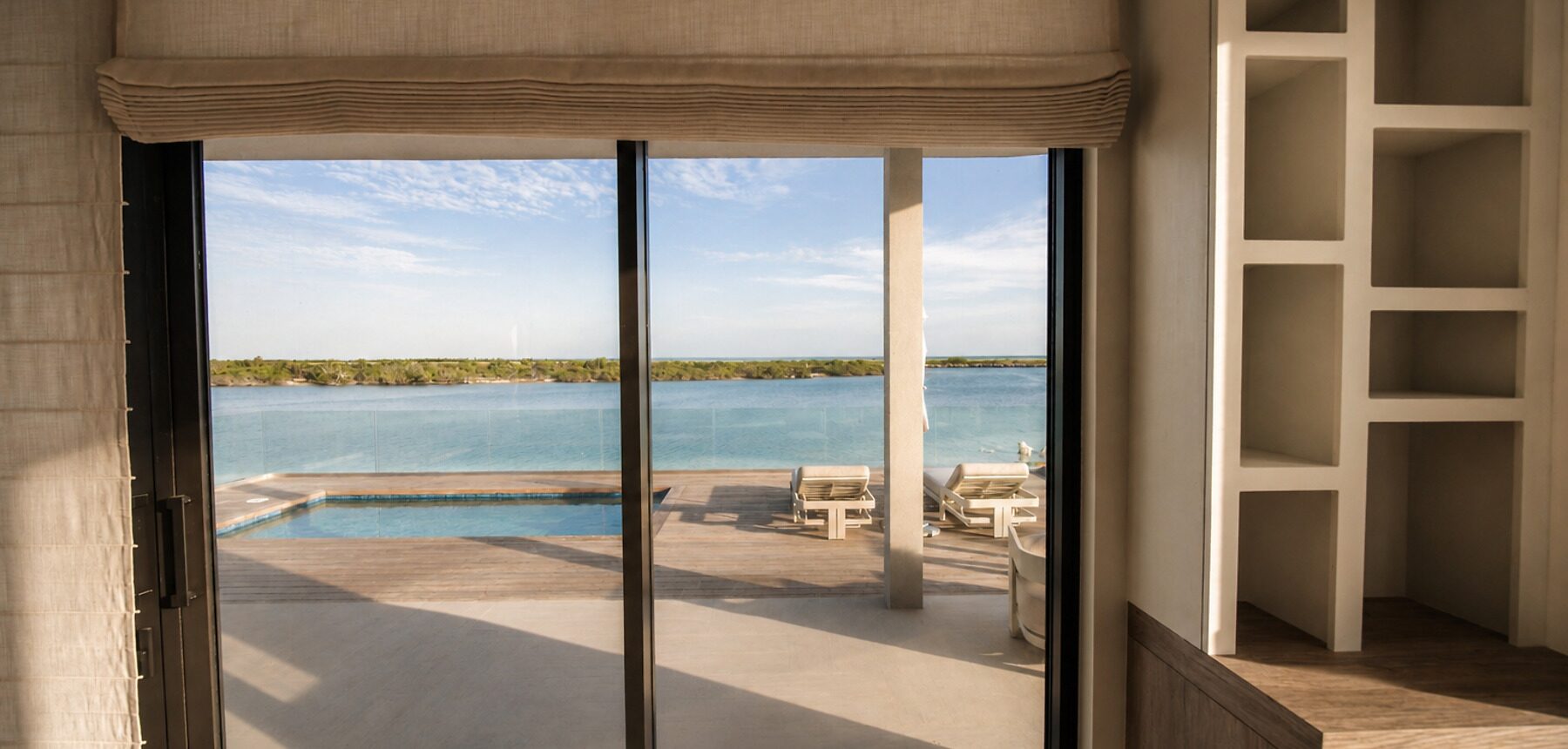
Roman Over the Pool
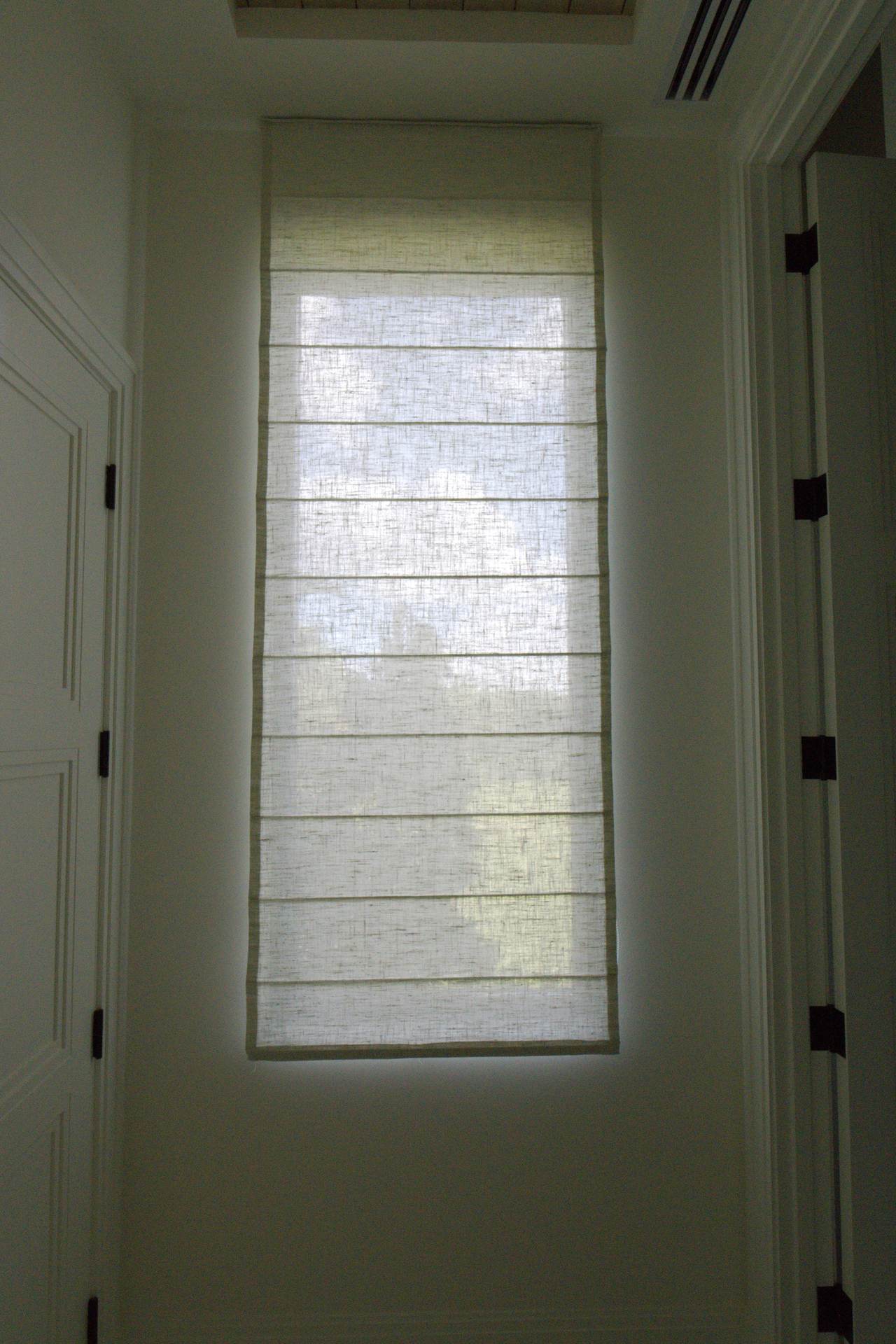
Landmark Ranch Estates
Conventional motorized Romans from our workroom: Six Private Villas, Big Ambergris Cay on the Lutron Roman system, and Landmark Ranch Estates on Somfy. The top-down bottom-up is sewn in the same fabrics with the same folds. More in the project gallery.
Frequently asked
What is a top-down bottom-up Roman shade?
A Roman shade whose top edge and bottom edge move independently. Raise the bottom and the folds stack under the headrail, as on any Roman. Lower the top and the folded stack travels down the window instead, leaving open glass above it for daylight and sky while the lower part stays covered for privacy. Ours is motorized, so both moves happen from a remote, an app or a schedule.
How is it different from a regular Roman shade?
The fabric, the folds, the linings and the valance are the same, and it comes out of the same workroom. The difference is at the head: the top edge hangs on its own lift, so the shade can open from the top as well as from the bottom and stop at any height in between. See our Roman shades page for the conventional version.
Is a motorized top-down bottom-up Roman really new in South Florida?
Cordless top-down bottom-up Romans are sold by national online sellers. We have not found a South Florida workroom offering one on a motor, sewn to order in the client's own fabric. As far as we know this is a first for the region, and if that changes we will say so here.
Which motors can it have?
Somfy, on the Telis and Situo remotes, the TaHoma app and the scenes the rest of a Somfy home already uses, or the motor built into the top-down bottom-up system itself. Either way there is no operating cord at the window. We choose per window, usually by what else in the home is motorized. See Somfy motorization.
Can the top stop anywhere, or only at the sill?
Anywhere between the headrail and the sill. The limits are set at installation, fully down, fully up and the height you want the top to stop at, and the motor returns to them on one press.
Which fabrics can it be made in?
Any fabric we make Roman shades from: the Alendel Roman shade fabrics in our library, or a linen, weave or print from the fabric houses we work with. Lined, interlined or blackout-lined, pattern-matched across the folds, with the valance wrapped in the same fabric.
Which fold style is it?
The hobbled fold, the one in the film: permanent overlapping folds that keep their shape whether the stack is at the top, at the sill or halfway. It reads full and formal, and it is the fold that stacks most neatly when the top comes down. Our fold guide explains the others.
Can it be blackout?
Yes, with a blackout lining. Fully down it darkens a bedroom like any blackout-lined Roman we make, with the usual light line at the sides. Lowered from the top it lets light in on purpose, over the stack, so one shade gives you both: dark for sleep, light and privacy after. See blackout shades.
Inside or outside mount?
Both. Inside the frame where the depth allows the headrail and the stack, on the wall or ceiling where it does not, or where you want the glass fully clear when the shade is raised. We confirm the mount at measurement; our inside vs outside mount guide explains the trade-offs.
How much stack does it take?
Typically 8 to 12 inches depending on the drop, the same as a conventional hobbled Roman. Raised from the bottom the stack sits under the valance; lowered from the top it sits on the sill.
What does a motorized top-down bottom-up Roman shade cost?
It is quoted per window, in writing, after measurement: the fabric, the lining, the size and the motor set the price, as on any Roman we sew. Our published pricing shows how we price motorized shades, and the instant price assistant gives a budget figure for a motorized shade in a minute.
Is it safe for a child's room?
There is no pull cord or chain at the window; the shade moves on its motor, and the lift lines that carry the top and bottom edges run inside the shade's travel, as on any Roman. A motor is what a nursery or a child's room wants on a Roman shade.
Top-down bottom-up Roman shades in Fort Lauderdale, Miami, Boca Raton & Palm Beach
Privacy at eye level and daylight above, on a motor, in a fabric sewn to order: the top-down bottom-up Roman is what we now offer for street-facing rooms, baths and low-floor bedrooms from Miami Beach to Palm Beach. Our workroom and showroom are at 4539 Powerline Rd in Fort Lauderdale, our second showroom is South of Fifth in Miami Beach, and the same in-house team measures and installs from Miami to Palm Beach.
Privacy below, daylight above, one press
One free hour with our team routinely saves owners thousands in avoidable mistakes - wrong fabrics, bad mounts, missed motorization. Book a private, complimentary consultation - we bring the fabrics, the linings and honest answers about which windows want a top-down Roman and which do not. Start with the free guide: the 5 costly mistakes.