

Dual Roller Shades
Dual roller shades from Exotic Shades & Draperies put two shades on one bracket: a solar screen or sheer in front, a blackout or light-filtering fabric behind, both hidden in one square 5 x 5 in Vertilux fascia. Cut to the millimeter in our Fort Lauderdale workroom in Mermet and Phifer fabrics woven in the USA, driven by Somfy or Vertilux motors or a manual chain, and installed by our own team from Miami Beach to Palm Beach.
View by day, darkness by night, one window
A dual roller shade, also sold as a double roller or day-night roller shade, is two independent roller shades sharing one bracket set. Lower the front screen and the glare goes while the ocean stays; lower the blackout behind it and the room is dark for sleep or a film. Each layer has its own motor or chain, so any combination is one tap away.
We build ours on the Vertilux dual system with a 5 x 5 in square fascia: one flat aluminum face that hides both tubes, both drives and both brackets, so a wall of glass reads as a single clean line instead of two stacked shades. Vertilux is a Miami-based shade hardware maker founded in the early 1980s, which keeps every component a short drive from our workroom. Not to be confused with zebra shades, one banded fabric on one tube.
Recently: Oceanfront Mansion, Hillsboro Mile - primary bedroom on dual rollers, Basketweave 90 solar in front and Luna White blackout behind, on Lutron Sivoia QS drives behind a custom woodwork valance. Same idea; on our Vertilux system the valance is the 5 x 5 in fascia.
Dual roller shades by the numbers
The fascia
A square extruded-aluminum fascia 5 in high by 5 in deep (127 x 127 mm) closes the front and top of the assembly; the two rollers sit staggered inside it, one low at the front and one high at the back, each fabric dropping off the glass side of its tube so the two hang close together and clear each other, and the head of the window shows one flat face and one shadow line. Inside mount in a deep frame, or outside mount on the wall or ceiling.
Two independent layers
The front tube carries the daytime fabric, the back tube the night fabric. Each has its own drive, so the screen can be down while the blackout is up, both down, or both up - and the hembars are set so the two fabrics never touch.
Four drives
Somfy WireFree rechargeable battery motors, Somfy RTS wired motors, Somfy SDN motors on a wired bus, Vertilux VTi motors, or a manual clutch and chain - any of them in either tube, mixed if you like. Somfy Sonesse ULTRA 30 WireFree: rechargeable lithium-ion, 2 Nm of lift, rated 42 dB, RTS radio with 656 ft open-field range.
Fabrics
Mermet and Phifer solar screens in 1%, 3%, 5% and 10% openness for the front tube; coated blackouts rated 0% light transmittance, light-filtering weaves or sheers for the back or front. In Mermet E Screen charcoal, total solar transmittance is 3% at 1% openness and 7% at 5%. See the openness guide.
Two fabrics, two sets of numbers
A dual roller is two fabric decisions. The front screen is chosen for the day: its openness sets the view and its colour sets how much of the sun's energy is reflected rather than absorbed. The back blackout is chosen for the night, but its colour still matters by day, because a dark blackout down on a west window absorbs the sun exactly as a dark screen would. The numbers below are the mills' own.
Figures: Lutron fabric specifications for E Screen S0202-E-3 and S3001-E-3 and Blackout Screen RF-BOSC-PR and RF-BOSC-CG; Mermet USA Sparta Twilight spec sheet. Retrieved September 2026.
Read next: Openness 1% vs 3% vs 5% vs 10% · Dark or light solar shade fabric? · Blackout shades
Which two fabrics go in the window
Solar screen + blackout
The South Florida standard. A Mermet E Screen or Phifer SheerWeave at 3% or 5% in front tames the glare and keeps the water view; a coated blackout behind it gives true darkness. Bedrooms with a view, living rooms with a television, any east or west wall of glass.
Light-filtering + blackout
A translucent decorative weave in front glows with soft daylight and gives full privacy even at noon; the blackout behind takes over at night. Street-facing bedrooms, nurseries, ground-floor rooms and baths where a screen would show too much.
Sheer or screen + light-filtering
Two view-through layers and no blackout: the screen for the afternoon sun, the light-filtering layer for evening privacy without a black window. Living and dining rooms, offices, kitchens - anywhere darkness is not the point but glare and privacy both are.
How we choose
We bring both fabrics to the consultation and check them in your own light. Exposure decides the openness of the screen: a west-facing Intracoastal wall or a bay-facing Brickell wall wants 3% or tighter, a north-facing room can take 10%. The blackout colour is chosen from the room side, the screen colour from the view.
Somfy, SDN, Vertilux or chain, by tube
The fascia and brackets are the same whichever drive goes in. What changes is the power, the control and where the wiring lands, so we settle it before the shade is made.
| Drive | What goes in the tube | Power and wiring | Control | Best for |
|---|---|---|---|---|
| Somfy WireFree | Sonesse 28 WireFree or Sonesse ULTRA 30 WireFree rechargeable lithium-ion motors, one per tube | None. Charged in place a few times a year | Telis or Situo remotes, TaHoma app, Amazon Alexa and Google Home through TaHoma | Condos and finished homes: no wiring, no opened walls, no construction approval in most buildings |
| Somfy RTS wired | Sonesse 30 or Sonesse 40 RTS motors | Power at the motor end, placed at framing or fished after | Same RTS remotes and TaHoma scenes as WireFree, without recharging | New construction and renovations where power can reach the head of the window |
| Somfy SDN | Sonesse 30, 40 or 50 motors on the SDN bus, each with its own address | Bus cable plus power, home-run to a panel | Crestron, Control4 and Savant through the integrator; groups and whole-facade commands with confirmation from every motor. About SDN | Large projects, walls of dual shades that must travel together, integrated homes |
| Vertilux VTi | Vertilux VTi motors (Celtic and RE-LION families) matched to the Vertilux tube and fascia | Battery or wired, by model | Vertilux remotes and the VTi app through the VTi Smart HUB | Projects standardised on the Vertilux system end to end |
| Manual | Vertilux clutch and chain, one per tube | None | Two chains, one per layer, on the side you choose | Small windows, secondary rooms, and the screen layer next to a motorized blackout |
Motor families and control paths are those we install and program ourselves. Lutron dual shades are built around Lutron's own Sivoia QS, Triathlon or Palladiom drives, behind a fascia or, as at Hillsboro Mile, a custom woodwork valance - see Lutron motorized shades.
What a dual asks of the installer that a single never does
Roll direction and clearance
Two tubes, two fabric thicknesses, one fascia. We set the roll of each fabric so the hembars clear each other and the fascia lip through the full drop, and reverse-roll the front layer where a door handle or crank sits in the way.
The light line at the sides
A blackout behind a screen still leaks at the jambs. Where the window allows we add side channels on the blackout layer; where it does not, we size the deduction so the gap is the same on every window in the room and the screen in front softens it.
Hembars that line up
Same fabric lot on each layer across the row, tubes sized to the drop so long shades do not telescope, and both hembars set to the same stop heights, so a bank of five dual shades reads as one line whether the screens are down or the blackouts are.
Motor side and power
Both motors on the same side, power or bus at one end, remotes and channels grouped so the client never wonders which button moves which layer. Programmed before we leave, with limits set on the finished floor.
Scenes, not buttons
Afternoon: screen down. Film: both down. Morning: both up. On Somfy TaHoma, SDN or the home's control system we build the scenes, and on a manual pair we put the chains where the hand falls.
One line across the glass
On a wall of sliders the fascias are cut to meet with the same reveal at every mullion, and the screen and blackout colours are chosen so the head of the window reads as one architectural element, not as hardware.
Dual layers, installed by Exotic
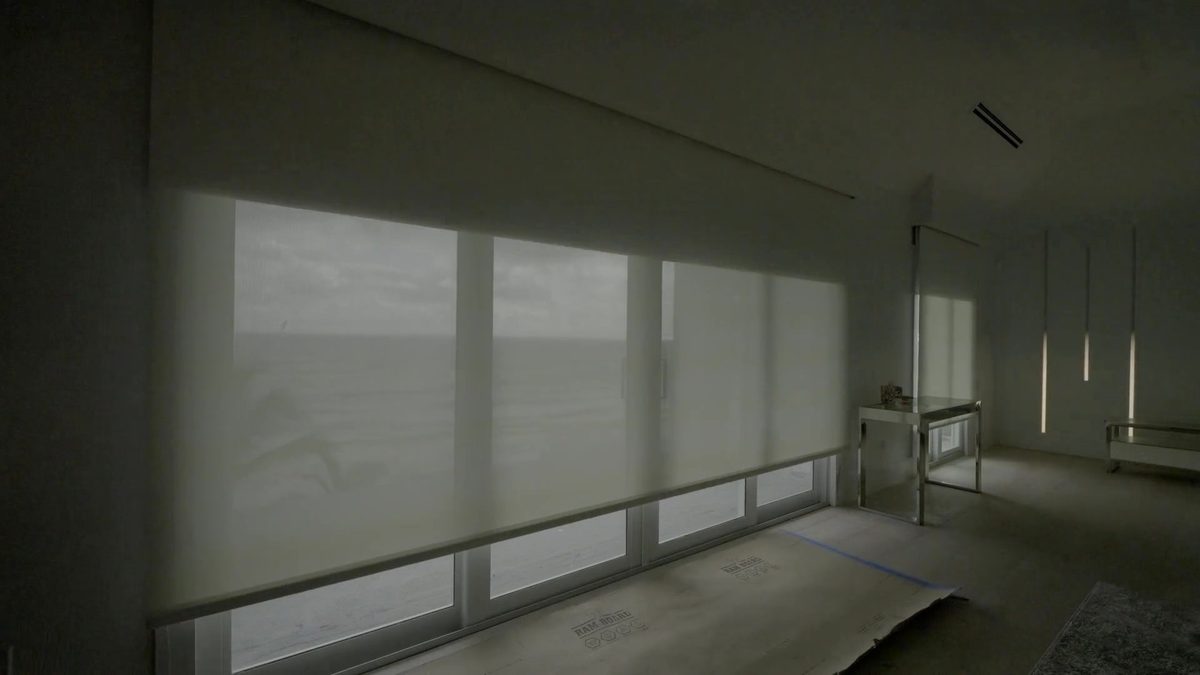
Screen Down, Blackout Up
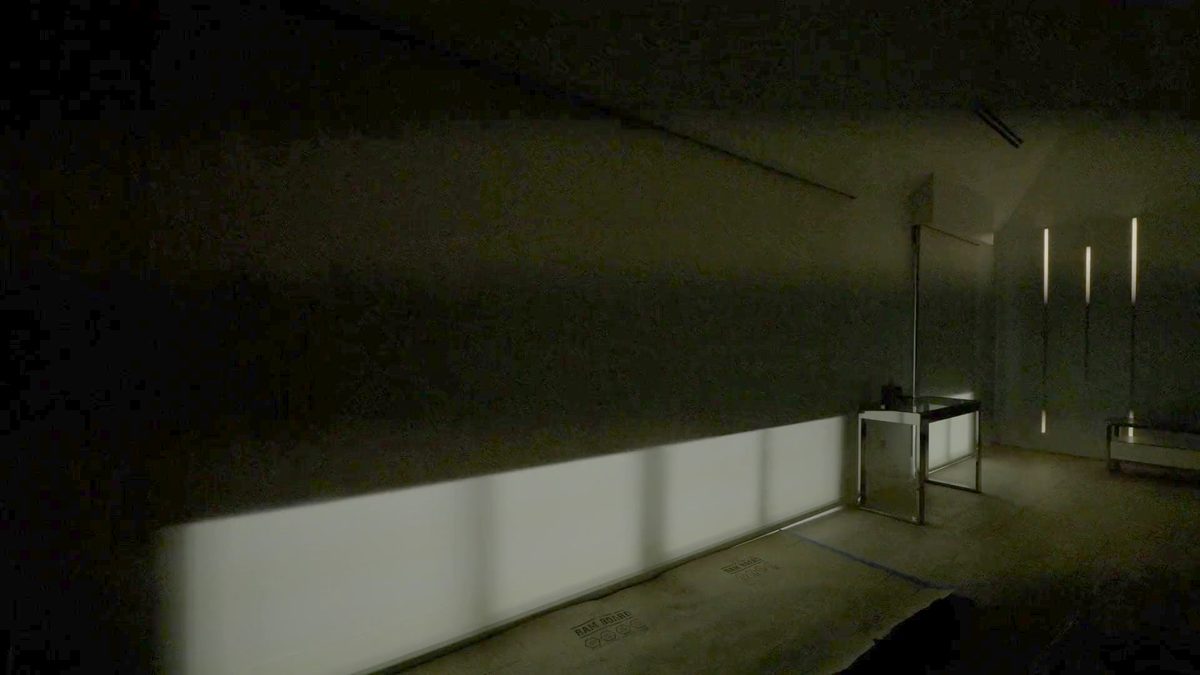
Blackout Down
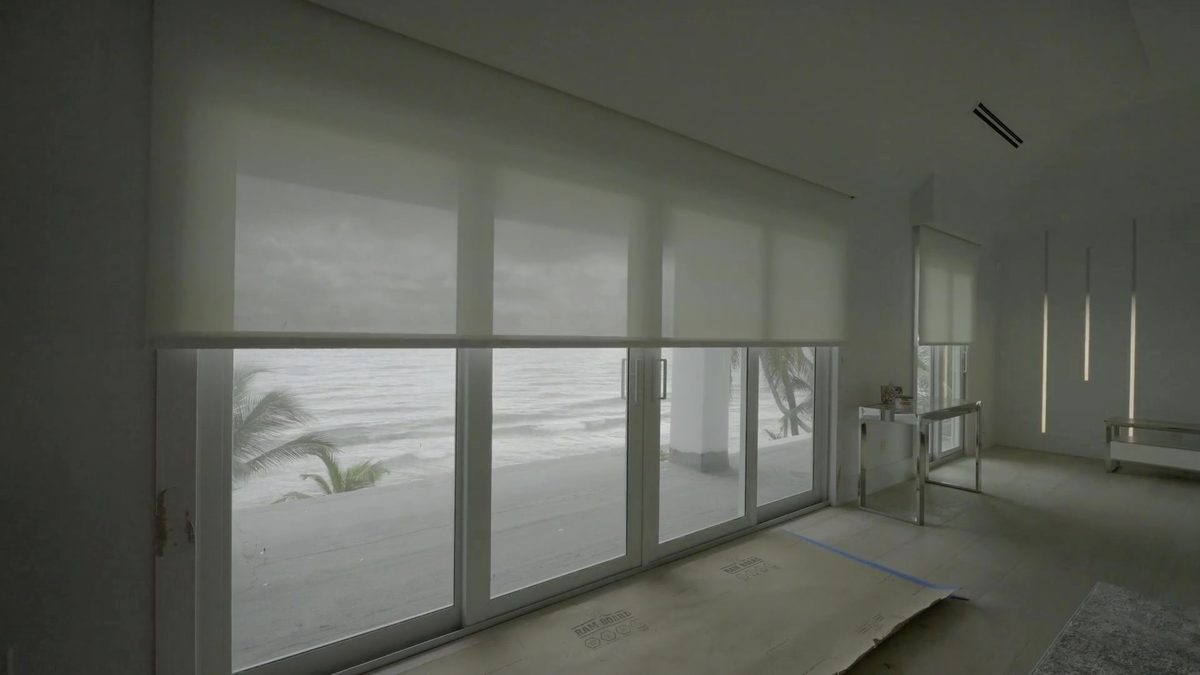
Screen Rising, Ocean Back
Primary bedroom, Oceanfront Mansion, Hillsboro Mile: Basketweave 90 Bright White solar in front, Luna White blackout behind, Lutron Sivoia QS drives behind a custom woodwork valance. Frames from our showcase film; more in the project gallery.
Two shades, built as one
A dual roller is only as good as the way its two layers meet. We fabricate both shades on precision cutting equipment in our own workroom, finish the hems by hand, size each tube to its drop and its fabric, and assemble the pair on the Vertilux dual brackets in the shop before it goes to the window, so the fascia, the tubes and the two hembars arrive as one tested unit. Somfy WireFree, RTS or SDN, Vertilux VTi or a clutch and chain in either tube; inside or outside mount; a wall of sliders or a single bedroom window.
Why the dual is the condo and oceanfront answer
Floor-to-ceiling glass facing east or west gives you the best view in the building and the hardest light to live with. A single solar screen keeps the view but never darkens a bedroom; a single blackout darkens it but takes the view with it every afternoon. The dual gives both in the same window with one fascia at the head, and with battery motors in both tubes it goes into a finished condo from Sunny Isles to Boca Raton without a wire, a permit or an opened ceiling. See how we treat sliding glass doors and bedroom windows.
Frequently asked
What is a dual roller shade?
Two independent roller shades on one bracket set, one roller in front of the other, hidden behind a single fascia. The front roller usually carries a solar screen or sheer for the day and the back roller a blackout or light-filtering fabric for the night, and each moves on its own motor or chain. Also sold as double roller shades or day-night roller shades.
What is the difference between dual roller shades and zebra shades?
A zebra shade is one banded fabric on one tube: sheer and solid stripes that align or overlap. A dual roller is two separate fabrics on two tubes, so you can have a true 3% solar screen by day and a true 0% blackout at night in the same window. Zebra shades are sometimes also called dual shades, which is why we keep the two on separate pages - see zebra shades.
Can each layer be operated separately?
Yes. Each tube has its own motor or its own clutch and chain. Motorized, the two layers are programmed as scenes: screen down for the afternoon sun, both down for a film or for sleep, both up for the view.
How much room does the 5 x 5 in fascia need?
The fascia is 5 in high and 5 in deep. An inside mount needs about 5 in of clear frame depth so the face sits flush; shallower frames and sliding doors get an outside mount on the wall or ceiling, where the square fascia reads as a clean architectural line. We confirm the mount per window at measurement - see the inside vs. outside mount guide.
Which motors can go in a dual roller shade?
Any of the drives we install: Somfy WireFree rechargeable battery motors, Somfy RTS wired motors, Somfy SDN motors on a wired bus for Crestron, Control4 and large projects, Vertilux VTi motors with the VTi app, or a manual clutch and chain. The two tubes can even use different drives, for example a motorized blackout and a manual screen. For a Lutron home the dual is built around Lutron's own Sivoia QS, Triathlon or Palladiom drives instead. See Somfy motorization and Lutron motorized shades.
Do you install dual roller shades in condos?
Every week. Somfy WireFree battery motors in both tubes mean no wiring, no opened walls and no construction approval in most buildings, and the single fascia keeps the head of a floor-to-ceiling slider tidy.
What do dual roller shades cost?
Budget roughly two motorized shades that share one fascia and one bracket set: two fabrics, two motors, one 5 x 5 in fascia. Our published pricing shows what one motorized roller shade costs by size and motor system; we quote the dual per window after measurement, in writing.
Woven in the USA. Specified by the numbers.
A dual is two fabrics chosen to work together, and only mill-branded fabric with a published spec lets us promise what each layer will do. The screen and light-filtering layers come from Mermet, woven in South Carolina, and Phifer SheerWeave, woven in Alabama, in their best grades only; the blackout layer follows the same rule - a certified fabric rated 0% light transmittance, with the spec sheet in the quote.
Mermet
E Screen, M Screen, T Screen, Satiné and the GreenScreen weaves, with KOOLBLACK for dark screens that reflect heat - woven by Mermet USA in Cowpens, South Carolina and listed by the mill as Made in USA. Mermet fabrics
Phifer SheerWeave
The SheerWeave family, including PVC-free styles and Microban-protected weaves that resist mildew in Florida humidity - woven by Phifer in Tuscaloosa, Alabama, where the mill has made fabric since 1952. Phifer fabrics
Best grade only
A core chosen for the window - fiberglass-core screens that stay flat on 10-foot glass, polyester where its lighter weight or PVC-free construction serves the room - an openness woven to tolerance, and a published spec sheet for UV, heat and light in every colour, with GREENGUARD Gold and NFPA 701 listings behind it. Never anonymous screen.
On any system
The same fabric on a Somfy or Vertilux motor, a Lutron or Crestron motor, or a manual chain. Both mills sell through distributors, and the ranges we specify are kept on the shelf by our authorized South Florida distributor, so the fabric is chosen for the window and its exposure, not for the motor brand - and it is ready to cut when the measurements are. Our shade fabrics
Discerning homeowners, designers, and developers across South Florida trust Exotic with their most important spaces.
“We hired exotic shades draperies for the motorized roller shades in our house in Hallandale, and we are really happy with the job. My husband wanted the best quality of shades and the quietest, so David recommended we go with Lutron shades that he installed with the system in our house. Super professional, meticuluos in detail. Exactly what we wanted. Great customer service! Recommend 10/10”
“We recently moved into a new condo and knew we wanted Lutron shades. Since there was no electrical wiring near the windows, Exotic Shades recommended battery powered Lutron roller shades. It was the perfect solution.the installation was clean, the shades work beautifully, and we are very happy happy. Good job!”
“We had roller shades before, but too much light was still coming in from both sides. Exotic Shades & Draperies recommended adding motorized blackout drapes with Sonfy motor, and it was the perfect solution. They made the drapes wide enough so they could fully clear the window when opens. Very happy with the recommendation, the installation and the final result!!”
Control systems these shades answer to
Every motorized system we install runs from a remote, an app or the home's control system. Which one depends on the motor family, so we settle it before the shade is made.
Somfy
Sonesse and WireFree motors on Somfy RTS or Zigbee: Telis and Situo remotes, the TaHoma app for scenes and schedules, Amazon Alexa and Google Home through TaHoma, and Control4, Crestron and Savant through the TaHoma integration or the SDN bus. Somfy motorization.
Crestron
Dual rollers on Somfy SDN or Crestron shade motors commissioned into the home's Crestron processor and keypads with your integrator, with the fabric, hems and hembars still made in our workroom. Crestron shades.
Lutron
For Lutron homes the dual is built around Lutron's own Sivoia QS, Triathlon or Palladiom drives, as in the Hillsboro Mile primary bedroom: Pico remotes, the Lutron app and native integration to Crestron, Control4, Savant, Apple Home, Amazon Alexa and Google Home. Lutron motorized shades.
Dual roller shades in Fort Lauderdale, Miami, Boca Raton & Palm Beach
Solar screen and blackout, or sheer and light-filtering, on one bracket behind one 5 x 5 in fascia - the dual is what we put on oceanfront bedrooms and bay-facing living rooms from Sunny Isles to Palm Beach. Our workroom and showroom are at 4539 Powerline Rd in Fort Lauderdale, our second showroom is South of Fifth in Miami Beach, and the same in-house team measures and installs from Miami to Palm Beach.
View by day and darkness by night, in one window
One free hour with our team routinely saves owners thousands in avoidable mistakes - wrong fabrics, bad mounts, missed motorization. Book a private, complimentary consultation - we bring both fabrics, the fascia sample, and honest answers. Start with the free guide: 10 costly window treatment mistakes.