

Types of Window Treatments: The South Florida Buying Guide
Window treatments come in five families - shades, draperies, blinds, shutters and exterior screens - and 17 types, every one of them made, motorized and installed by Exotic Shades & Draperies from our Fort Lauderdale workroom. This guide defines each type, gives its pros, cons, best rooms and the prices we publish, and chooses for South Florida glass: west sun, floor-to-ceiling sliders, salt air and condo rules.
Every type, defined, compared and priced
Window treatments fall into five families - shades, draperies, blinds, shutters and exterior screens - and this guide walks through the 17 types in them. Each one gets a plain definition, its pros and cons, the rooms it belongs in and the price we publish, so you can read it the way we run a consultation: by exposure, by room, by how the window is used.
Everything here is made, motorized and installed by our own team from a workroom in Fort Lauderdale, with fabrics woven in the USA and a published price list, for glass from Miami Beach to Palm Beach: west sun, floor-to-ceiling sliders, salt air and condo rules.
The short version
- A water view with heat and glare control: a solar roller shade in a 3% charcoal screen: 5% where the view matters more, 1% on the harshest west glass.
- A dark bedroom: a blackout roller shade with side channels, a double-cell blackout honeycomb (R 4.4) or blackout draperies with returns and a center overlap. View by day and dark at night: a dual roller shade.
- The AC bill: honeycomb shades, the only soft treatment with a published insulation value (R 3.5 to R 4.4), and light-coloured screens that reflect the sun instead of absorbing it.
- A sliding glass door: a motorized roller shade that clears the handle, Allusion sheer verticals for a door you walk through all day, or ripplefold sheers on a motorized track.
- Softness and scale on 10 to 12 ft glass: floor-to-ceiling sheer draperies, ripplefold on a track, layered over a solar roller.
- Architecture that stays with the house: plantation shutters built to the window, in finishes chosen for humidity and salt air.
- A finished condo: rechargeable-battery motors (Somfy WireFree or our Essential tier): no wiring, no opened walls, no construction approval in most buildings.
Blinds, shades, draperies, shutters and screens: the difference in one sentence each
Shades
A shade is a single piece of material - woven screen, coated blackout, cellular fabric, sewn fabric or a natural weave - that rolls, folds or stacks up and down. There are no slats to tilt: light control comes from the fabric you choose and how far you lower it, which is why the fabric line on a quote matters more than the hardware.
Blinds
A blind is a set of slats or vanes - real wood, faux wood, aluminum or fabric - that tilt to meter light and lift or draw aside. Blinds give the most precise mechanical light control of any treatment and the least softness; the slats always pass some light, so they are never a blackout.
Draperies
Draperies are sewn fabric panels that hang from a rod or a track and draw sideways. Curtains are the casual, unlined version bought to a standard length; draperies are lined, often interlined, pleated or ripplefold, and cut to the window. They bring scale and softness that no hard treatment can, and they layer over shades for day and night control.
Shutters
Plantation shutters are hinged panels with wide louvers, built to the opening to the millimeter and finished like millwork. They are the most architectural treatment, the one that reads as part of the house rather than something added to it, and the one that stays when you sell.
Exterior screens
Outdoor shades are motorized exterior screens that stop heat and glare before they reach the glass, on patios, lanais, balconies and summer kitchens. They are comfort products, not storm protection; impact glass does that job.
All 17 types on one table
What each one is, how it handles light, what it does about heat, where it belongs in a South Florida home, how it motorizes and what we publish for it.
| Type | What it is | Light and darkness | Heat and insulation | Best rooms here | Motorized | Published price, Sep 2026 |
|---|---|---|---|---|---|---|
| Roller shade | One sheet of fabric on a tube: a solar screen (1% to 10% openness), a light-filtering weave or a coated blackout | Solar screen keeps the view (3% charcoal shows the water); blackout with side channels goes fully dark | Charcoal E Screen 3% passes 5% of solar energy; white 3% reflects 73% | Living rooms, kitchens, offices, sliders, any view; blackout in bedrooms | Lutron, Somfy, Essential | 72 x 84 in motorized from about $733 (Essential), $793 (Somfy WireFree), $1,910 (wired Somfy), $3,141 (Lutron) |
| Dual roller shade | Two rollers on one bracket set in one 5 x 5 in fascia: screen or sheer in front, blackout behind | View by day through the front layer, dark at night behind the back layer | Screen by day, blackout at night | Oceanfront bedrooms, living rooms with a television, east and west glass | Somfy, SDN, Vertilux; Lutron drives in Lutron homes | Roughly two motorized shades sharing one fascia; quoted per window |
| Zebra shade | Alternating sheer and opaque bands on one loop; align for view, offset for privacy | Softened view when aligned; privacy when offset; never fully dark | Moderate | Living and dining rooms, condo sliders | Lutron, Somfy | Quoted per window |
| Sheer shade | 2 or 3 in fabric vanes between two layers of sheer; tilts like a blind, glows like drapery | View with the vanes open; room-darkening versions give privacy, not blackout | Moderate | Living rooms, floor-to-ceiling glass | Lutron, Somfy | Quoted per window |
| Honeycomb (cellular) shade | Pleated fabric bonded into hollow cells that trap air | No view through; blackout cells are among the darkest we install | The only soft treatment with a published R-value: R 3.5 to R 4.4 | Bedrooms, nurseries, west-facing rooms, skylights | Lutron, Somfy, cordless | Quoted per window |
| Roman shade | Sewn fabric that draws up into flat, relaxed or hobbled folds | No view through; dark with a blackout lining | Lining and interlining add body and insulation | Kitchens, studies, bedrooms | Cordless, Lutron, Somfy | Quoted per window |
| Woven wood shade | Bamboo, reeds, grasses and jute woven into a shade; unlined or lined | Filtered glow unlined; dark with a blackout lining | Moderate | Glass rooms and coastal interiors that need texture | Lutron, Somfy | Quoted per window |
| Skylight shade | A honeycomb fabric in tensioned side tracks that hold it flat against gravity | No view through; dark with blackout cells | R 3.5 to R 4.4 overhead; schedules close it over the hottest hours | Skylights and angled glass | Lutron, Somfy, battery | Quoted per opening |
| Sheer draperies | Floor-to-ceiling panels of voile or linen | Softened view; no darkness | Low; layer over a solar roller or a blackout panel | Living rooms, walls of glass, condos | Motorized tracks | $85 per linear foot of width on a manual track in a house; $95 in a condo |
| Ripplefold draperies | No pleats: snap-tape carriers hold the fabric in a continuous S-wave on a track | Depends on the fabric; dark with a blackout lining | Depends on the lining | Modern rooms, walls of glass, motorized tracks | Motorized tracks | 12 ft motorized track about $1,452 track only; $2,833 with smart-hub motor, ceiling mount and lined drapery |
| Pinch pleat draperies | Two- or three-finger pleats hand-tacked at the base into deep, regular folds | Depends on the fabric; dark with a blackout lining | Lining and interlining add weight and insulation | Formal rooms, bedrooms, decorative rods | Rods or motorized tracks | Quoted per panel; track figures as ripplefold |
| Blackout draperies | A face fabric with a sewn-in three-pass blackout lining, a return to the wall and a center overlap | No view through; dark | Interlining adds insulation and a quieter room | Bedrooms, media rooms | Motorized tracks | Motorized, 16 ft track in a recessed pocket about $3,691 |
| Horizontal blinds | Real hardwood, moisture-proof faux wood or slim aluminum slats that tilt | View with the slats tilted; slats always pass some light | Low | Studies (wood); kitchens, baths, laundry (faux wood); modern rooms (aluminum) | Cordless or motorized tilt | Quoted per window |
| Vertical blinds and panel track | Fabric vanes that rotate and draw aside, or wide panels that glide on a headrail | View with the vanes open; no darkness | Low | Sliding doors, wall-wide glass | Motorized track | Quoted per opening |
| Allusion sheer verticals | Overlapping sheer and fabric vanes you walk straight through | Softened view; privacy with the vanes turned; no darkness | Low | Sliding glass doors used all day | Motorized track | Quoted per door |
| Plantation shutters | Hinged panels with wide louvers, built to the opening and finished like millwork | View with the louvers open; partial darkness, light at the edges | Some | Bedrooms, baths, arches, French doors; bypass panels on sliders | Manual | Quoted per panel |
| Outdoor shades | Exterior performance mesh in zippered side channels, marine-grade hardware | View and breeze kept; no darkness | Stops heat and glare before the glass | Patios, lanais, balconies, summer kitchens | Somfy exterior motors | Quoted per opening |
Prices are from our own quote engine, budgetary and before tax, as published on the pricing page; "quoted per window" means the type is priced from real measurements at the free in-home measure. Fabric figures are Lutron's published values for Mermet E Screen; R-values are Lutron's for its cell fabrics.
Shades: eight types, one piece of fabric each
A shade is chosen twice: first the type, then the fabric. Solar screens, light-filtering weaves and blackouts each come from a spec sheet, and the same Mermet and Phifer screens and Lutron colourways go on a Lutron, Somfy or Essential motor. Every shade below is cut in our own Fort Lauderdale workroom.
Roller shades
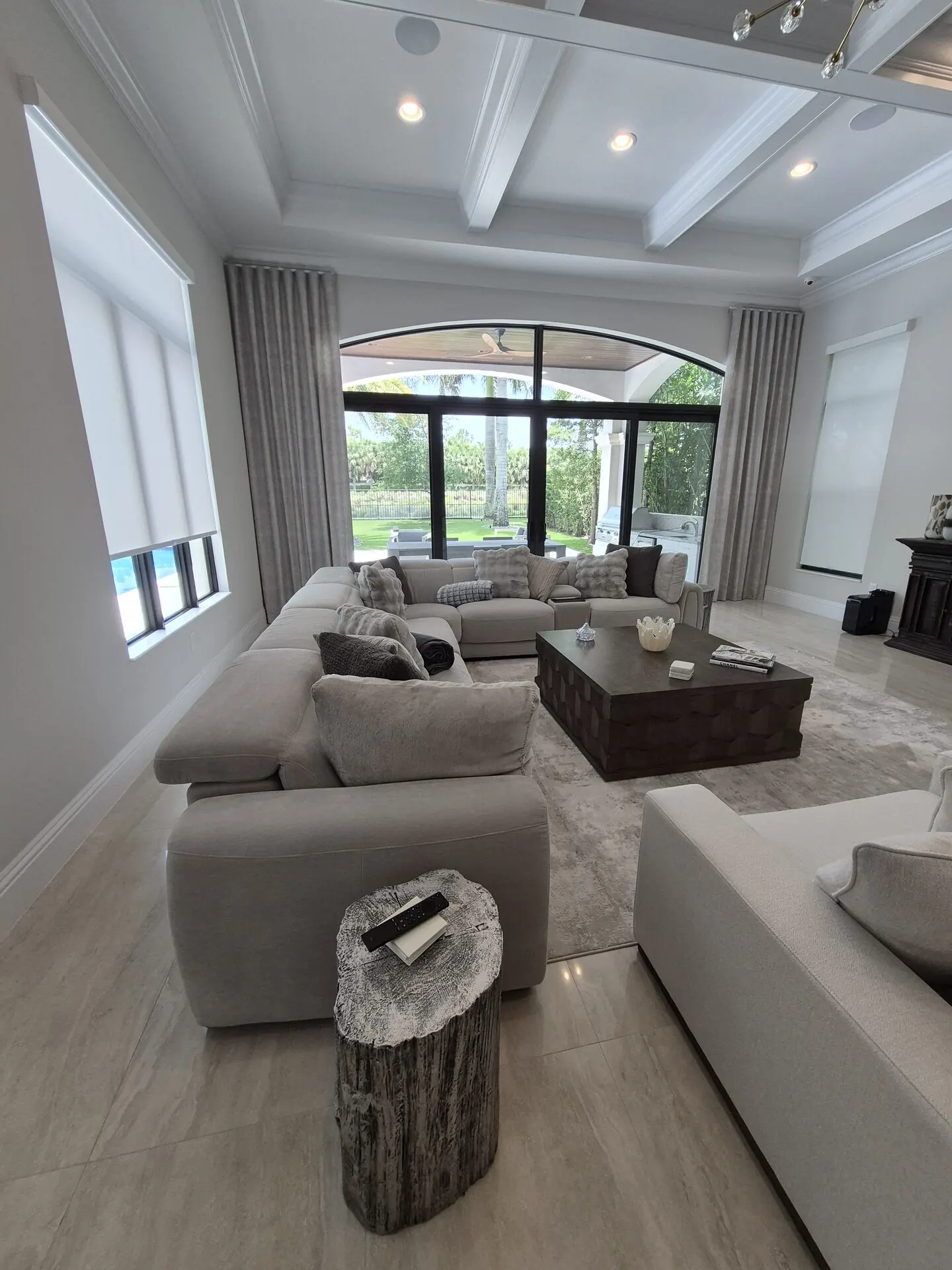
A roller shade is a single sheet of fabric on a tube, and the fabric sets its whole personality: a woven solar screen you see through, a light-filtering weave, or a coated blackout. Ours are cut to the millimeter in Mermet and Phifer screens woven in the USA and in every Lutron colourway, with cassette, fascia or open-roll hardware.
- Keeps the view: a charcoal E Screen 3% passes 5% of solar energy and still shows the water
- The slimmest stack and the widest single piece: solar screens to 124 in usable width, blackouts to 116 in
- The natural motorized shade on Lutron, Somfy or our Essential tier
- A flat fabric leaks light at the jambs, so true darkness needs side channels
- One fabric per tube: a view or darkness, not both (that is what a dual roller is for)
- At night, with the lights on, a screen shows the room to the outside
Best for: Walls of glass, water views, sliding doors and most of the motorized work we do.
Price: One 72 x 84 in motorized roller shade, fabric and motor included: about $733 on our Essential tier, $793 on Somfy WireFree, $1,910 on wired Somfy with its power panel, $3,141 on Lutron. Budgetary, before tax. More on roller shades.
Dual roller shades
A dual roller shade, also sold as a double or day-night roller, is two independent rollers on one bracket set behind one square 5 x 5 in fascia: a solar screen or sheer in front, a blackout or light-filtering fabric behind, each on its own motor or chain.
- View by day and darkness by night in the same window
- One flat fascia hides both tubes, both drives and both brackets
- Battery motors in both tubes go into a finished condo without a wire
- Needs about 5 in of frame depth for an inside mount; shallower frames get an outside mount
- Two fabrics and two drives cost roughly two shades
- The blackout behind a screen still wants side channels for full dark
Best for: Oceanfront bedrooms, living rooms with a television, east and west walls of glass.
Price: Budget roughly two motorized shades sharing one fascia; quoted per window after measurement. More on dual roller shades.
Zebra shades
Zebra shades, also called banded or layered shades, alternate sheer and opaque fabric bands on one continuous loop: align the bands and the room fills with softened light and view, offset them and the solid bands overlap for privacy.
- The most flexible light control you can put on one tube
- Softens hard sun without closing the room in
- Motorizes to the exact band position you programmed
- Never fully dark: the sheer bands always pass light
- Not a heat screen the way a solar weave is
- The sheer bands show the room at night with the lights on
Best for: Living and dining rooms, condo sliders, rooms that swing between view and privacy all day.
Price: Quoted per window after the free measure; the instant price tool gives a range. More on zebra shades.
Sheer shades
A sheer shade holds 2 or 3 in fabric vanes between two layers of sheer, so it tilts like a blind and glows like drapery. The 2 in vane suits standard windows; the 3 in vane opens a taller view on floor-to-ceiling glass.
- Vanes tilt for view or privacy; the sheer layers filter daylight into a glow
- Room-darkening versions give privacy without going black
- Fabrics to 114 in usable width; Lutron and Somfy motors tilt and lift them
- Night privacy with the lights on needs the vanes closed
- Not a blackout
- Sheer facings want gentle care
Best for: Living rooms and tall glass where you want daylight without glare.
Price: Quoted per window after the free measure. More on sheer shades.
Honeycomb (cellular) shades
A honeycomb shade is pleated fabric bonded into hollow cells that trap air. It is the only soft window treatment with a published insulation value: Lutron rates its cell fabrics from R 3.5 for single-cell light-filtering to R 4.4 for blackout.
- Insulation at the glass: R 3.5 to R 4.4
- A double-cell blackout is among the darkest treatments we install and seals the edges better than a flat fabric
- Cordless or motorized; Lutron D-cell motors are rated by Lutron at three to five years
- You never see through it
- The stack at the top is deeper than a roller tube
- Fabrics run to 114 in, so very wide glass becomes two shades
Best for: Bedrooms, nurseries, west-facing rooms and skylights, anywhere the air conditioning is fighting the glass.
Price: Quoted per window after the free measure. More on honeycomb (cellular) shades.
Roman shades
A Roman shade is a sewn fabric shade that draws up into flat, relaxed or hobbled folds: a soft treatment cut from the same designer fabrics as draperies, lined, interlined or blackout-lined in our own workroom.
- Any drapery fabric, patterns aligned, hems that break where they should
- Lined for body, interlined for quiet, blackout-lined for bedrooms
- Cordless lift or Lutron and Somfy motorization
- The folded stack stays in the window when raised
- No view-through when lowered
- Fabric shades are dry-clean, not wipe-clean
Best for: Kitchens, studies and bedrooms, and any window that wants fabric without full-height drapery.
Price: Quoted per window after the free measure. More on roman shades.
Woven wood shades
Woven wood shades are bamboo, reeds, grasses and jute woven into a shade that filters light through the material itself, which is what all-glass rooms are usually missing.
- A texture no synthetic fabric matches
- Unlined for a filtered glow, privacy-lined for bedrooms, blackout-lined for full darkness
- Motorizes on Lutron or Somfy like any other shade
- Natural weaves vary, so the lining sets the privacy, not the weave
- Unlined, they are not private at night
- A heavier stack than a roller
Best for: Glass rooms and coastal interiors that need organic texture.
Price: Quoted per window after the free measure. More on woven wood shades.
Skylight shades
A skylight shade rides in tensioned side tracks that hold the fabric flat against gravity, usually a honeycomb fabric for its insulation value, on a Lutron or Somfy motor with app schedules.
- R 3.5 to R 4.4 of insulation overhead
- Schedules close it over the hottest hours and open it for the evening
- Battery motors avoid wiring in a ceiling; wired low-voltage on new construction
- Motorized in practice: nobody reaches a skylight
- Sized to the well, so every one is a custom opening
Best for: Skylights and angled glass that heat a room from above.
Price: Quoted per opening after the free measure. More on skylight shades.
Draperies: four ways to sew fabric to a window
Draperies are the treatment a workroom is judged on. Ours are cut and sewn by five in-house seamstresses, lined, interlined or blackout-lined, on hand-drawn hardware or motorized tracks, and they layer over shades for day and night control on the same glass.
Sheer draperies
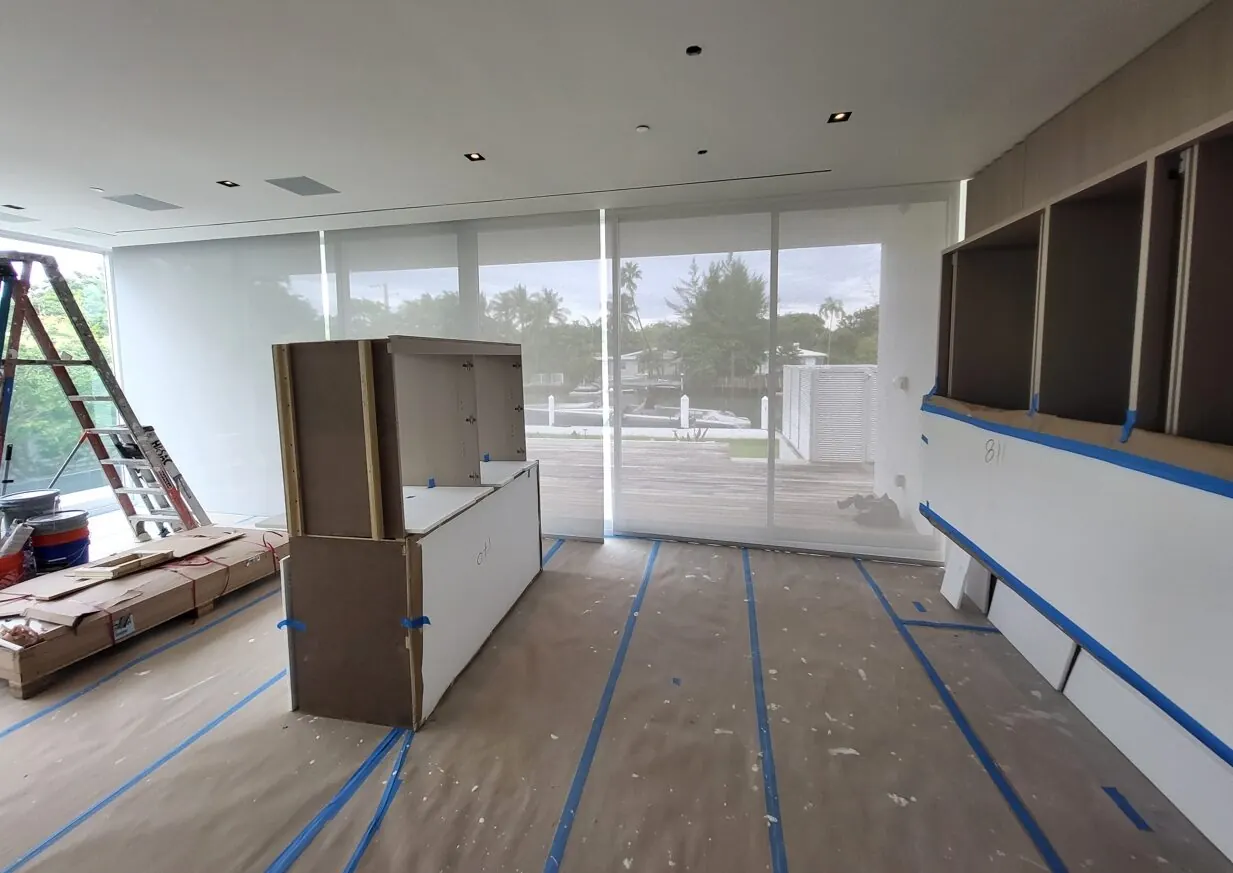
Sheer draperies are floor-to-ceiling panels of European voile or linen that filter hard sunlight into a soft, even glow and frame the view instead of hiding it. They are the drapery we are asked for most.
- Softness and scale on 10 to 12 ft glass
- Hand-drawn hardware or motorized tracks that glide thirty feet of fabric open in silence
- Deep hems and full fullness from our own workroom
- No darkness and little night privacy on their own
- They need a track or rod and room to stack
- Priced by width, so a wall of glass is a wall of fabric
Best for: Living rooms, walls of glass and condo sliders; layered over a solar roller or a blackout panel for day and night.
Price: $85 per linear foot of width on a manual track in a house (a 20 ft glass wall about $1,700); $95 per linear foot in a condo unit (about $1,900). More on sheer draperies.
Ripplefold draperies
Ripplefold, also written ripple fold and known in Europe as wave or S-fold drapery, has no pleats: snap-tape carriers hold the fabric in a continuous, uniform S-curve on a low-profile track. Fullness is set by the tape spacing: 80% for a shallow contemporary wave, 100% for the balanced standard, 120% for deep folds.
- Stacks tightly and reads architectural where a pinch pleat reads formal
- The natural partner for motorization
- Every panel cut and sewn to your track length
- Needs a track, not a decorative rod
- Stack width has to be planned so the panels park off the glass
- The wave shows both faces of the fabric
Best for: Modern rooms, walls of glass and anything on a motorized track.
Price: A 12 ft motorized drapery track with a rechargeable motor, remote and installation about $1,452 (track only); about $2,833 with a smart-hub motor, ceiling mount and lined drapery from our workroom. More on ripplefold draperies.
Pinch pleat draperies
A pinch pleat, the French pleat, gathers the fabric into two- or three-finger pleats hand-tacked at the base, so the panel breaks into deep, regular folds and holds them for decades. Two-finger reads lighter; three-finger is the full, formal classic.
- Buckram headers that stay crisp, hand-tacked fingers that do not splay, weighted hems
- Hangs on decorative rods as well as tracks
- Lining and interlining give the panel weight and quiet
- A wider stack than ripplefold
- More fabric and more sewing per foot
- Reads formal, which not every room wants
Best for: Formal rooms, bedrooms and any window dressed on a decorative rod.
Price: Quoted per panel: the fabric and the width decide it. Track figures as ripplefold. More on pinch pleat draperies.
Blackout draperies
A blackout drapery is a face fabric with a sewn-in three-pass blackout lining, plus the three details that keep light out: a return that carries the panel back to the wall, a generous center overlap and a top treatment or ceiling mount that seals the header.
- Essentially all light blocked at the fabric
- Interlining adds weight, insulation and a quieter room
- The face stays silk, linen or velvet, so the room reads luxurious by day
- Heavy panels need proper hardware and a solid mount
- Without the returns and the overlap, light finds the edges
- Room to stack when open
Best for: Bedrooms and media rooms that want hotel-grade darkness in a couture face fabric.
Price: Motorized blackout drapery on a 16 ft track in a recessed pocket, smart-hub control: about $3,691. More on blackout draperies.
Blinds: three kinds of slat and vane
Blinds are the mechanical answer: slats and vanes that tilt by degrees. Horizontal for windows, vertical and panel track for sliders, and Allusion sheer verticals for the door you walk through all day. Custom-cut to the opening, matched to the millwork, installed by our own team.
Horizontal blinds
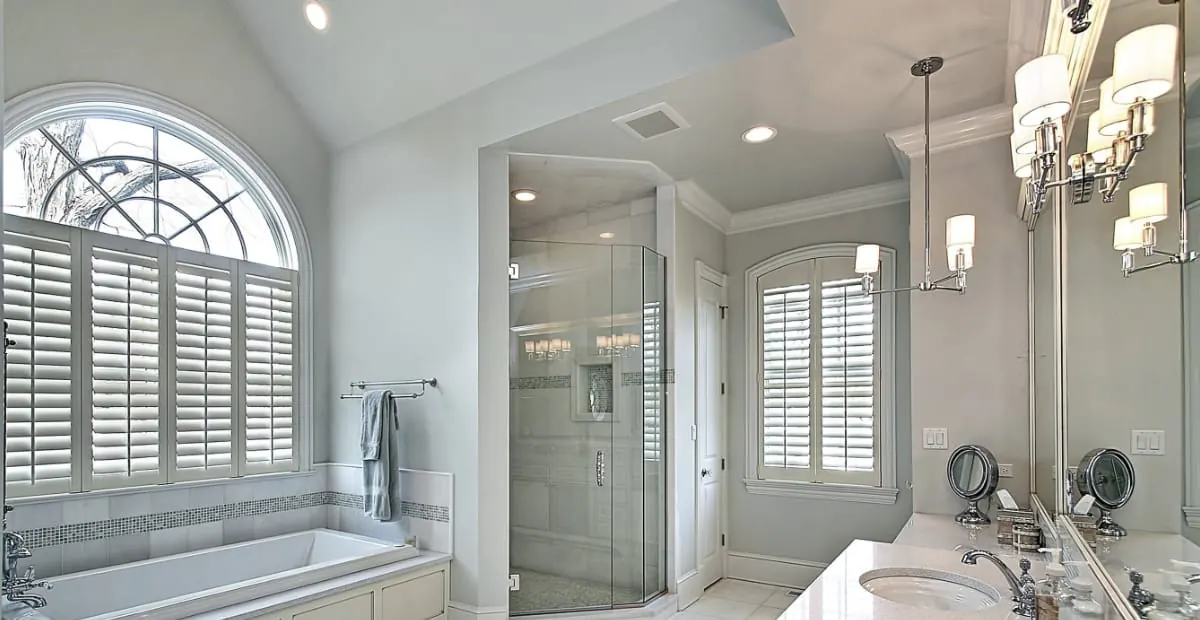
Horizontal blinds are slats, real hardwood, moisture-proof faux wood or slim aluminum, that tilt a few degrees to change the room. They remain the most precise mechanical light control at the window.
- Tilt the slats and the light changes by degrees
- Stains and paints matched to your millwork; valances conceal the headrail
- Cordless or motorized tilt keeps them clean and child-safe
- Slats always pass some light, so never a blackout
- Real wood does not belong in bath, kitchen or laundry humidity
- Hard lines where a room wants softness
Best for: Studies and living rooms in real wood; kitchens, baths and laundry rooms in faux wood; modern spaces in aluminum.
Price: Quoted per window after the free measure. More on horizontal blinds.
Vertical blinds and panel track
Vertical blinds hang vanes that rotate and draw aside; panel track systems glide wide fabric panels on a headrail. Today they come as soft fabric vanes and gliding panels, not the rattling PVC of the 90s.
- Stack fully off the door, parked exactly where you walk through
- Vanes rotate for privacy, panels glide open at a touch on a motorized track
- Nothing rattles, nothing yellows on a good fabric vane
- No darkness
- The look still carries a dated association for some rooms
- Stack direction and traffic pattern must be planned
Best for: Sliding doors and wall-wide glass.
Price: Quoted per opening after the free measure. More on vertical blinds and panel track.
Allusion sheer verticals
Allusion blinds hang overlapping sheer and fabric vanes that filter light like a drapery yet let you walk straight through: no wand to fight, no hard slats to clatter. Searching for illusion blinds? Same product.
- Walk straight through
- Vanes rotate for privacy and glide fully aside on open-door days
- Diffuse hard sun into an even glow
- Not a blackout
- Sheer fabric at a high-traffic door wants care
Best for: Sliding glass doors you use all day.
Price: Quoted per door after the free measure. More on allusion sheer verticals.
Shutters: the treatment that becomes the house
Plantation shutters are built, not sewn: panels fitted to the opening to the millimeter, louvers wide enough to sculpt the light, finishes chosen for Florida humidity and salt air. Arches, sliders, French doors and floor-to-ceiling glass included.
Plantation shutters
Plantation shutters are hinged panels with wide louvers, built to the opening to the millimeter and finished like millwork, in finishes chosen for Florida light, humidity and salt air.
- Reads as architecture, not as window covering
- Louvers sculpt the light and open to a clear view
- Built for humidity and salt air, and it stays with the house
- Louvers narrow the view even when open
- Panels need swing or bypass space
- Not a blackout: louvers pass light at the edges
Best for: Bedrooms, baths, arches, French doors and floor-to-ceiling glass; bypass panels on sliders.
Price: Quoted per panel after the free measure. More on plantation shutters.
Exterior screens: shade before the glass
Florida living happens outdoors until the afternoon sun makes the terrace unusable. Motorized exterior screens drop weather-rated mesh at the touch of a button and share the remotes and scenes of the interior shading.
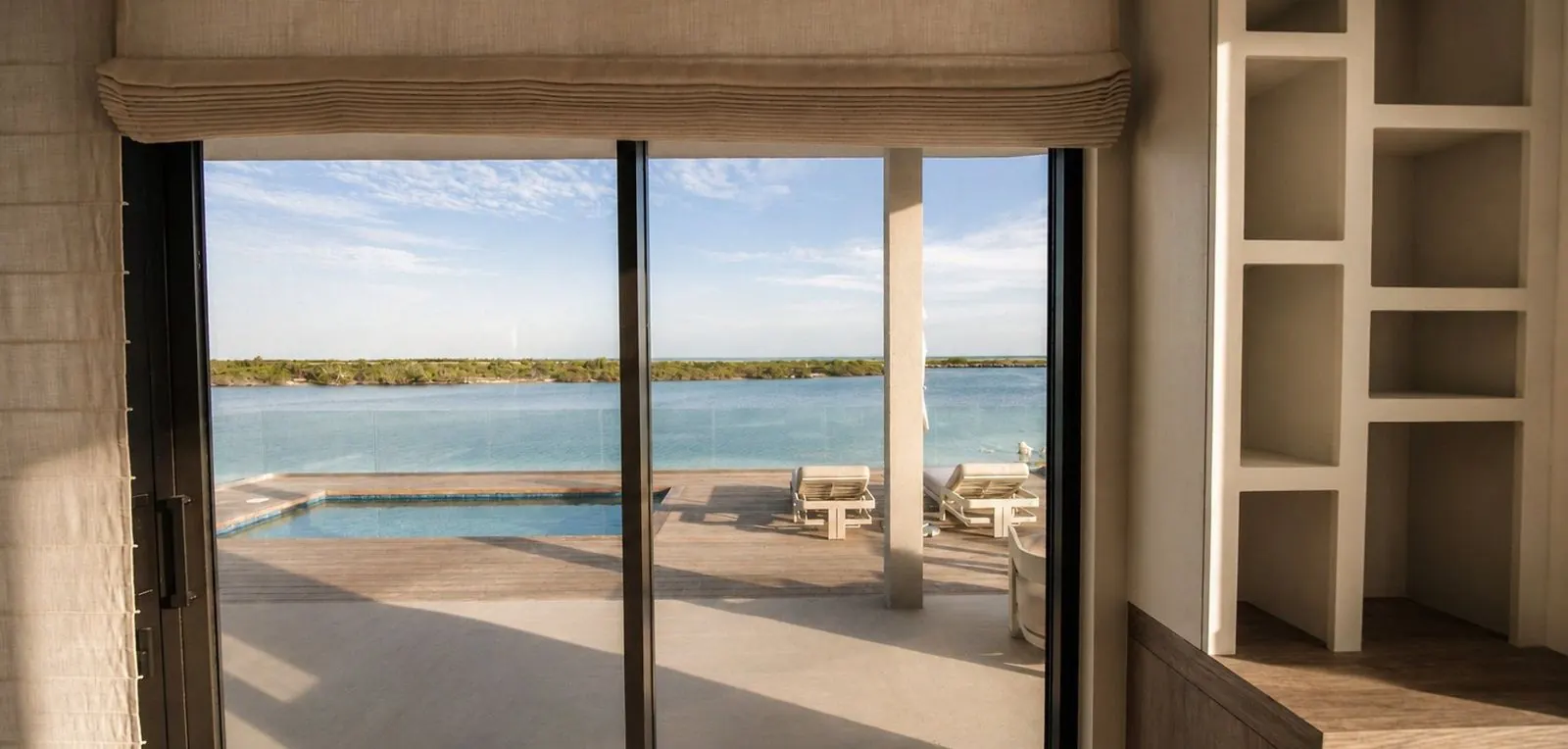
Outdoor shades
Outdoor shades are motorized exterior screens in Mermet and Phifer performance mesh, in zippered side channels with marine-grade hardware, on Somfy exterior motors that share the remotes and app scenes of the interior shades.
- Stop heat and glare before they reach the glass
- Keep the view and the breeze; zippered channels keep the insects out
- Same app, remotes and scenes as the interior shading
- Sun, glare and insect comfort products, not storm protection
- Exterior exposure means marine-grade hardware and power at the header
Best for: Patios, lanais, balconies and summer kitchens the afternoon sun makes unusable.
Price: Quoted per opening after the free measure. More on outdoor shades.
Motorization is a layer, not a type
Any shade on this page, and any drapery on a track, takes a motor. What changes the number and the wiring is the system: a rechargeable battery motor that goes into a finished condo without a wire, or a wired low-voltage system with a power panel for new construction and larger projects. The four we install, priced on the same 72 x 84 in roller shade:
Essential tier
Our value tier on Dooya rechargeable motors with their remote: no wiring, no power panel. One 72 x 84 in motorized roller shade about $733.
Somfy WireFree
Sonesse ULTRA 30 WireFree: rechargeable lithium-ion, 2 Nm of lift, rated 42 dB, RTS radio with 656 ft open-field range. The quiet, proven rechargeable motor most projects plan around: about $793 for the same shade.
Wired Somfy
Sonesse 50 motors on a 24 V low-voltage power panel that serves up to five motors, so the per-shade cost falls as the count rises; SDN adds a bus for Crestron, Control4 and large projects. About $1,910 for the same shade, panel included.
Lutron
Sivoia QS wired shades cover 20 in to 20 ft with coupling brackets, side channels and pockets; Triathlon runs on replaceable D batteries rated by Lutron at three to five years; Palladiom and Sivoia QS are the lines architects and integrators specify. About $3,141 for the same shade.
Six questions decide it
This is the order we ask them in at a consultation. Answer them for one window and the type usually picks itself. Once the type is chosen, the measuring guide gives the numbers: inside or outside mount, depth by motor system, rod height, fullness and length.
01Which way does the glass face?
West and east sun: a solar screen at 3% or tighter, 1% on the harshest west walls. North or shaded glass: 5% or 10% for a clearer view. Dark weaves see out; light weaves bounce heat. See the openness guide.
02Does the room need to be dark?
Bedrooms, nurseries and media rooms: a blackout roller with side channels, a double-cell blackout honeycomb, or blackout draperies with returns and an overlap. The view by day as well: a dual roller. See blackout vs solar.
03Is it a sliding door?
Plan around the panel that moves and the handle: a motorized roller that clears the handle, Allusion sheer verticals for a door used all day, ripplefold sheers on a track, bypass shutters. See the sliding door guide.
04Condo or house?
A finished condo takes rechargeable motors: no wiring, no opened walls, no construction approval in most buildings. New construction takes wired low-voltage with a power panel and pockets designed in. Sheers price at $95 per linear foot in a condo against $85 in a house. See battery vs wired.
05Is the AC fighting the glass?
Honeycomb cells (R 3.5 to R 4.4) in bedrooms and skylights; light-coloured screens that reflect (E Screen white 3% reflects 73% of solar energy); exterior screens on the terrace before the glass. See roller vs honeycomb.
06What is the budget per opening?
Start from the published figures: a 72 x 84 in motorized roller from about $733 to $3,141 by motor system, sheers from $85 per linear foot. Then the instant price tool, then a free in-home measure and a written quote.
What goes where in a South Florida home
| Room | First choice | Also works | The common mistake |
|---|---|---|---|
| Living room with a water view | Solar roller, 3% charcoal, motorized | Sheer draperies layered over it; sheer shades | Anything that closes the view all day |
| Bedroom | Blackout roller with side channels, or a double-cell blackout honeycomb | Dual roller for a view by day; blackout draperies | A solar screen alone: no privacy at night |
| Kitchen | Faux-wood blinds or a light-filtering roller | Roman shade in a washable weave | Real wood or unlined fabric next to the sink and the stove |
| Bathroom | Faux-wood blinds or plantation shutters | Honeycomb, privacy-lined roller | Real wood, silk, unlined weaves |
| Home office | Solar roller at 3% or 5% | Sheer shades; light-filtering roller | Glossy blackout fabrics that make a screen the only light |
| Media room | Blackout roller with side channels | Blackout draperies with returns and overlap | Blinds and louvers: light gets through the slats |
| Sliding glass door | Motorized roller that clears the handle | Allusion sheer verticals; ripplefold sheers on a track; bypass shutters | Blinds that block the panel you slide |
| Skylight | Honeycomb in tensioned side tracks, motorized | Roller in side tracks | Anything manual |
| Terrace, lanai, balcony | Motorized outdoor screen in zippered channels | Retractable systems by project | Interior hardware outdoors |
One motorized roller shade, fabric and motor included
From the same engine that produces our quotes, budgetary and before tax. The wired Somfy and Lutron figures include the power panel that serves up to five motors, so their per-shade cost falls as the count rises. The full table by size, whole-floor examples and the drapery figures are on the pricing page.
| Window, width x height | Essential (Dooya motor) | Somfy WireFree | Somfy wired (Sonesse 50, power panel) | On Lutron |
|---|---|---|---|---|
| 36 x 60 in, a bathroom or kitchen window | about $501 | about $561 | about $1,678 | about $2,759 |
| 72 x 84 in, the reference window | about $733 | about $793 | about $1,910 | about $3,141 |
| 96 x 108 in, a floor-to-ceiling condo bay | about $918 | about $978 | about $2,095 | about $3,445 |
| 144 x 120 in, the widest single shade | about $1,294 | about $1,354 | about $2,471 | about $4,064 |
Draperies and sheers
Custom sheers $85 per linear foot of width on a manual track in a house (a 20 ft glass wall about $1,700) and $95 per linear foot in a condo unit (about $1,900). A 12 ft motorized drapery track with a rechargeable motor, remote and installation about $1,452; the same track with a smart-hub motor, ceiling mount and lined drapery from our workroom about $2,833. Motorized blackout drapery on a 16 ft track in a recessed pocket about $3,691.
Everything else is quoted per window
Zebra, sheer, honeycomb, Roman, woven wood and skylight shades, blinds, Allusion verticals, shutters and outdoor screens are priced from real measurements, because their hardware prices by width and drop brackets and their fabric by the line. The instant price tool gives a range from a rough count; the free in-home measure gives the written number, and the quote you sign is the number you pay.
Frequently asked
What are the main types of window treatments?
Five families: shades (roller, dual roller, zebra, sheer, honeycomb, Roman, woven wood and skylight shades), draperies (sheer, ripplefold, pinch pleat and blackout), blinds (horizontal, vertical and panel track, and Allusion sheer verticals), plantation shutters, and exterior screens. That is the 17 types in this guide, all made, motorized and installed by Exotic Shades & Draperies from its Fort Lauderdale workroom.
What is the difference between blinds and shades?
Blinds are slats or vanes that tilt to meter light and lift or draw aside; shades are a single piece of material that rolls, folds or stacks. Blinds give the most precise light control and always pass some light at the slats; shades take their character from the fabric, which is why a solar screen keeps the view and a blackout fabric with side channels darkens a bedroom.
What is the difference between curtains and draperies?
Curtains are the casual, unlined panels bought to a standard length; draperies are lined, often interlined, pleated or ripplefold, and cut and sewn to the window. Our draperies are made in our own workroom by five in-house seamstresses, on decorative rods or motorized tracks.
Which window treatment is best for South Florida sun and heat?
For a room with a view, a solar screen roller shade: a charcoal Mermet E Screen at 3% passes 5% of solar energy and keeps the view, and 1% blocks more on a west wall. For insulation, honeycomb shades are the only soft treatment with a published R-value (R 3.5 to R 4.4). Light-coloured screens reflect heat (E Screen white 3% reflects 73% of solar energy), and outdoor shades stop it before the glass on a terrace.
Which window treatment is best for a bedroom?
A blackout roller shade with side channels, a double-cell blackout honeycomb (rated R 4.4 and among the darkest treatments we install), or blackout draperies with a return to the wall and a center overlap. When the bedroom has a view you want by day, a dual roller shade puts a solar screen in front of a blackout in one window.
What works best on a sliding glass door?
Plan around the panel that moves and the handle: a motorized roller or solar shade that clears the handle, Allusion sheer verticals for a door you walk through all day, ripplefold sheers on a motorized track, or bypass plantation shutters. Blinds that block the panel you slide are the common mistake.
Are wood blinds a good idea in Florida humidity?
Real hardwood blinds belong in dry living spaces, studies and bedrooms. In kitchens, bathrooms and laundry rooms, moisture-proof faux wood does the same job without warping, and plantation shutters come in finishes chosen for humidity and salt air.
How much do custom window treatments cost in South Florida?
From our own quote engine, budgetary and before tax: one 72 by 84 inch motorized roller shade, fabric and motor included, runs about $733 on the Essential tier, $793 on Somfy WireFree, $1,910 on wired Somfy and $3,141 on Lutron; by size, one shade from about $501 (36 by 60 inches, Essential) to $4,064 (144 by 120 inches, Lutron). Custom sheers are $85 per linear foot of width on a manual track in a house and $95 in a condo; a 12 ft motorized drapery track is about $1,452 track only or $2,833 with a smart-hub motor and lined drapery; a motorized blackout drapery on a 16 ft track in a recessed pocket is about $3,691. Every other type is quoted per window after the free in-home measure.
Can every type of window treatment be motorized?
Every shade type, on Lutron, Somfy or our Essential tier; draperies on motorized tracks; vertical blinds and panel tracks on a motorized track; horizontal blinds with motorized tilt; skylight shades always; outdoor shades on Somfy exterior motors. Plantation shutters are operated by hand. Rechargeable-battery motors need no wiring; wired low-voltage systems with a power panel suit larger projects and new construction.
Which window treatments work in a condo where I cannot run wires?
Rechargeable-battery motors: Somfy WireFree or our Essential tier on roller, dual, zebra, sheer and honeycomb shades, and rechargeable motors on drapery tracks. No wiring, no opened walls and no construction approval in most buildings. Dual roller shades with battery motors in both tubes are what we put on oceanfront condo bedrooms every week.
Do impact windows change which window treatment to choose?
Impact glass handles the storm, so interior treatments are chosen for light, heat, privacy and the view, not for protection. Outdoor shades are comfort products that come up before a storm, not storm protection.
How many types of window treatments are there?
This guide covers 17: eight shades, four draperies, three blinds, plantation shutters and outdoor shades. Within each, the fabric, the lining, the mount and the motor decide how it performs, which is what the comparison table on this page lays out.
Sources: Lutron fabric specifications (lutronfabrics.com, retrieved September 2026) for the E Screen transmittance and reflectance figures, usable widths and cell-fabric R-values; Somfy Systems, Sonesse ULTRA 30 WireFree RTS Li-ion; our published pricing (quote-engine figures, budgetary, before tax, September 2026). Written by David Martineau, owner of Exotic Shades & Draperies, Lutron certified dealer, Somfy Expert, Crestron and SDN certified. Updated September 13, 2026.
Not sure which type your window wants?
One free hour with our team routinely saves owners thousands in avoidable mistakes - wrong fabrics, bad mounts, missed motorization. Book a private, complimentary consultation - we bring the fabrics, the swatches, and honest answers. Start with the free guide: the 5 costly mistakes.