

The Best Window Covering Solution for a South Florida Home
Our straight answer, from the workroom that sews it and the team that installs it: not one product but one system - the right fabric on the glass, a second layer where the room needs it, one motor running all of it. With published prices, and the cases where something else wins.
There is a best solution. It is not a product.
Ask ten companies for the best window covering and you get ten products: the one each of them sells. After more than twenty years of making and installing window treatments, our answer is a combination. The sun, the heat, the view and the night each ask a South Florida window for something different, and no single blind, shade or curtain does all four well.
What does is a layered, motorized window. The glass gets a solar screen roller shade that cuts glare and heat and keeps the view. The rooms where you sleep get a blackout layer. The rooms where you live get a sheer or a lined drapery for softness and scale. And one motor system runs all of it on a schedule, so the house closes the west glass at three o'clock whether you are home or not.
What is the best window covering solution for a South Florida home? For most South Florida homes the best window covering solution is a layered, motorized window rather than any single product: a solar screen roller shade on the glass (3% openness in a dark weave on a water view, 1% on the harshest west glass) for glare and heat without losing the view; a blackout layer in the rooms where you sleep (a dual roller shade, or a blackout roller in side channels); and ripplefold sheers or lined draperies on a ceiling track in the rooms where you live, for softness and scale on 10 ft glass. All of it runs on one motor system - rechargeable motors in a finished condo, wired low-voltage in new construction - so the house closes the west glass on a schedule whether you are home or not. Installed, budgetary and before tax: a 72 x 84 in motorized roller shade from about $733 on our Essential motor to $3,141 on a wired Lutron system, custom sheers from $85 per linear foot of width in a house and $95 in a condo. The exceptions are further down.
Why this combination wins in South Florida
Six things a window here has to deal with that a window in Montreal or Denver does not. Each one rules out a single-product answer.
The glass is bigger than the wall
Floor-to-ceiling sliders, corner glass and 10 to 12 ft walls of window leave no wall to mount on and no frame to tuck into. A roller shade is the one treatment that scales with the glass: up to 144 in wide on a single tube (wider openings are split and coupled), rolled into a 4 or 5 in fascia or a ceiling pocket, with room for a drapery to run in front of it. Blinds and shutters reach their width limits long before the glass ends.
Glare off the water is not the same as sun
On a water view the light bounces up from below, so a cheap light-filtering fabric glows and the room still squints. A dark solar screen - charcoal or black, 3% open - absorbs the glare, keeps the view readable and reads from the street as tinted glass. Lighter screens bounce more heat and show less view. Which one, and at what openness, is in the openness guide.
The AC is fighting the glass
A screen stops a large share of the solar energy before it turns into heat inside: Mermet's E Screen in white at 3% openness reflects 73% of it. Honeycomb cells add real insulation, R 3.5 to R 4.4 in Lutron's published figures, which is why they still win in some rooms (below). A lined drapery over the screen adds a second barrier at night. The numbers are in the Florida cooling bill guide.
A screen is see-through at night
The weave that keeps your view by day does the same for the street after dark, once the lights come on inside. The second layer solves it: a blackout on the second tube of a dual roller shade, in side channels where the room has to be dark, and privacy-lined drapery in the living areas. See blackout vs solar shades.
Salt air and humidity
Woven fiberglass and polyester screen fabrics, coated blackouts, powder-coated aluminum tubes and fascias, composite shutters: the materials that shrug off a coastal room. Unlined natural fabrics fade on west glass, and we specify real wood where the room is dry and the look asks for it, composite where the salt or the steam would decide otherwise.
The building has rules
Many associations ask for a uniform look from the street - a white or off-white backing on every window - and most finished condos will not let you open walls. A screen or blackout with a white back on rechargeable motors meets both. In new construction the same system is wired low-voltage, with the pockets and the power panel designed in before the drywall - see pre-wiring motorized shades.
The solution, layer by layer
Not every window gets every layer. The glass always gets the first one; the room decides the second and the third; the house decides the system.
LAYER 01
On the glass: the solar screen roller shade
Mermet E Screen and T Screen, Phifer SheerWeave - woven in the USA - at 1%, 3%, 5% or 10% openness: dark on a water view, lighter on shaded or north glass, 1% on the harshest west wall. One shade per glass bay on a wall of glass, so the wall is tuned bay by bay as the sun moves. It is the layer that works all day, every day, and the one most homes get wrong by buying it on price.
LAYER 02
Where you sleep: the blackout
A dual roller shade - solar screen and blackout on one 5 x 5 in fascia - when you want the view by day and dark at night. A blackout roller in side channels when the room must be dark for a night-shift sleeper, a nursery or a media room. Blackout draperies with returns to the wall and a center overlap when you want fabric. No blackout fabric is blackout at its edges without channels or a drapery over it.
See dual roller shades · blackout shades · blackout draperies
LAYER 03
Where you live: the drapery
Ripplefold sheers on a ceiling track over the solar screen in the living and dining areas: softness and scale on 10 ft glass, with the heat handled by the screen behind. Every ripplefold panel from our workroom is built on 6 in snap tape, so the wave holds its depth to the hem instead of going loose in the bottom third. A lined drapery where the room wants weight, or a second barrier at night.
LAYER 04
Running it: one motor system
Everything that moves is motorized and on one platform - Somfy, Lutron or Crestron, or our Essential tier where the budget decides - rechargeable in a finished condo, wired low-voltage with a power panel in new construction. Scenes and schedules close the west glass at three and open the bedroom at seven. The schedule is the energy feature; the motor is just how it happens.
See motorized shades · the four systems compared · Lutron · Somfy
The best solution, window by window
The same layers, applied to the openings South Florida homes actually have. The room-by-room version is in the buying guide.
| The window | What we install | Why | Also considered |
|---|---|---|---|
| Sliding glass door | Motorized solar roller mounted to clear the handle and the moving panel; ripplefold sheers on a track in front | Nothing should block the door you use all day; the handle and the panel that moves decide the mount | Allusion sheer verticals, bypass shutters; the slider guide |
| Floor-to-ceiling wall of glass | One solar roller per glass bay, on its own motor or coupled; one ripplefold sheer across the whole wall | The wall is tuned bay by bay as the sun moves; the sheer hides the hembar line and softens 12 ft of glass | Zebra shades on a secondary wall; covering large windows |
| Corner glass | Two rollers meeting at the corner with the smallest light gap the fascias allow; a track that turns the corner for the sheer | A light leak at a corner shows at night; it is a measuring job before it is a product | A recessed pocket where the ceiling allows |
| Bedroom window | Dual roller (screen and blackout) or a blackout roller in side channels; blackout drapery with returns | Dark at night, the view by day, privacy once the lights come on | Double-cell blackout honeycomb on a small hot east window; bedroom guide |
| Home office and media room | 3% or 5% screen in the office; a blackout roller in side channels in the media room | A screen takes the glare off a monitor without turning the room into a cave; a media room needs its edges sealed | Blackout draperies with an overlap; media room guide |
| Kitchen and bathroom | Composite shutters or faux-wood blinds; a washable light-filtering roller | Steam, grease and splashes: wipeable surfaces, nothing unlined next to the stove | Plantation shutters, faux-wood blinds, a privacy-lined roller |
| Two-story and high-ceiling glass | Ripplefold sheer and lined drapery on two ceiling tracks, motorized; coupled rollers on the glass above | At 18 ft nothing should be manual, and the seams and the weight are planned before a panel is cut | Two-story curtains, with prices |
| Skylight | Honeycomb in tensioned side tracks, motorized | The one place a roller cannot hang, and the hottest glass in the house | Skylight shades |
| Terrace, lanai, balcony | Motorized exterior screen in zippered side channels | Stops the heat before the glass; the only treatment that works outdoors | Outdoor shades |
| Arched and shaped windows | A screen or blackout shade cut to the shape, or a track at the ceiling that treats the arch as part of the glass | Shaped tops are a template job: measured in place, cut once | Classic drapery on medallions - see classic treatments |
When the best solution is something else
The combination above is what we install most, not what we install always. These are the cases where we recommend something else, and would say so at the consultation.
Plantation shutters, for a house that will be sold
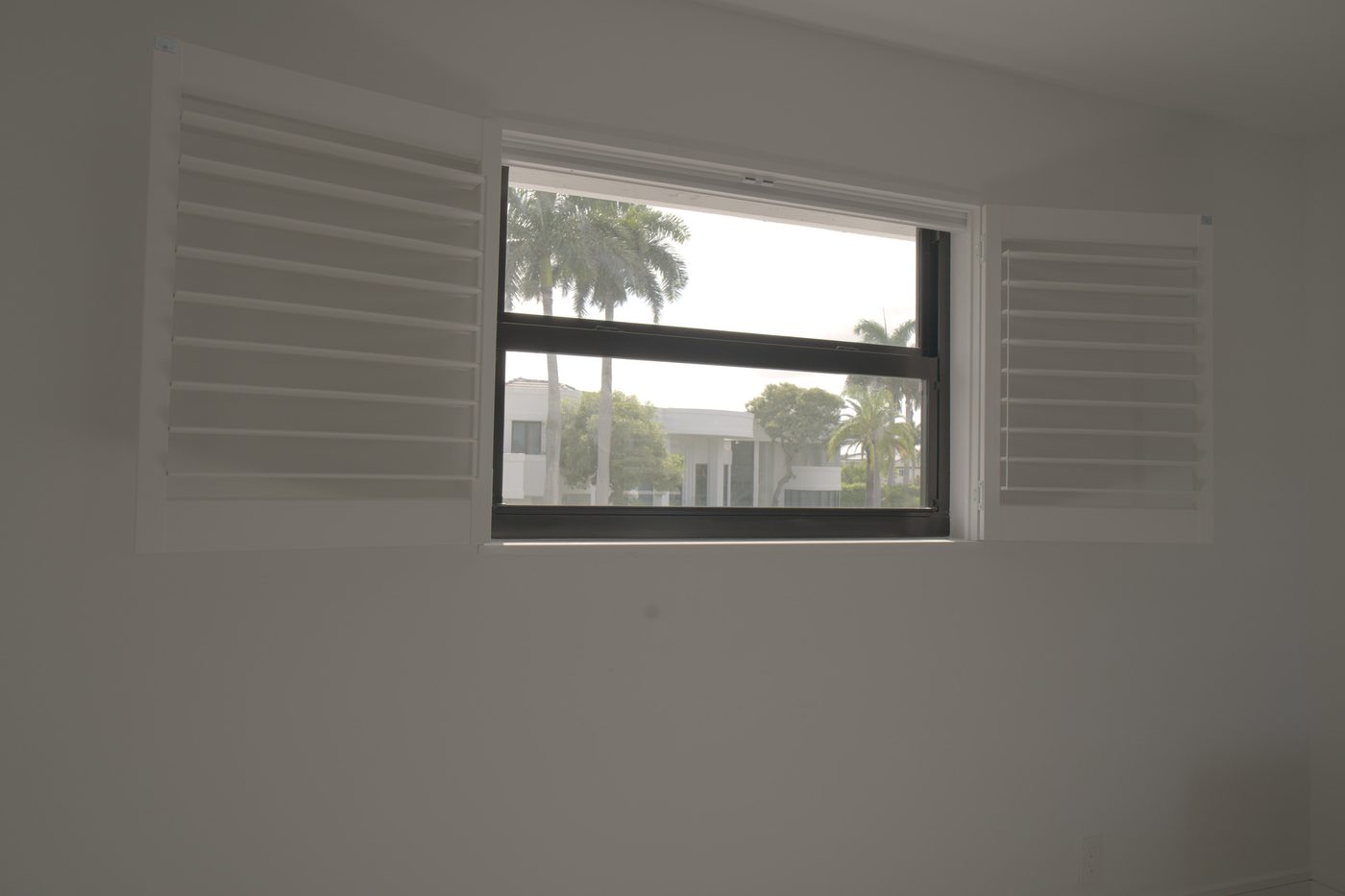
Shutters are the one treatment that reads as part of the house and stays with it. On a traditional or coastal home, in kitchens and bathrooms, and wherever the owner wants wood rather than fabric, we build shutters to the opening - composite in humid and oceanfront rooms - and put a blackout honeycomb behind them where the mornings have to be dark. See plantation shutters and the golf course home in Boca Raton.
Honeycomb shades, when insulation is the problem
On a small hot window, an east bedroom, a skylight or a room the AC never catches up with, a double-cell blackout honeycomb (R 4.4) does more for the bill than any screen. Less view-through than a screen, which is why it is the exception and not the rule. See honeycomb shades and roller vs honeycomb.
Blinds, in the wet rooms and on a budget
Faux-wood blinds tilt to meter the light precisely, wipe clean and cost the least of any treatment we make to measure. Kitchens, bathrooms, laundry rooms and garages: yes. Sliders and bedrooms: no, because slats always pass some light and always block the panel you slide. See horizontal blinds.
Drapery alone, in the right bedroom
A lined blackout drapery with returns to the wall and a center overlap, on a motorized track, can be the whole answer in a bedroom with one wall of glass and no view to keep by day. No shade, one layer, done. See blackout draperies.
Roman and woven wood shades, for the textile look on a smaller window
A study, a dining room, a powder room: a window that wants fabric or a natural weave rather than a screen. A Roman shade motorized on a Lutron or Somfy kit gives the look of drapery in the space of a shade. See Roman shades and woven wood shades.
Zebra shades, for a view you dim rather than lose
Alternating sheer and solid bands give quick, lower-cost light control on secondary rooms and rentals. Not a blackout, and not our first choice on a water view. See zebra shades.
What we would not install
- A single solar screen in a bedroom: see-through at night once the lights are on.
- Blinds on a sliding glass door: they block the panel you use.
- An unlined natural fabric on west glass: it fades and weakens, and sooner than the quote suggested.
- A blackout fabric without side channels sold as a blackout: the room is gray at the edges.
- A different remote in every room: the shades that are a chore to move stop being moved.
- A stock roller cut to a standard width on custom glass: the light gap is the first thing you see every morning.
What the solution costs
From the same engine that produces our quotes, budgetary and before tax. Fabric, motor, measurement and installation included; the wired Somfy and Lutron figures include the power panel that serves up to five motors, so their per-shade cost falls as the count rises. The full tables are on the pricing guide.
Layer one and two: one motorized roller shade, by motor system
Solar screen or blackout; a dual roller shade carries two of these on one fascia and is quoted per window.
| Window, width x height | Essential (Dooya motor) | Somfy WireFree | Somfy wired (Sonesse 50, power panel) | Lutron wired (power panel) |
|---|---|---|---|---|
| 36 x 60 in, a bathroom or kitchen window | about $501 | about $561 | about $1,678 | about $2,759 |
| 72 x 84 in, the reference window | about $733 | about $793 | about $1,910 | about $3,141 |
| 96 x 108 in, a floor-to-ceiling condo bay | about $918 | about $978 | about $2,095 | about $3,445 |
| 144 x 120 in, the widest single shade | about $1,294 | about $1,354 | about $2,471 | about $4,064 |
Layer three: sheers and drapery
Sewn in our Fort Lauderdale workroom; per linear foot of track width, installed.
| Item | What it includes | Installed |
|---|---|---|
| Custom sheers, house | Per linear foot of width on a manual track (a 20 ft glass wall about $1,700) | $85 per ft |
| Custom sheers, condo | Per linear foot of width on a manual track (a 20 ft glass wall about $1,900) | $95 per ft |
| 12 ft motorized track | Rechargeable motor, remote and installation | about $1,452 |
| 12 ft motorized track, lined drapery | Smart-hub motor, ceiling mount and lined drapery from our workroom | about $2,833 |
| 16 ft motorized blackout drapery | In a recessed ceiling pocket | about $3,691 |
The solution in real South Florida homes
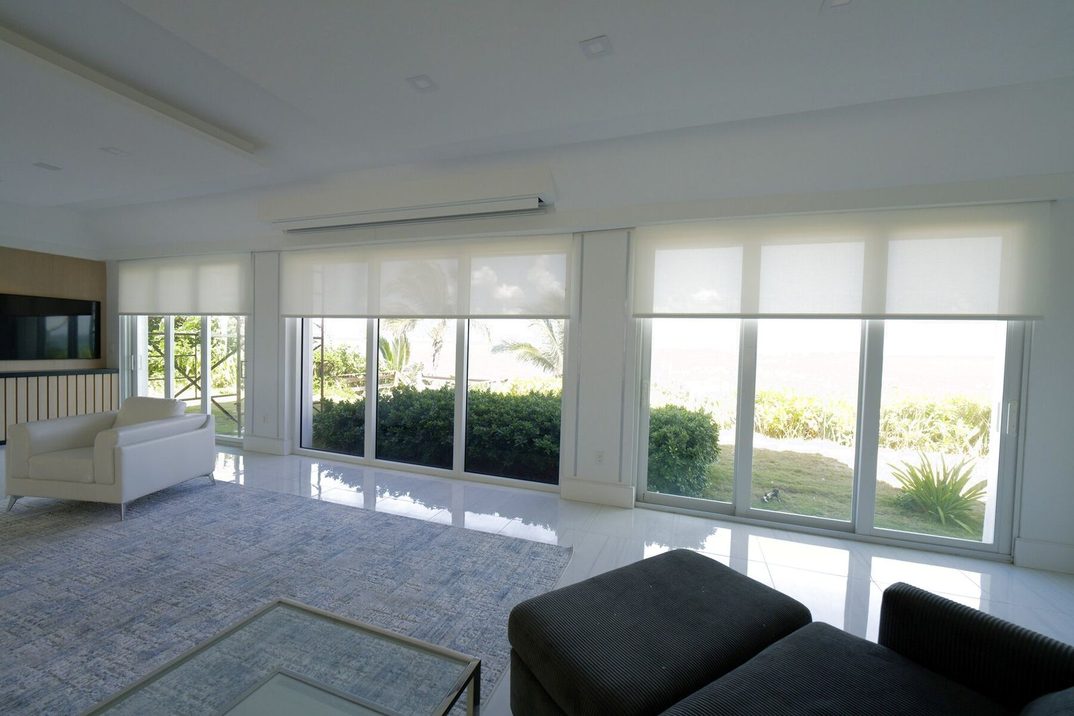
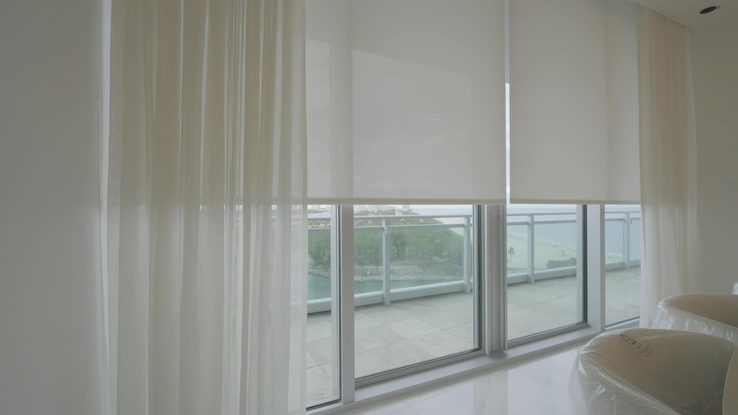
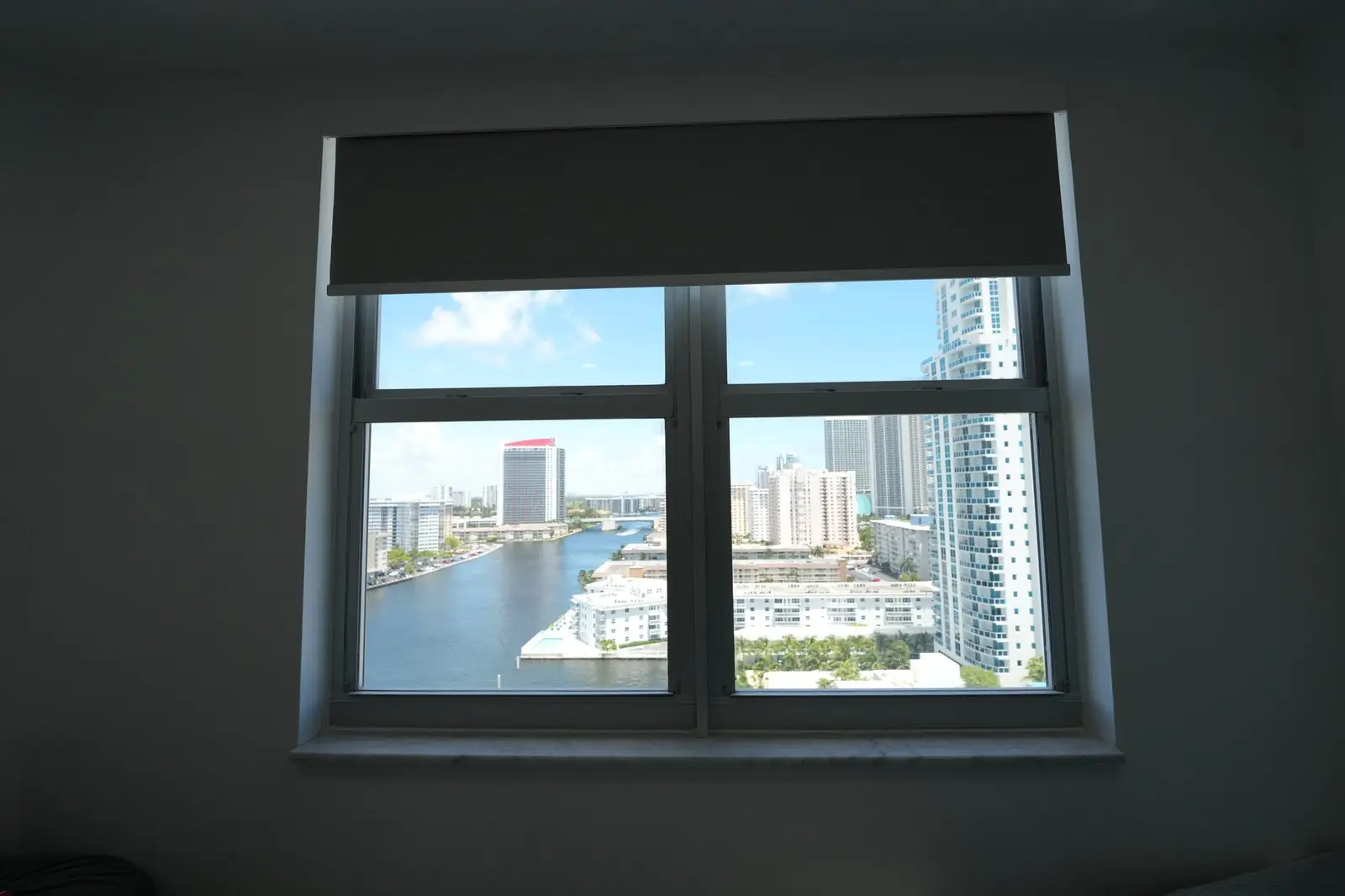
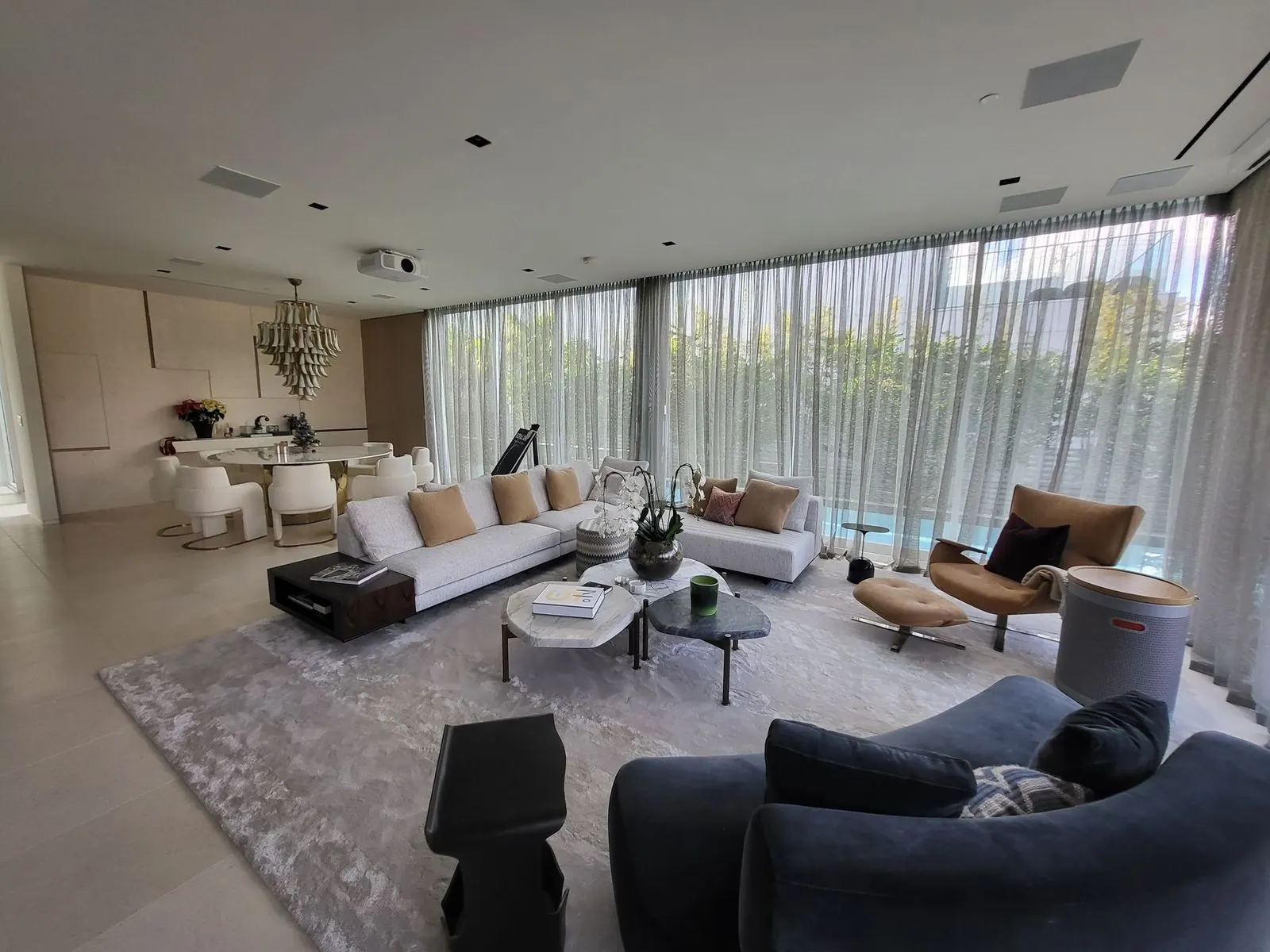
Each layer, photographed on a job of ours, with the fabric and the motor named. More in the project gallery.

How we get it right on your glass
One free hour
A consultation in your home. One free hour with our team routinely saves owners thousands in avoidable mistakes.
Six questions
Which way the glass faces, whether the room must be dark, whether it is a door, condo or house, whether the AC is losing, and the budget per opening. The layers pick themselves from the answers.
Fabric by the numbers
Openness, reflectance and color from the mills' published figures and our fabric libraries, then confirmed against your own glass at the measure.
Written quote
Every window listed, the layers and the motor system side by side, published prices, options priced separately.
Made by us
Draperies sewn by our five in-house seamstresses in Fort Lauderdale; shades fabricated to the measure, typically 3 to 4 weeks after it.
Installed and programmed
By the same team that measured, with limits, scenes and schedules set before we leave. We service the systems we install.
The best window covering, frequently asked
What is the best window covering solution for a South Florida home?
A layered, motorized window rather than one product: a solar screen roller shade on the glass, a blackout layer where you sleep (a dual roller shade or a blackout roller in side channels), ripplefold sheers or lined drapery on a ceiling track where you live, all on one motor system - rechargeable motors in a finished condo, wired low-voltage in new construction. From about $733 per 72 x 84 in motorized shade on our Essential motor to $3,141 on a wired Lutron system, installed and before tax. The exceptions - shutters, honeycomb, blinds, drapery alone - are on this page.
What is the best window covering for Florida heat?
A solar screen on the glass first: a light, reflective weave where the view matters less (Mermet's E Screen in white at 3% reflects 73% of the solar energy that reaches it), a dark weave where the view matters more. Honeycomb shades where insulation is the problem - a small hot window, an east bedroom, a skylight - because cells carry a published R-value of 3.5 to 4.4. A motorized exterior screen on the terrace stops the heat before the glass. And a schedule that closes the west glass before the afternoon builds, which does more for the bill than the fabric. The figures are in our Florida cooling bill guide.
What are the best window treatments for sliding glass doors?
A motorized roller shade mounted to clear the handle and the panel that moves, with ripplefold sheers on a ceiling track in front where the room wants softness. For a door you walk through all day, Allusion sheer verticals or bypass shutters. Never blinds that block the panel you slide. See sliding glass door window treatments.
What is the best window covering for large or floor-to-ceiling windows?
One roller shade per glass bay, each on its own motor or coupled on one, so the wall can be tuned bay by bay as the sun moves - a single roller runs to 144 in wide, and wider openings are split. A ripplefold sheer across the whole wall in front hides the hembar line and gives 12 ft of glass its softness. Seven worked examples in covering large windows.
What is the best window treatment for a bedroom in Florida?
A dual roller shade - solar screen and blackout on one fascia - when you want the view by day and dark at night; a blackout roller in side channels when the room has to be dark for a night-shift sleeper or a nursery; blackout draperies with returns and a center overlap when you want fabric. On a small hot east window, a double-cell blackout honeycomb. Never a solar screen alone: it is see-through at night once the lights are on.
What is the best window covering for a condo?
The same layers on rechargeable motors: no wiring, no opened walls and, in most buildings, no construction approval. A white or off-white backing keeps the uniform look from the street that many associations ask for. Dual rollers in the bedrooms, a screen and a sheer in the living areas; custom sheers price at $95 per linear foot in a condo against $85 in a house. See window treatments for condos.
Which window coverings hold up to humidity and salt air?
Woven fiberglass and polyester screen fabrics, coated blackout fabrics, powder-coated aluminum tubes and fascias, composite shutters and faux-wood blinds. Unlined natural fabrics fade on west glass, and real wood belongs in the dry rooms, not in a bathroom or on an oceanfront wall.
Are motorized shades worth it?
On any window you would move every day or cannot reach, yes: the shade that is easy to move gets moved, and the schedule is what saves the cooling cost, not the motor itself. The motor system sets the price: a 72 x 84 in roller runs from about $733 on our Essential motor and $793 on Somfy WireFree to $3,141 on a wired Lutron system. The four systems are compared in Lutron vs Somfy vs Vertilux vs Dooya.
Blinds, shades or drapes: which is best?
Shades for the glass, drapes for the room, blinds for the wet rooms. A shade is one piece of fabric that controls light by what it is woven from; it is the only treatment that scales to a wall of glass. Drapery adds the softness and scale no hard treatment has and layers over the shade. Blinds tilt to meter light precisely and wipe clean, and their slats always pass some light. The three families, compared in blinds vs shades vs drapes.
Do I need both a solar screen and a blackout?
In a bedroom, usually yes - that is what a dual roller shade is for. In the living areas, a screen on the glass and a sheer in front handle the day, and a privacy-lined drapery or a dim-out roller handles the night where the glass faces a neighbor or the street. Blackout vs solar goes room by room.
What do interior designers specify for South Florida glass?
The same layers: a solar screen on the glass, a sheer on a ceiling track in front, blackout in the bedrooms, every motor on the house system. The fabric schedule is where the design lives - the residences we installed at the Ritz-Carlton Residences, Miami Beach and The St. Regis Longboat Key were sewn to the designers' own schedules.
What is the least expensive solution that still works?
Among the treatments we make to measure, a motorized roller shade on our Essential motor - about $501 for a 36 x 60 in window and $733 for 72 x 84 in, fabric and motor included - and faux-wood blinds, quoted per window, in the kitchen and bathrooms. What we would not do to save money: a stock roller cut to a standard width on custom glass, or a screen alone in a bedroom.
How long does a whole-home project take?
Turnaround after the free in-home measure is typically 3 to 4 weeks, varying with fabric availability; special-order designer fabrics and wired systems in new construction set their own dates. The same in-house team measures, installs and programs every project.
Where do you install?
Across Miami-Dade, Broward and Palm Beach County - Miami Beach, Brickell, Aventura, Sunny Isles, Hollywood, Fort Lauderdale, Pompano Beach, Boca Raton, Delray Beach and West Palm Beach - from our Fort Lauderdale workroom and our Miami Beach showroom.
Discerning homeowners, designers, and developers across South Florida trust Exotic with their most important spaces.
“Very happy with my new pinch pleat drapes! Exotic Shades & Draperies came to my condo in Fort Lauderdale with many fabric options and a variety of material. I wasn’t sure what to choose, but they gave me great guidance on the fabric and style. The result is perfect more privacy while still keeping plenty of natural light. Highly recommended !”
“Exotic Shades and Draperies made is to easy for me to change up my bedroom design for a new aesthetic i’ve been really wanting. They helped me choose a new look for my curtains and installed them very quickly. Thank you david for helping me throughout the process. i highly recommend if u want high quality drapes or shades”
“The experience with Exotic Shades Draperies was excellent. The shades are high quality and custom fit. They are really careful with details. We bought sheer curtains and they offered us a better price than all the other companies we contacted, and their work was flawless. It was a pleasure working with Dave and Alex.”
Exotic Shades & Draperies, Fort Lauderdale and Miami Beach
Exotic Shades & Draperies is a South Florida window-treatment company that designs, sews and installs its own work: Lutron and Somfy motorized shades, custom draperies sewn in our Fort Lauderdale workroom by five in-house seamstresses, plantation shutters and blinds. Established in South Florida in 2024, backed by more than 20 years of window-treatment manufacturing and installation experience. Lutron certified dealer, Somfy Expert, Crestron and Control4 integration. The same in-house team measures, installs and programs every project; when shading has to integrate with another control system, we bring in our smart-home partner Adom Smart Home.
Fort Lauderdale workroom and showroom
4539 Powerline Rd, Fort Lauderdale, FL 33309 · 954-881-9331
Miami Beach showroom
500 South Pointe Dr #150, Miami Beach, FL 33139 · 954-872-9007
Where we install
Miami-Dade, Broward and Palm Beach counties: Miami Beach, Sunny Isles and Aventura through Hollywood, Fort Lauderdale and Pompano Beach to Boca Raton, Delray Beach and West Palm Beach, with projects in the Caribbean and New York.
How a project runs
Free in-home measurement, a written quote from the same engine as our published prices, fabrication in our own workroom, installation and programming by our own team, and service on the systems we install.
The best window covering solution in Fort Lauderdale, Miami, Boca Raton & Palm Beach
Solar screens, blackouts, sheers and the motors that run them, across Miami-Dade, Broward and Palm Beach County - from Miami Beach, Brickell and Sunny Isles through Hollywood and Fort Lauderdale to Boca Raton, Delray Beach and West Palm Beach - sewn in our own workroom at 4539 Powerline Rd in Fort Lauderdale and installed by our own team. Our second showroom is South of Fifth in Miami Beach.
The best solution for your glass, not for a catalog
One free hour with our team routinely saves owners thousands in avoidable mistakes. Book a private, complimentary consultation - honest answers, published prices and a plan for every window.