

Window Treatments and Your Florida Cooling Bill: Heat, UV and Fading by the Numbers
October 4, 2026 · Guides · By David Martineau
In South Florida the air conditioner is the biggest line on the electric bill and the windows are where most of its work comes from. Sunlight through glass becomes heat; the air conditioner moves it back outside at your expense. This guide puts published numbers on what window treatments do about it, from the utility's share-of-bill figure to the fabric mills' reflectance data, and explains why the schedule matters more than the shade.
The short answer. Air conditioning is typically 50 to 60% of a Florida household's energy bill. A light-colored solar screen on the west and south glass reflects most of the sun's energy before it becomes heat, a cellular shade insulates, and an exterior screen stops the heat before it reaches the glass. The DOE puts tight cellular shades at up to 60% less unwanted solar heat and white-backed draperies at 33% less heat gain. Put the shades on a schedule so they are closed when the sun is on the glass, and you also stop the UV, heat and light that fade floors and art.
Where the money goes in a Florida house
Florida Power & Light's own guidance, repeated every summer, is that air conditioning typically makes up 50 to 60% of a household's energy bill, and that closing curtains and blinds during the hottest part of the day is one of the cheapest ways to cut it. The physics is simple: sunlight through glass becomes heat in the room, and the air conditioner then spends electricity moving that heat back outside. A window treatment that stops part of the sun before it becomes heat is doing part of the air conditioner's job for free, every afternoon, for twenty years.
How much a treatment stops depends on four things: the fabric's solar reflectance and transmittance, its color, how tightly it fits the window, and whether it is actually closed when the sun is on the glass. The last one is where motors earn their keep.
What the fabric figures mean
Every screen and blackout fabric we install carries three published figures from the mill: solar transmittance (Ts), the share of the sun's energy that passes through; solar reflectance (Rs), the share bounced back out; and solar absorptance (As), the share the fabric soaks up and re-radiates, partly into the room. Lower Ts and higher Rs mean a cooler room. A white 3% Mermet E Screen reflects 73% of the sun's energy and passes 13% of daylight; a charcoal 3% screen reflects far less but gives a sharper view and kills glare. Our dark-or-light guide puts the two side by side with the mills' numbers, and every fabric page in the library shows its own.
The U.S. Department of Energy's consumer guidance puts the same idea in household terms: in cooling seasons, tightly fitted cellular shades can reduce unwanted solar heat through windows by up to 60%, and medium-colored draperies with a white plastic backing can reduce heat gain by 33%. The Pacific Northwest National Laboratory's Lab Homes study, which we cite on our cellular shade guide, measured a 13.3% cooling-season HVAC saving with cellular shades kept closed against vinyl blinds. The DOE's 2013 modeling study of window attachments is blunter still about climates like ours: in cooling-dominated climates, every window attachment it tested saved energy, with solar screens and roller shades singled out as effective at reducing cooling energy.
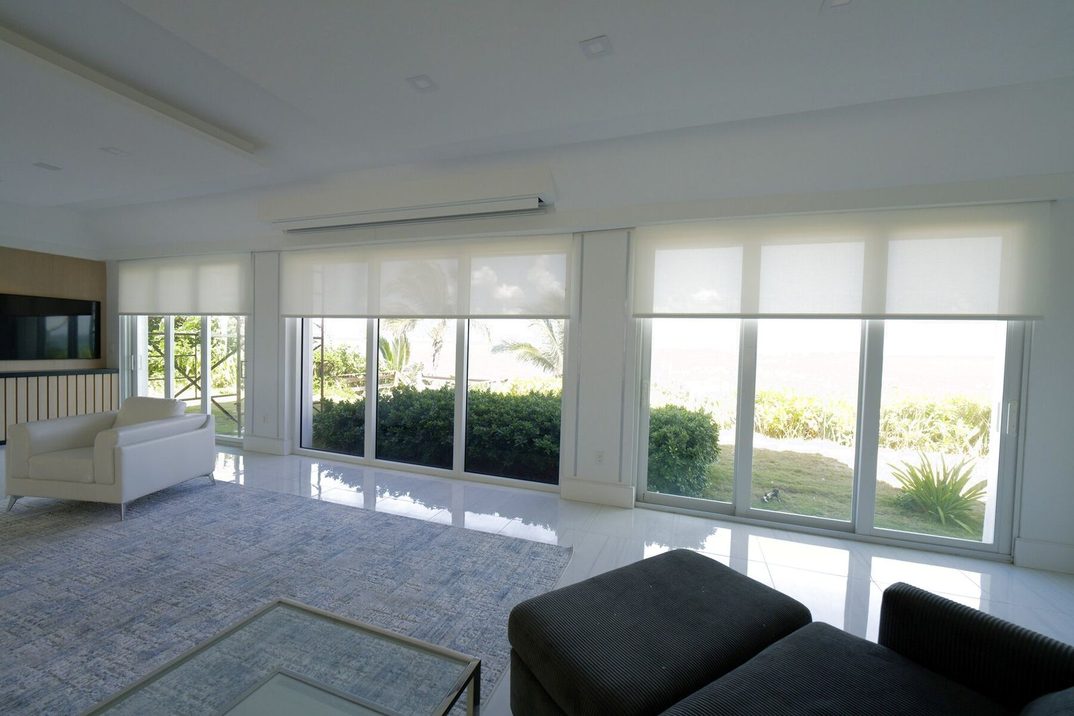
The treatments that cut cooling cost, in order
Exterior motorized screens stop the sun before it reaches the glass, which is the most effective place to stop it; the heat never enters the building envelope. On a lanai, a balcony or a west-facing slider they are the biggest single saving available. See outdoor shades.
Interior solar screens in a light color on the sunny walls are the everyday answer: they reflect most of the energy, keep the view and cost a fraction of new glass. A white or linen 3% to 5% screen is the cooling choice; a dark screen is the glare-and-view choice; a dual-face screen gives both.
Cellular shades trap still air in their cells and are the best insulators of the group, which matters on a west bedroom window and in the two cold weeks of January. Lutron's honeycomb fabrics carry R-values from 2.8 to 4.4; see the honeycomb page.
Lined draperies with a white-backed lining, closed over the glass with returns to the wall, reduce heat gain substantially and double as the softest layer in the room; our lining guide explains sun-out and blackout linings.
Dual shades, a screen for the day and a blackout for the night, give a bedroom both a cooler afternoon and a dark morning on one bracket. See dual roller shades.
Why motors are the energy feature
The DOE's attachment study notes that how an operable attachment is actually used can have a large effect on its energy performance, which is a polite way of saying a shade that is up at 3 pm saves nothing. In a working household nobody walks the west side of the house at the right hour every day. A Somfy, Lutron or Crestron schedule does: east glass closes for the morning and opens at noon, west glass does the reverse, and the whole house opens for the evening. A sun sensor refines it on a cloudy day. The saving is not the motor; the saving is that the shade is closed when the sun is on the glass, every day, without anyone remembering. Our planning section lists the decisions behind a schedule.
UV, fading and what glass does not stop
The second cost of a bare window is slower: faded floors, bleached upholstery and artwork that loses its color on the sunny wall. The window-film industry's rule of thumb attributes fading to ultraviolet light for about 40 to 45%, to heat for about 25% and to visible light for about 25%, with the rest down to the fabric or finish itself. Ordinary window glass stops most UVB but passes a large share of UVA, which is the part that does the long-term work. A solar screen cuts all three drivers at once because it reduces the total energy and light reaching the room, not just one band; the mills publish UV blockage alongside the solar figures, and the screens we use most block well over 90% of UV when closed. For a room with art or a rug that matters, a screen that is down during the sun hours is cheaper than reupholstering, and it is why we ask what is hanging on the walls at the measure.
What we specify, room by room
West and south living glass: a light 3% or 5% screen on a schedule, or a dual-face screen where the view is the point; exterior screens on the lanai. Bedrooms: a dual shade, light screen by day and blackout by night, or a blackout cellular on a small window. North glass and shaded rooms: sheers or a 5% to 10% screen, since there is less heat to stop. Rooms with art: a screen down through the sun hours and UV figures checked on the fabric page. Then motors on anything that should move at a fixed hour. The openness guide and the buying guide go deeper, and our pricing page puts a number on each option.
Frequently asked questions
How much can window treatments cut a Florida cooling bill?
No single figure is honest for every house, but the parts are published: air conditioning is 50 to 60% of a typical Florida bill according to FPL; the DOE says tight-fitting cellular shades can cut unwanted solar heat through windows by up to 60% in cooling seasons and white-backed draperies can cut heat gain by 33%; PNNL measured a 13.3% cooling-season HVAC saving with cellular shades closed. The saving in your house depends on how much glass faces west and south and whether the shades are closed when the sun is on it.
Which solar shade fabric keeps a room coolest?
The one with the highest solar reflectance, which is usually the lightest color: a white 3% E Screen reflects 73% of the sun's energy. A dark screen gives a better view and less glare but absorbs more heat. A dual-face screen, white out and charcoal in, does both.
Are exterior shades better than interior shades for heat?
Yes, for heat: an exterior screen stops the sun before it reaches the glass, so the heat never enters the building. Interior screens are easier to retrofit, cheaper and protect the furniture; most homes end up with both on the worst exposure.
Do motorized shades save energy?
The motor does not; the schedule does. A shade that closes at the right hour every day without anyone remembering is the difference between a treatment that saves energy on paper and one that saves it on the bill.
Do solar shades block UV?
Yes, substantially: a solar screen reduces the total energy and light reaching the room, and the mills publish UV blockage alongside the solar figures on each fabric page. Fading is driven by UV, heat and visible light together, so cutting all three matters more than any UV film alone.
Will energy-saving shades make the room dark?
Not necessarily. A 3% to 5% screen keeps daylight and the view while reflecting most of the heat; blackout is a separate layer for bedrooms. The openness figure tells you how much light and view you keep.
What do these treatments cost?
From our published list, a 72 by 84 in motorized solar roller shade is about $793 on a Somfy WireFree motor, about $1,910 on wired Somfy and about $3,141 on Lutron, installed and programmed, before tax; manual shades and cellular shades cost less. See pricing.
Sources
- WQCS (NPR, Treasure Coast), July 23, 2026: FPL tips to cut summer energy bills (air conditioning typically 50 to 60% of a household's total energy bill; close curtains and blinds during the hottest part of the day)
- U.S. Department of Energy, Energy Saver: Energy Efficient Window Coverings (cellular shades up to 60% reduction of unwanted solar heat in cooling seasons; medium-colored draperies with white plastic backings reduce heat gain by 33%)
- U.S. Department of Energy, Building Technologies Office: Energy Savings from Window Attachments, October 2013 (in cooling-dominated climates all window attachments saved energy; solar screens and roller shades effective in reducing cooling energy; deployment state has a large effect)
- Buildings.com: Control Fading Damage with Window Film (fading attributed about 40 to 45% to UV, 25% to heat, 25% to visible light)
- Exotic Shades: Dark or light solar shade fabric? View, glare and heat by the numbers (Mermet and Lutron published Ts, Rs and Tv figures)
- Exotic Shades: Pleated vs cellular shades (PNNL Lab Homes 13.3% cooling-season HVAC saving; Lutron honeycomb R-values)
Ask the people who made them
If you are not sure how a shade or a drapery we made should be cleaned, protected or replaced, call the workroom before you try anything. The advice is free and it is faster than a repair.