

Dark or Light Solar Shade Fabric? View, Glare and Heat by the Numbers
September 29, 2026 · Guides · By David Martineau
Once the openness is settled, the next question at every consultation is the colour of the screen. Dark or light changes more than the look: it decides how sharp the view is, how much glare you feel, and how much of the sun's heat ends up in the room. This guide puts the mills' published numbers on all three, for the fabric we install most in South Florida, and says what we specify room by room.
The short answer. Dark screens see out better and kill glare; light screens keep the room cooler and brighter. In Mermet E Screen at 3% openness, Charcoal/Grey rates 42% view-through and passes 5% of daylight, but reflects only 10% of the sun's energy and absorbs 85%. White/White reflects 73% and passes 13% of daylight, and the view drops to 17%. Mermet's published solar heat gain coefficient (SHGC) for the two as an interior shade behind residential glass is 0.60 for the charcoal and 0.28 for the white. If the room exists for its view, go dark or mid-tone; if it runs hot all afternoon, go light; if you want both, look at a two-tone weave, a dual-face twill or KOOLBLACK.
What colour changes, and what it does not
A solar screen is a woven mesh. The openness factor, 1%, 3%, 5% or 10%, is the share of the weave that is hole, and it sets how much you see through the fabric and how much light comes in. Colour is about the other 97%: the yarn. When sunlight hits a white yarn, most of it is reflected back out through the glass. When it hits a charcoal yarn, most of it is absorbed, and the yarn warms.
That single difference drives everything else in this article. It does not change the UV protection, which follows the openness (Mermet rates every 3% E Screen colourway at about 97% UV blockage and every 1% at about 99%), and it does not change the fire rating, the width or the weight. It changes the view, the glare and the heat.
The numbers: one weave, five colours
Every figure below is published by the mill for Mermet E Screen at 3% openness, the weave on most of our oceanfront work. Tv is visible light transmittance, the share of daylight that reaches the room. Rs is solar reflectance, the share of the sun's energy sent back out. As is solar absorptance, the share the yarn soaks up. Ts is the share that passes straight through. View is Lutron's view-through rating. SHGC is Mermet's solar heat gain coefficient for an interior shade behind residential glass: lower means less heat in the room.
| E Screen 3% | Tv | Rs | As | Ts | View | SHGC |
|---|---|---|---|---|---|---|
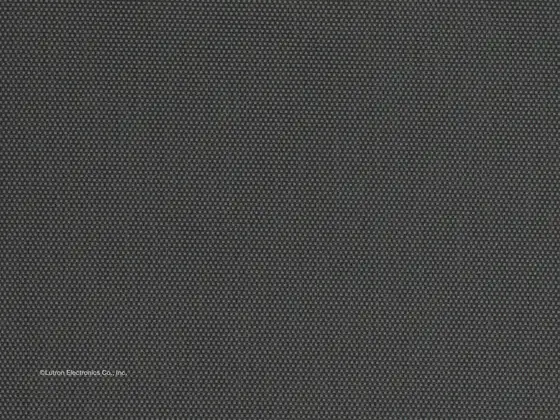
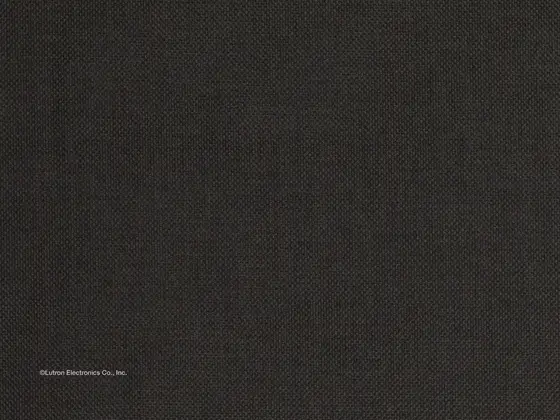
| Charcoal/Charcoal dark | 4% | 4% | 91% | 5% | 52% | 0.62 |
| Charcoal/Grey dark | 5% | 10% | 85% | 5% | 42% | 0.60 |
| Pearl/Grey mid | 8% | 27% | 63% | 10% | 27% | 0.50 |
| White/Linen light | 12% | 63% | 21% | 16% | 18% | 0.34 |
| White/White light | 13% | 73% | 11% | 16% | 17% | 0.28 |
Tv, Rs, As, Ts and view as published by Lutron for each E Screen colourway; SHGC as published by Mermet USA on the E Screen 3% spec sheet (interior shade, residential glazing). The two mills' optical figures agree within a point. Retrieved September 2026.
Read the table from the dark end. As the colour lightens, reflectance climbs from 4% to 73%, absorptance falls from 91% to 11%, and the heat gain coefficient halves. At the same time the view rating falls from 52% to 17% and the daylight coming in roughly triples. That is the whole trade in one row of numbers.

Why a dark screen sees out better
Stand inside and look through a screen. What you see is the view through the holes, with the yarn in front of it. Light yarn is bright: it scatters daylight towards your eye and lays a pale veil over the picture, the frosted-glass effect that a white 3% weave gives. Dark yarn scatters almost nothing, so the eye reads straight past it to the water. That is why Lutron rates Charcoal/Grey at 42% view-through and White/White at 17% in the same weave, and why a charcoal 5% screen scores 56% against 28% for white.
It also means openness and colour trade against each other. A charcoal 3% screen sees out better than a white 5%, with more glare control and more UV protection. If the view is the reason the room exists, the colour decision usually matters more than the step from 3% to 5%.
Why a light screen keeps the room cooler
A solar shade hangs inside the glass. Whatever the fabric absorbs, it absorbs in the room: the yarn warms, then gives that heat back to the air and to anything near the window. So the number to watch for heat is not only how much passes straight through (Ts), it is how much is absorbed (As). Charcoal/Grey lets only 5% through, which sounds better than white's 16%, but it absorbs 85% and re-radiates a good part of that inward. White/White reflects 73% back out before it can warm anything. Mermet's heat gain coefficients settle the argument: 0.28 for the white against 0.60 for the charcoal, behind the same glass.
Two practical consequences. First, a dark screen on a west window is warm to the touch at four in the afternoon and a white one is not. Second, the rule flips outside the glass: an exterior screen absorbs the sun outdoors where the air carries it off, so a black exterior mesh gives the clearest view with no heat penalty. Phifer's figures for SunTex 95 put black and white within a hundredth of each other on heat gain.
Glare and glow
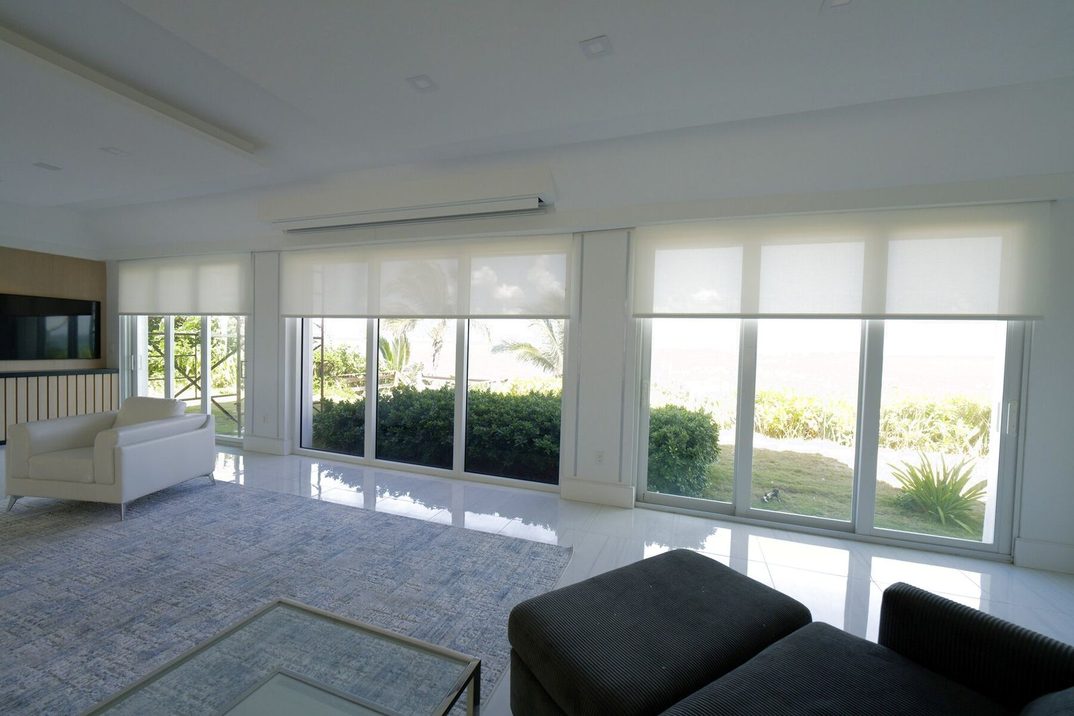
Glare is visible light, Tv. At 3% openness, charcoal passes 5% of the daylight and white 13%, so on a television wall or above a desk the dark screen is the calmer one. The light screen has a second effect worth seeing before you buy: when the sun is on it, a white weave becomes a luminous panel. In a bright white room that reads as glow and people love it; across from a screen, or in a room you want to feel dim in the afternoon, it is the brightest surface in sight. A mid-tone such as Pearl/Grey, at 8% Tv, is often the compromise in living rooms that do both jobs.
Privacy, by day and by night
By day, a screen gives privacy because the bright side is outside: the person on the street sees light bouncing off the fabric, not the dim room behind it. A lighter colour reflects more, so it reads a little more opaque from outside; a tight weave does more for privacy than any colour. At night the physics reverses and every solar screen becomes see-through once the lights are on, whatever its colour. Bedrooms and street-facing rooms get a second layer: a dual roller, a zebra shade or a blackout. On the blackout, colour matters on the street side too. Lutron's Blackout Screen reflects 65% of the sun in Pearl and 7% in Charcoal/Grey.
The middle ground: two-tone weaves, dual-face twills and KOOLBLACK
Three ways to have some of both. The first is a two-tone weave. E Screen's Pearl/Grey and Charcoal/Grey mix a light and a dark yarn, which is why Pearl/Grey lands in the middle of every column in the table. The second is a dual-face twill. Mermet T Screen in White/Charcoal puts a white face to the street and a charcoal face to the room: measured with the white outside, it reflects 59% of the sun's energy and passes 5% of daylight, close to white on heat and close to charcoal on glare. It is often the answer in a condo where the building wants one light colour from the street and the owner wants the dark view.
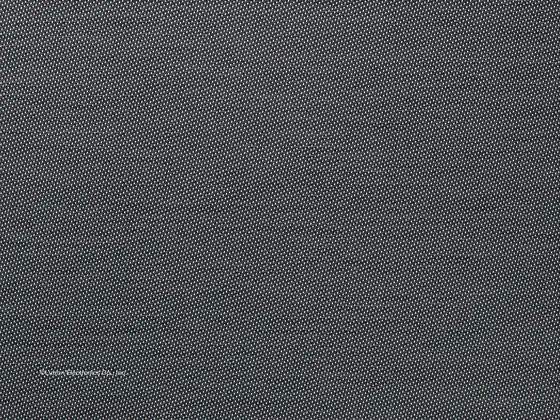
The third is KOOLBLACK, Mermet's dark yarn that reflects the near-infrared part of sunlight. In E Screen 3%, KOOLBLACK Charcoal/Charcoal reflects 34% of the sun's energy where the conventional charcoal reflects 5%, absorbs 49% instead of 91%, and brings the heat gain coefficient from 0.62 down to 0.53, while passing 6% of daylight and keeping a dark-fabric view. It is not white, and it does not pretend to be. It is the charcoal to specify when the room is hot and the view is not negotiable.
What we specify, room by room
Ocean, bay and Intracoastal living rooms. Dark or mid-tone at 3%. The view is why the room exists, and the extra warmth of a dark yarn is a price we take knowingly. Charcoal/Grey where the owner wants the horizon sharp; Pearl/Grey or a linen tone where the interior is light and the screen should disappear into it. At Salato the whole residence went White/White for a bright, single-colour unit and took the softer view with it, which is a legitimate choice too.
Rooms that run hot all afternoon. White or off-white, especially west-facing bedrooms, nurseries and any room where the shade will be down for hours with nobody looking out. The reflectance is doing real work there.
Television walls, offices and reading corners. Charcoal, at 1% or 3%. Low daylight transmittance kills reflections, and a dark fabric never glows behind a screen. The Boca Raton guest house runs SheerWeave 2500 in Charcoal at 1%: 2% of daylight through.
Condos with a facade rule. White outside, whatever happens inside: a white screen, or T Screen White/Charcoal if the owner wants the dark view. See the condo buildings we quote.
Skylights and glass roofs. Light colours or a white-backed blackout. Overhead, a dark fabric becomes a warm panel a few feet above your head.
Terraces and exterior shades. Dark mesh. Outside the glass the absorbed heat never reaches the room, so black and bronze give the clearest view and the deepest shade at no cost.
Whatever the room, we bring the memo samples to the window at the hour that bothers you and let you look through each colour. Or upload a photo of your own glass to the visualizer and try the colourways on it.
Sources
Lutron fabric specifications (lutronfabrics.com): openness, Tv, Ts, Rs, As and view rating as published per colourway for Mermet E Screen and T Screen and for Lutron Blackout Screen, retrieved September 2026. Mermet USA spec sheets for E Screen 3%, E Screen KOOLBLACK 3% and T Screen 3%: UV blockage and solar heat gain coefficients (interior shade, residential glazing), retrieved September 2026. Phifer product data for SunTex 95, retrieved September 2026. Room-by-room recommendations are Exotic Shades & Draperies' own practice across Miami-Dade, Broward and Palm Beach counties.
Frequently asked questions
Do dark solar shades make a room hotter?
Warmer than a light one, yes. In Mermet E Screen 3%, Charcoal/Grey absorbs 85% of the sun's energy and White/White 11%; the published heat gain coefficients behind residential glass are 0.60 and 0.28. The dark screen still cuts heat compared with bare glass, and it wins on view and glare, so the question is which matters more in that room.
Which solar shade colour gives the best view?
The darkest one. Lutron rates E Screen Charcoal/Grey at 42% view-through at 3% openness and White/White at 17%; at 5% the figures are 56% and 28%. A charcoal 3% sees out better than a white 5%.
Do white solar shades block more heat than dark ones?
They keep more of it out of the room, because they reflect it instead of absorbing it. White/White reflects 73% of the sun's energy at 3% openness; Charcoal/Grey reflects 10%. On an exterior shade the difference disappears, because the absorbed heat stays outside.
Which colour is best for privacy?
By day, lighter colours read a little more opaque from the street, but the openness does most of the work: a 1% or 3% weave is hard to see into in daylight whatever its colour. At night no solar screen gives privacy once the lights are on. Bedrooms need a blackout or a dual roller.
Does the colour change the UV protection?
No. UV blockage follows the openness: Mermet rates every 3% E Screen colourway at about 97% and every 1% at about 99%, dark or light.
What colour do you recommend for an ocean view?
A dark or mid-tone weave at 3% for most west, south and waterfront glass, because the view is the point and the dark yarn keeps it sharp. If the room runs hot all afternoon or the interior is very light, White/Linen or White/White, accepting the softer view. On an ocean wall in a building with a facade rule, T Screen White/Charcoal gives white outside and the dark view inside.
Can I have a dark screen that stays cool?
KOOLBLACK is the closest thing. In E Screen 3%, KOOLBLACK Charcoal/Charcoal reflects 34% of the sun's energy against 5% for conventional charcoal and brings the heat gain coefficient from 0.62 to 0.53, with 6% of daylight through and a dark-fabric view. A dual-face twill such as T Screen White/Charcoal reflects 59% with 5% of daylight through.
Is there a colour that does both, view and heat?
Not fully; it is a trade. Two-tone weaves such as Pearl/Grey sit in the middle of every column (27% reflected, 27% view-through at 3%). Dual-face twills and KOOLBLACK move the trade in the dark fabric's favour. The honest answer is to look through the memo samples at your own window at the hour that bothers you.
Time to dress your windows?
One free hour with our team routinely saves owners thousands in avoidable mistakes - wrong fabrics, bad mounts, missed motorization. Book a private, complimentary consultation - we bring the fabrics, the swatches, and honest answers. Start with the free guide: the 5 costly mistakes.