

Drapery Lining Explained: Every Type, and Why Each One Exists
September 30, 2026 · Guides · By David Martineau
You choose a drapery by its face fabric, but what is sewn behind it decides how it performs: how dark the room gets, how long the colour lasts in the sun, how the folds hang, how warm the glass side runs and how the room sounds. This guide takes every lining we get asked about (light-filtering sateen, dim-out or sun-out, 2-pass and 3-pass blackout, interlining and French blackout) and gives the reason each one exists. Then it answers the questions that decide between them: colours, heat, noise, and 100% polyester against cotton.
The short answer. A standard sateen lining protects the face fabric from the sun, gives the panel body and keeps a lit room private at night, while daylight still glows through. Dim-out, also sold as sun-out, cuts most of the light. Blackout, a cloth coated with two or three passes of foam, stops light through the drapery; the returns, the center overlap and the header stop it at the edges. Interlining is a soft layer between face and lining for body, insulation and quiet. Linings come mostly in white, ivory and natural, which is also what some condo associations require from the street; the dim-outs come in real colours. For heat, a white back facing the glass is what helps. For sound, weight, fullness and interlining matter more than fiber. For humidity, polyester holds its size best, poly-cotton comes close, and cotton drapes the softest.
On this page: Why line a drapery · Types at a glance · Light-filtering · Dim-out and sun-out · Blackout · Interlining · Colours · Heat gain · Sound · Polyester vs cotton · Weights and specs · FAQ
Why a drapery has a lining at all
A lining is a second cloth sewn behind the face fabric, on the side that faces the glass. Nobody chooses a drapery for it, and every job it does is one the face fabric cannot do alone.
- It takes the sun. The face fabric is the expensive layer and often the fragile one. Michigan State University's extension bulletin Fabrics for the Energy-Conscious Home rates cotton for a gradual loss of strength and gradual yellowing in sunlight, linen for a gradual loss of strength, silk and rayon worse, and polyester for only a very gradual loss of strength with no discoloration. The textile house James Dunlop tells its buyers that cotton and linen draperies should be protected with a quality lining, and that viscose should always be lined. That is why every drapery we sew is lined: the lining carries the UV load off the face cloth.
- It gives the panel body. A lining adds weight at the hem and structure at the header, so the folds hold and the panel hangs plumb instead of clinging to the glass. The rule of thumb is a lining close in weight to the face fabric, so the two drape as one.
- It keeps a lit room private. At night the light is inside, and a light, unlined fabric shows the room behind it to the street. A lined drapery does not.
- It sets the light level. A sateen softens daylight, a dim-out cuts most of it, a blackout stops it through the cloth. Each one has its own section below.
- It gives the building one face. From outside, every closed drapery shows its lining, not its face fabric, which is why condominium rules care about lining colour.
- It insulates and quiets. A lining, and even more an interlining, puts a layer of fiber and still air between the room and the glass. Heat and sound each get a section below.
Workroom Tech, a training resource for drapery workrooms, puts the whole job in one line: linings "protect the face fabric from wear and sun exposure; increase privacy; provide light control and insulate the window." Sheers are the exception. They stay unlined on purpose, because their job is to filter light, not stop it.
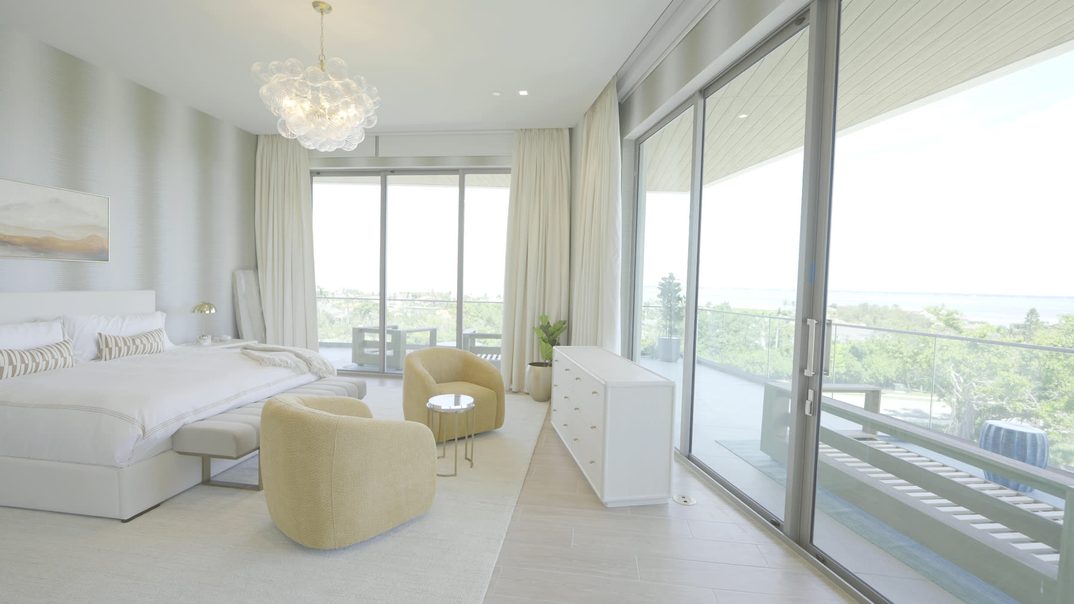
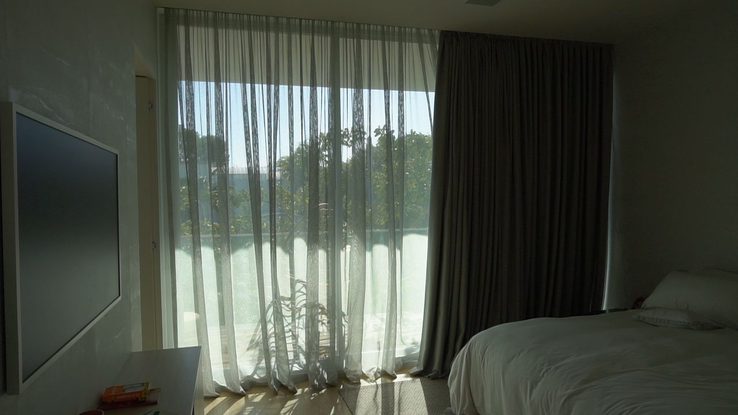
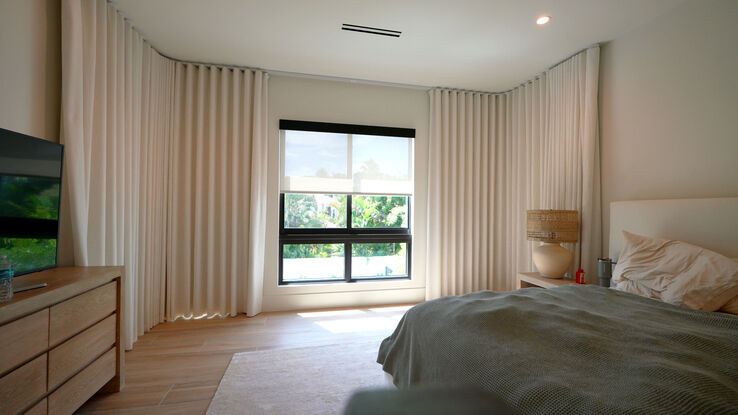
Drapery lining types at a glance
Eight builds cover almost every drapery. The light figures are the makers' and workrooms' own; how dark a room actually gets also depends on the edges, covered under blackout.
| Build | What it is | Light through the cloth | What it is for |
|---|---|---|---|
| Unlined | The face fabric alone | Filters freely | Sheers, which are meant to let light through |
| Light-filtering lining | A cotton or poly-cotton sateen sewn behind the face | Softens it; the room still glows | Protects the face fabric, gives body, keeps a lit room private |
| Dim-out, or sun-out | A lining with one pass of acrylic foam, or a dense dim-out weave | Very little: it blocks about 98%, in one workroom's figure | Rooms that should be dim, not dark; the lining family that comes in colours |
| Blackout, 2-pass | A black foam coat, then a white one, on a base cloth | None: rated 100% blackout | Blackout at a lighter weight than 3-pass; the cloth side reads grey |
| Blackout, 3-pass | White, black, then white foam; the first white pass seals the weave | None: rated 100% blackout | Bedrooms and media rooms; white on both sides of the black |
| Interlining | A soft layer between face and lining: bump, domette, flannel or polyester | Less, but it is not blackout | Body, insulation and quiet; silk and linen that hang like couture |
| French blackout | Face, flannel, a black sateen, then a standard lining | None, with no coated layer | Darkness behind silk and fine fabrics without the stiffness of foam |
| Decorative blackout | A face fabric that blocks light by itself | None | One layer that is both the look and the dark |
Light-filtering lining: the sateen most draperies need
The everyday lining is a sateen: a smooth, tightly woven cotton or polyester-cotton cloth with a slight sheen on one side. It softens daylight rather than stopping it, so a lined living room still glows in the afternoon, and it does all the protective work above. When a room should not go dark, this is the lining.
The choices inside the family are fiber, width and colour. Alendel, the Toronto and Buffalo distributor whose drapery range fills our fabric library, publishes its lining book with full specifications, and it is a fair picture of the trade: a 100% cotton sateen at 54 in, in white, ivory and parchment; polyester-cotton sateens and sheetings at 54 and 108 in, from 40% to 50% cotton; and flame-resistant versions for contract work. The 108 in cloths can be railroaded, run sideways behind a wide-width face fabric, so a tall panel's lining does not need a seam every 54 in. Every one of them is in the spec table below.
A light-filtering lining is also the right partner for a sheer on a second track: the sheer filters by day, the lined drapery closes for the evening, and neither has to do both jobs.
Dim-out, or sun-out: the in-between lining
A dim-out lining stops far more light than a sateen without going all the way to black. The coated kind is a cloth sprayed with a single pass of acrylic foam; one workroom says it blocks about 98% of the light, and that it is thinner, softer and less expensive than blackout. In the Canadian trade the same idea is sold as sun-out: Equus Fabrics, a contract wholesaler in Ontario, describes sun-out lining as one that keeps the sun out while letting some filtered light through, "a softer, diffused glow" instead of the complete dark of blackout.
It exists for the room that should be dim, not dark: a west-facing living room at four in the afternoon, a TV room used in daylight, a guest room. A dim-out also insulates better than a sateen alone, and some American workrooms call it thermal suede.
It is also where lining colour opens up. Alendel's Sun Out, a 60 in, 100% polyester dim-out that lists NFPA 701, comes in eleven colours: Snow, Ivory, Cream, Showroom Beige, Taupe, Woodstock Tan, Terra Red, Denim, Stone Harbor, Platinum and Black. Its Siesta dim-out, a foam-coated polyester, is white or ivory.
Blackout lining: 2-pass, 3-pass, and where light still gets in
Blackout lining is a cloth coated with layers of foam, called passes, a process invented by Rockland Industries of Baltimore. A 2-pass lining gets a black coat and then a white or light coat over it. A 3-pass gets white, then black, then white again. In the 3-pass, that first white pass seals the weave before the black goes on; in the 2-pass, where the black sits directly on the cloth, the cloth side reads grey.
Both are sold as 100% blackout through the cloth. Rockland tests its Roc-lon blackouts under 160,000 lux, brighter than the roughly 120,000 lux of direct sun. The difference is what you see: behind a pale face fabric, a grey back can show through, and a 3-pass, white on both sides of the black, does not. Our blackout draperies are sewn with 3-pass lining, stitched in rather than clipped on. The coating faces the glass, where, as Rockland points out, the foam blocks the ultraviolet before it can reach the face fabric.
Where a blackout room still leaks
Needle holes. When a needle pierces the foam it leaves a hole, and on a bright day every stitch through the coating can show as a pinpoint of light. Rockland's sewing guidance is a straight stitch at no more than 5 to 6 stitches per inch with a Teflon needle, with French or overlapped seams. Some workrooms bond with fusible tape instead of stitching, and the French blackout build avoids coated cloth altogether.
The edges. A blackout lining only darkens what it covers. The rest is geometry: a return that carries the panel back to the wall, a generous center overlap where the pair meets, and a header sealed by a ceiling mount or a top treatment. That is why a blackout drapery is specified with its hardware, not just its lining.
Or let a shade do the dark. When the drapery should stay soft and light-filtering, the darkness can come from behind it. At the Bay Drive Mansion in Pompano Beach, the master bedroom's drapery panels and valance in Kravet hang in front of motorized Phifer SheerWeave 7400 blackout shades. At the Ritz-Carlton Residences, Miami Beach, each bedroom has a sheer and a blackout drapery on two independent Lutron tracks. And a decorative blackout puts the blackout into the face fabric itself, so no separate lining is needed.
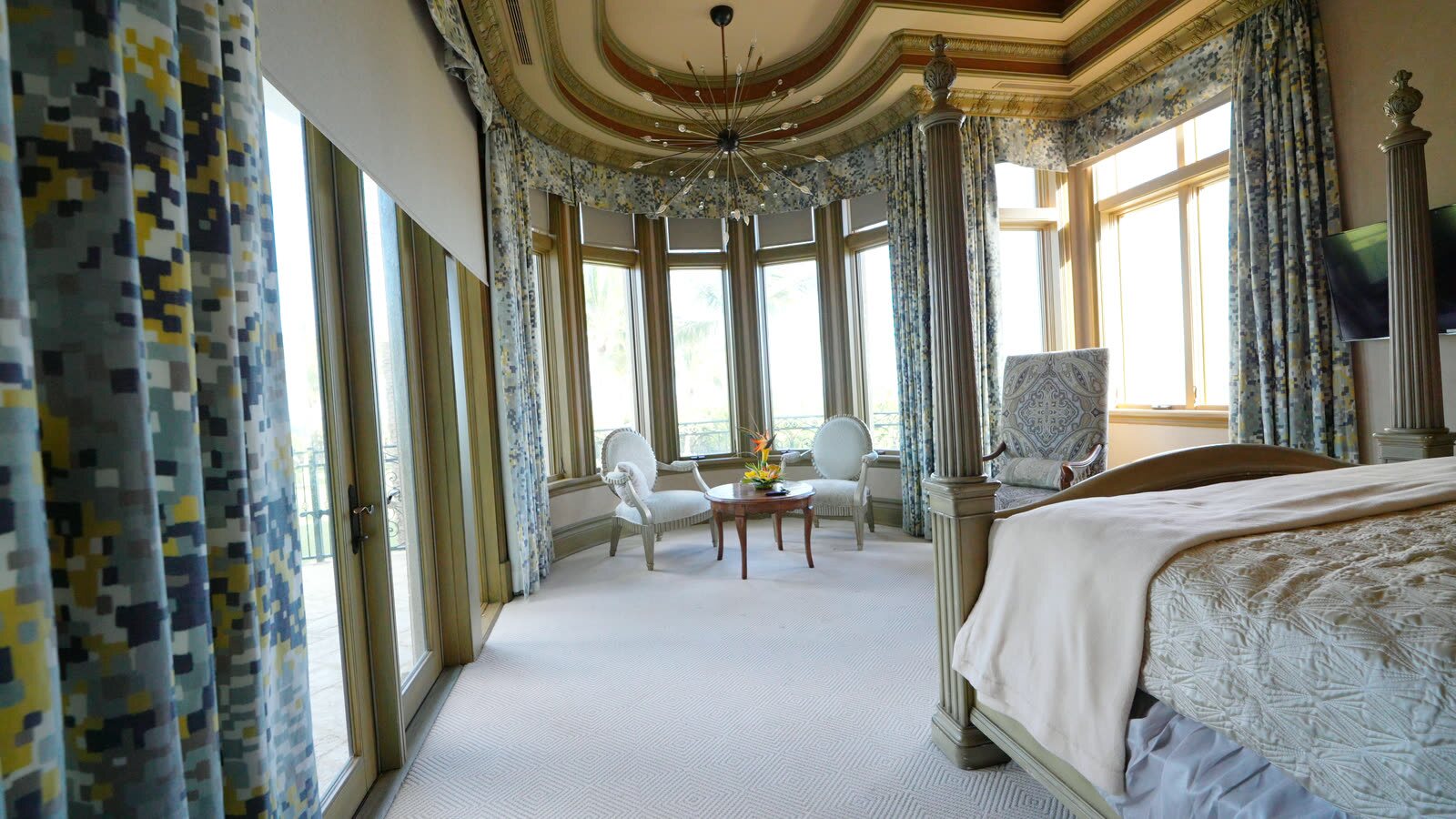
Interlining: when we interline, and why
Interlining is a soft cloth sewn between the face fabric and the lining. You never see it, and it is the difference between a drapery that hangs and one that has presence: the folds turn round and deep, the leading edge looks full, and the panel reads heavier and richer. Workroom Tech says a bump interlining creates a drapery "with rounded, soft edges and deep folds," one that is "more sculptural, elegant."
Four families do the work:
- Bump, the heaviest and bulkiest interlining, usually 100% cotton, loosely woven, about 350 to 400 g/m². Alendel's Valu Bump is 54 in, 100% cotton, made in the United Kingdom, 1.76 lb per yard.
- Domette, the lighter cotton, about 150 to 300 g/m². Domettes raised on one side are made for silk.
- Flannel, a soft, napped fabric in white or natural and in several weights, which Workroom Tech calls the most common interlining. Alendel lists 5 oz and 7 oz cotton interlinings, an American-made cotton interlining and a napped 50/50 cotton-polyester.
- Polyester, sold in Britain as sarille: white, about 120 to 300 g/m², and far steadier than cotton, because it resists stretching, distortion and shrinkage.
A 3-pass blackout can also be sewn in as the middle layer, between the face fabric and a sateen lining, which workrooms do to stop colour showing through.
Why interline. Body, first. Then insulation: the loose fibers trap air, which the curtain-making trade credits with greater thermal efficiency, and which Michigan State's bulletin explains the same way for napped and layered fabrics. Then protection, a second layer between the sun and a silk. Then quiet, because a thick, soft layer absorbs sound (more under sound).
What it costs. Weight, bulk and hand work. An interlined panel stacks wider when it is open, since the thicker the fabrics, the larger the stack; it weighs more on the rod or track; and it takes more labor to make. We weigh the actual fabric, lining and interlining before specifying the motor and the blocking.
When we do it. Formal living and dining rooms on pinch pleat, bedrooms and media rooms, and any silk, linen or velvet that should hang the way it does in the photograph. It is optional everywhere else, and a sheer is never interlined.
French blackout: dark without the coated cloth
French blackout builds darkness from woven layers only: the face fabric, a flannel interlining, a tightly woven black lining, then a standard lining. There is no foam to stiffen the panel, so it keeps the hand and drape of the face fabric, and no coating for a needle to pierce. The trade-off is labor and weight: it is much more work to make and heavier to hang. It earns its place behind silk and fine linen in a bedroom that has to go dark.
Lining colours: what is available, and why it matters
Standard linings come in a short, practical palette: white, ivory, and naturals such as parchment or khaki. Blackouts are mostly white and ivory: Rockland makes its Roc-lon linings with a white or ivory face and white or ecru foam, and every blackout in Alendel's current lining book is white or ivory. Interlinings are white, ivory or natural. Colour lives in the dim-outs, such as Alendel's eleven-colour Sun Out; in the black sateen of a French blackout; and in decorative blackouts, which Rockland makes in dozens of stock colours.
Why the colour matters:
- The street sees it. Every closed drapery shows its lining to the outside. Some condominium and co-op bylaws require window treatments to read white or off-white from outside, so the building looks uniform. Read your association's rules before choosing anything but white or ivory for a window that faces the street.
- The room sees it through the fabric. When the sun is behind a lined drapery, daylight reaches the room through the lining and the face together, so the lining tints the glow. Hold the face fabric and the lining against the glass together, in daylight, before you choose.
- Sometimes the back is on display. At Landmark Ranch Estates, the theater sits behind a glass wall and its drapery is seen from the hallway as much as from the seats, so the velvet was made double-sided, velvet on both faces, and it still closes the room to true dark. In the same house, Roman shades in the cabana bath and one bedroom are lined in black. At the Ritz-Carlton Residences, Miami Beach, a reversible Holland & Sherry wool flannel was hung with its lighter face outward, as the designer's schedule called for.
Heat gain: what a lining does against the South Florida sun
Behind the glass, a drapery can do one of two things with sunlight: send it back out through the window, or absorb it and turn it into heat inside the room. That is why the back of a drapery matters more than its face. Michigan State University's extension bulletin says a reflective surface on the outer facing of a drapery fabric or lining "would reduce summer interior heat gain by reflecting the heat," and that "a sun-sensitive fabric backed with a highly reflective lining can be more efficient than a sun-resistant but unlined fabric."
The U.S. Department of Energy's Energy Saver guidance gives the figure most often quoted: "Studies demonstrate that medium-colored draperies with white-plastic backings can reduce heat gains by 33%." A white or ivory blackout coating facing the glass is today's version of that white backing. A dark lining facing the sun absorbs more of it and releases more of that heat into the room.
The edges decide the rest. The air in the pocket between drapery and glass warms up, and wherever it can escape, at the top and the sides, it carries that heat into the room. Cornell's figures for the same mechanism in winter show what sealing is worth: conventionally hung, unsealed draperies cut window heat loss by no more than 10%, while tightly woven, lined draperies sealed at all four edges reach about 25%. The details that make a room dark, a ceiling mount or top treatment, returns to the wall and a center overlap, are the same ones that keep the heat at the glass.
Interlining adds insulation on top, and a dim-out insulates better than a sateen. The honest limit: a lining works inside the glass, after the sun is already through it. On west glass that bakes all afternoon, a solar screen at the glass does the daytime work and the lined drapery does the evening and the dark. On a west window we line generously and, where the client wants it, add a solar roller behind; the dark vs light solar fabric guide has the heat figures for those screens.
Sound: what lining does for noise, and whether soundproof curtains work
Two different problems hide under the word noise: echo inside the room, and noise coming in from outside. Drapery is good at the first and limited at the second.
Echo: absorption
Glass, stone and tile reflect sound; soft, thick fabric absorbs it. Acousticians rate absorption with the noise reduction coefficient, NRC, from 0 for a surface that reflects everything to 1 for one that absorbs everything, measured in a reverberation chamber under ASTM C423. The published figures for drapery are blunt about what matters: a lightweight cotton drapery hung flat rates about 0.10, a medium-weight drapery gathered to 50% about 0.55, and heavy velour gathered to 75% about 0.75, while single-pane glass rates 0.05. As one acoustics guide puts it, the published NRC "is highly dependent on how the drape is hung." The classic absorption tables tell the same story: a light 10 oz per square yard velour hung flat against a wall rates about 0.15; a heavy 18 oz velour gathered to half its width, about 0.60.
Two limits. Even that heavy velour absorbs only about 14% of the sound at 125 Hz, so bass and the rumble of traffic pass through. And absorption quiets the room itself; it does not stop sound from coming in.
Outside noise: blocking
Stopping sound from getting in takes mass and an airtight seal, and an ordinary drapery has little of either; the window glass does most of that work. The exception is a purpose-built acoustic interlining. At the University of Adelaide, acousticians tested curtains with a heavy mass layer, 800 to 1,500 g/m², sandwiched between two sound-absorbing fabrics, in 76 lab tests: the complete curtain, two face fabrics with the mass interlining between them, gave a frequency-weighted improvement of 17 dB, reported as cutting perceived noise by more than half, with similar results when the tests were repeated behind three thicknesses of glass. That is the difference between a curtain that softens a room and one that insulates it.
So, do soundproof curtains work? No curtain makes a room soundproof. A heavy, lined and interlined drapery softens a hard room noticeably and takes the edge off higher-pitched outside noise. Real insulation needs a dedicated mass layer, closed edges and good glass.
The best build for sound
- A heavy, dense face fabric: velvet, velour, a heavy chenille or a wool. The absorption tables list drapery by weight and by how it hangs, not by fiber, and that is the right way to choose.
- Bump interlining, the thickest, softest layer you can add behind it.
- Full fullness: 2 to 2.5 times the width for pinch pleat, 120% on ripplefold, because gathered fabric absorbs far more than flat.
- Floor to ceiling, with returns and a center overlap, so the drapery covers the glass and closes its edges.
- A mass layer where outside noise is the problem. For media rooms and bedrooms we layer acoustic liners and blackout, which is how a media room goes dark and quiet at once.
The theater at Landmark Ranch Estates is the build in practice: double-sided velvet across a glass wall. On the rear and side walls of a home theater, interlined panels are part of the acoustic treatment, not only the dressing.
100% polyester, cotton or poly-cotton: which lining fiber
Every fiber does the lining's job on day one. The differences show over the years, in sun and in humidity, and South Florida has plenty of both.
| 100% cotton | Poly-cotton blend | 100% polyester | |
|---|---|---|---|
| Hand and drape | The softest hand; presses crisp; the traditional choice | Close to cotton, a little smoother | Smooth, with very good drape and wrinkle recovery |
| In the sun | Gradual loss of strength and gradual yellowing | Between the two, by blend | Very gradual loss of strength, no discoloration |
| In humidity | Absorbent: moves as the humidity changes | Moves less than cotton | Non-absorbent: moves very little |
| Mildew | Can be affected; a finish helps | Between the two | Not affected |
| Shrinkage | Shrinks unless pre-shrunk | Less than cotton | Resists stretching and shrinkage |
| In Alendel's book | Cotton Sateen 54, Cottonsoft 3-pass blackout (cotton base) | Satinline, Texline, Waterline (50/50), Yorkline (40% cotton), Thermosoft 3-pass (50/50), Ultra Blackout (80% polyester) | Sun Out and Siesta dim-outs, Pitch Black and Shadow blackouts, Contract F.R. |
Humidity is the one to watch. Michigan State's bulletin warns that "too much absorption, for example in drapery fabrics, can cause a fabric to stretch or shrink, thus losing its shape." A cotton-rich lining behind a polyester face can move while the face does not, and the hem starts to wander; a linen face does the moving itself (see the linen guide). In a South Florida house, and above all one closed up for part of the year, the stable end of the table is the safer default: polyester holds its size and shrugs off mildew, and poly-cotton sits between it and cotton. A 100% cotton lining is the choice where hand and drape come first and the air conditioning never goes off.
Flame resistance. For hotels, offices, common areas and other public spaces, drapery generally has to pass NFPA 701; Mermet's guide to the fire standards points to NFPA 101, section 10.3.1, for draperies and curtains, and to section 806.1 of the International Building Code for decorative materials; both lead to NFPA 701. An inherently flame-resistant polyester carries that in the fiber; a treated cloth is flame retardant. In Alendel's book, Bangard FR (70% polyester, 30% cotton), Contract F.R., Sun Out and the Pitch Black FR blackouts all list NFPA 701.
What the linings weigh, and why the motor cares
Every layer adds weight to the hardware and bulk to the stack. Here is a real trade lining book, as Alendel publishes it, read on September 30, 2026. Weights are per running yard at the full width, so compare like widths.
| Lining | Type | Content | Width | lb per yard | Colours | Fire listing |
|---|---|---|---|---|---|---|
| Cotton Sateen 54 | Sateen | 100% cotton, water-repellent finish | 54 in | 0.49 | White, ivory, parchment | - |
| Satinline 54 | Sateen | 50% cotton, 50% polyester | 54 in | 0.41 | White, ivory | - |
| Texline 54 | Sheeting | 50% cotton, 50% polyester, water-repellent finish | 54 in | 0.49 | White, ivory, parchment | - |
| Waterline 108 | Sheeting | 50% cotton, 50% polyester, water-repellent finish | 108 in | 0.82 | White, ivory | - |
| Yorkline 108 | Sheeting | 40% cotton, 60% polyester | 108 in | 0.43 | White, ivory | - |
| Bangard FR | Flame-resistant lining | 70% polyester, 30% cotton | 54 in | 0.35 | Ivory | NFPA 701 |
| Contract F.R. | Flame-resistant lining | 100% inherently flame-resistant polyester | 56 in | 0.30 | Natural | NFPA 701 |
| Siesta Dimout | Dim-out | 100% polyester, acrylic foam | 54 in | 0.40 | White, ivory | - |
| Sun Out | Dim-out | 100% polyester | 60 in | 0.88 | 11 colours, Snow to Black | NFPA 701 |
| Pitch Black | Blackout | 100% polyester, acrylic foam | 54 in | 0.76 | White, ivory | - |
| Ultra Blackout | Blackout | 80% polyester, 20% cotton, acrylic foam | 54 in | 0.76 | White, ivory | - |
| Cottonsoft 3 Pass | 3-pass blackout | 100% cotton base | 55 in (also made 110 in) | 0.76 at 55 in | White, ivory | - |
| Thermosoft 3 Pass 108 | 3-pass blackout | 50% cotton, 50% polyester base | 108 in (also made 54 in) | 1.56 | White, ivory | - |
| Shadow 3 Pass | 3-pass blackout | 100% polyester, acrylic foam | 110 in | 1.57 | White, ivory | - |
| Pitch Black FR | Blackout, flame resistant | 100% flame-retardant polyester | 54 in | 0.93 | White, ivory | NFPA 701 |
| Pitch Black 3 Pass FR | 3-pass blackout, flame resistant | 100% polyester, acrylic foam | 110 in | 1.85 | White, ivory | NFPA 701 |
| Interlining 5 oz | Interlining | 100% cotton | 54 in | 0.52 | Ivory | - |
| Interlining 7 oz | Interlining | 100% cotton | 54 in | 0.72 | White, ivory | - |
| Interlining USA | Interlining | 100% cotton, made in the USA | 54 in | 0.62 | Natural, white | - |
| Texline Napped | Interlining | 50% cotton, 50% polyester | 54 in | 0.78 | White, ivory | - |
| Valu Bump 54 | Bump interlining | 100% cotton, made in the United Kingdom | 54 in | 1.76 | Natural | - |
Two things stand out. The heavy layers are the blackouts and the bump: a yard of Valu Bump weighs more than three yards of a 54 in sateen. And the wide cloths weigh more per yard mostly because they are twice as wide, not because the cloth is heavier. Put a sateen lining and a bump interlining behind a 54 in drapery cloth such as Alendel's Dolce, at 0.88 lb per yard, and each yard of the made-up cloth weighs more than 3 lb, before the fullness multiplies it across the track. That is why we weigh the actual fabric, lining and interlining before specifying the motor and the blocking. Our motorized curtain tracks page has the motors and what they carry.
What we specify, room by room
| Room | What we build | Why |
|---|---|---|
| Living room with a view | A sheer on its own track, or a drapery with a light-filtering sateen; a solar screen behind it on west glass | Keeps the glow and the view; the screen takes the afternoon sun |
| Primary bedroom | 3-pass blackout lining with returns, a center overlap and a ceiling mount; or a sheer and a blackout drapery on two tracks | Dark in the morning, soft by day |
| Formal living or dining room | Pinch pleat, lined and interlined | Round, deep folds and a quieter room |
| Media room or theater | Blackout with interlining or an acoustic liner, at full fullness, floor to ceiling | Dark and quiet in one drapery |
| West room used by day | A dim-out, or sun-out, lining | Dim rather than dark, and cooler |
| Silk or fine linen in a bedroom | French blackout, or interlining with a blackout shade behind | Dark without the stiffness of foam |
| Humid rooms and seasonal homes | A poly-cotton or polyester lining | Holds its size and resists mildew |
| Street-facing condo windows | White or ivory lining, unless the association allows otherwise | The facade reads as one building |
| Hotel, office or common area | A face fabric and a lining that list NFPA 701 | The fire code for public spaces |
Frequently asked questions
What are the different types of drapery lining?
Light-filtering sateen, dim-out (also sold as sun-out), 2-pass and 3-pass blackout, interlining (bump, domette, flannel or polyester), French blackout and decorative blackout. A sateen protects the face fabric and softens light; a dim-out cuts most of it; a blackout stops it through the cloth; an interlining adds body, insulation and quiet; a French blackout reaches dark with woven layers; a decorative blackout does it in the face fabric.
What is the difference between blackout and dim-out (sun-out) lining?
A blackout stops light through the cloth, and the makers rate it 100%. A dim-out stops most of it, about 98% in one workroom's figure, and leaves a soft glow. A dim-out is thinner, softer and less expensive, and it is the lining family that comes in colours, like the eleven of Alendel's Sun Out.
Is 3-pass blackout better than 2-pass?
Both are rated 100% blackout. In a 2-pass the black coat sits directly on the cloth, so the cloth side reads grey; a 3-pass has white foam on both sides of the black, so a pale face fabric stays clean in front of it. Our blackout draperies are sewn with 3-pass lining.
What is interlining, and when do you need it?
A soft layer sewn between the face fabric and the lining: bump, domette, flannel or polyester. It gives round, deep folds, insulation and quiet, and it protects silk and linen. It belongs in formal rooms, bedrooms and media rooms, and behind any fabric that should hang like couture; it is optional elsewhere.
Does blackout lining keep a room cooler?
It helps, because its white coating faces the glass and sends sunlight back out. The U.S. Department of Energy cites studies showing that medium-colored draperies with white plastic backings can reduce heat gains by 33%. Closing the top and the sides matters as much as the lining, and on west exposures a solar screen at the glass does more.
Do soundproof curtains work?
Not the way the name promises. A heavy drapery gathered at full fullness absorbs echo well, with published NRC values of about 0.55 to 0.75 against 0.05 for glass, but it does little for low-frequency traffic noise. Real insulation takes a dedicated mass interlining; in University of Adelaide tests, a curtain built around one improved sound insulation by 17 dB.
Which material is best for sound?
Weight, thickness and fullness, more than fiber. A heavy velvet or velour face, bump interlining and a blackout or acoustic liner, gathered at full fullness from floor to ceiling with returns and a center overlap, is the quietest build. The absorption tables sort drapery by weight and by how it hangs, not by fiber.
Is a cotton or a polyester lining better?
Cotton has the softest hand and drapes beautifully, but it absorbs moisture, moves with humidity, yellows and weakens slowly in the sun, and can mildew. Polyester barely moves in humidity, resists mildew and loses strength only very gradually in the sun. Poly-cotton sits between them. In a humid South Florida house the stable end is the safer default.
What colours do drapery linings come in?
Standard linings come in white, ivory and naturals such as parchment; blackouts mostly in white and ivory; interlinings in white, ivory and natural. Colour lives in the dim-outs, like Alendel's Sun Out in eleven colours from Snow to Black, in the black sateen of a French blackout and in decorative blackouts.
Why do some condos require white linings?
From outside, every closed drapery shows its lining, and some condominium and co-op bylaws require window treatments to read white or off-white so the building looks uniform. Check your association's rules before choosing a coloured lining for a window that faces the street.
Does lining make a motorized drapery heavier?
Yes. In Alendel's published specs a yard of 54 in sateen weighs about 0.4 to 0.5 lb, a 54 in blackout about 0.76 lb and a cotton bump interlining 1.76 lb. We weigh the actual fabric, lining and interlining before specifying the motor and the blocking.
Do sheers need a lining?
No. A sheer is meant to filter light, so it stays unlined. When a room needs both, the sheer goes on one track and a lined or blackout drapery on a second, as in the bedrooms at the Ritz-Carlton Residences, Miami Beach.
What is French blackout?
A way to make a drapery dark without a coated lining: the face fabric, a flannel interlining, a tightly woven black lining, then a standard lining. It keeps the hand of the face fabric and has no coating for a needle to pierce, at the cost of more labor and more weight.
Sources
- Michigan State University Cooperative Extension Service: Fabrics for the Energy-Conscious Home, bulletin E-1772 (1984): fiber sunlight resistance, reflective linings, moisture and shape
- U.S. Department of Energy, Energy Saver: energy efficient window coverings (draperies with white plastic backings, heat gain)
- Cornell University, Department of Design and Environmental Analysis: energy saving window treatment (sealed and unsealed draperies)
- Wikipedia: Blackout (fabric), 2-pass and 3-pass construction, Rockland Industries
- Rockland Industries, Roc-lon FAQs: 160,000 lux test, foam toward the window, colours, sewing guidance
- Hotel Drapery & Bedding: 2-pass vs 3-pass blackout
- Seamless Workroom: 2-pass, 3-pass and dim-out linings
- Home Dec Gal: linings and interlinings, part II (one-pass dim-out, needle holes, thermal suede)
- Workroom Tech: linings and interlinings
- Cord & Pleat Design: French blackout lining
- Equus Fabrics: sun-out lining
- Sew Helpful: guide to interlinings (bump, domette and sarille weights)
- James Dunlop Textiles: characteristics of textile fibres
- OnlineFabricStore: how to pick drapery lining (weight matched to the face fabric)
- Curtarra: curtain stack back
- Commercial Acoustics: sound absorption coefficients (drapery NRC by how it is hung)
- Sound absorption coefficients reference table (light velour hung flat, heavy velour gathered to half area)
- Acoustical Society of America: curtains and drapes that can reduce noise pollution by more than half (University of Adelaide, 2023)
- Mermet: flame retardant and flame resistant test standards (NFPA 701, IBC 806.1, NFPA 101 10.3.1)
- KhoobchandaniLaw: why some condo bylaws require white window treatments
- Alendel: lining category and product specifications, read September 30, 2026
Our own installs named above are documented in the case studies for The St. Regis Longboat Key, the Ritz-Carlton Residences, Miami Beach, the luxury home in Boca Raton, the Bay Drive Mansion and Landmark Ranch Estates.
Fabric on your windows, cut to your room
We bring the swatch books and the linings to the house, measure the hardware before the fabric, and sew the panels in our own Fort Lauderdale workroom. Book a private, complimentary consultation, or start with the free guide: the 5 costly mistakes.