

Linen Is Back on the Window. Here Is Why, and How to Do It Right.
September 27, 2026 · Trends · By David Martineau
Sheers are the drapery we are asked for most, and every year more of those requests are for linen or a cotton-linen blend rather than a polyester voile. We now hang it from Boca Raton oceanfront condos to the Ritz-Carlton Residences in Miami Beach. This guide covers why linen is booming, the trends inside the trend, how it behaves on South Florida glass, and how to choose between real linen, a blend and a linen-look.
The short answer. Linen is booming because there is more of it than ever, it costs less than it did two years ago, texture has replaced pattern on the drapery layer, and a soft natural weave is what a wall of glass needs. The trend is real, and it is not only a mood board: the European flax harvest behind most drapery linen has more than doubled in ten years. But linen is also the most misunderstood fabric we hang. It moves with humidity, it reacts to sun, and the word "linen" on a sample tag can mean anything from 100% flax to 5%.
Why is linen drapery booming? Five real drivers
1. There is more of it than ever
France, Belgium and the Netherlands grow about three-quarters of the world's flax fibre. Their certified flax area hit a record 200,000 hectares in 2025 and an estimated 220,000 to 230,000 in 2026, up 106% since 2016. Europe produced a record 190,000 tonnes of long fibre in 2025, and sold about 185,000 tonnes of it (Alliance for European Flax-Linen & Hemp). Growers plant more when demand is there to buy it.
2. And it costs less than it did
Long-fibre flax peaked at €9.08/kg in March 2024 after a short harvest (2024 market figures). With the bigger harvests it was back to €5.49/kg by December 2025 and €5.89/kg in March 2026. Fibre is a fraction of what a finished drapery costs, but it steadies mill prices and keeps wide-width linens in the books.
3. Still rare enough to feel special
Flax is less than 0.5% of the world's textile fibre. On a window it signals the same thing a linen shirt does: natural, a little imperfect, not mass-produced.
4. Texture has replaced pattern
On the drapery layer, the interest now comes from the hand of the cloth rather than a print. Warm neutrals (alabaster, parchment, chalk, limestone) are replacing cool grey, and a plain linen in a warm white is the fabric that makes that palette read as rich instead of flat. We see the same shift on our schedules: see trends 05 and 06 in our Window Treatment Trends 2026.
5. A natural story that holds up
European flax is grown in rotation, on the same field about once every seven years, with low nitrogen needs, and is retted in the field by dew, rain and sun rather than chemically (Alliance: flax growing). Traceability labels (Masters of Linen, Masters of Flax Fibre) let a buyer check where it came from.
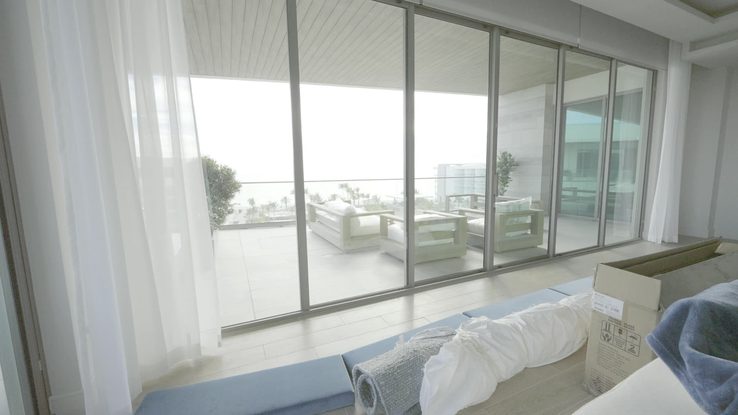
There is one more driver that is specific to the homes we work in: glass. A room with a 20 ft wall of floor-to-ceiling glass needs something soft to balance it, and a linen sheer diffuses Florida light into a glow without killing the view.
Six trends inside the linen trend
Wide-width and seamless
Linens woven 118 in wide are railroaded and sewn without a seam, then cut to the room rather than to a packet length. On a 10 to 12 ft ceiling that is the only way a panel reaches the floor. Ready-made curtains stop at 120 in long.
Ripplefold on a track, at real fullness
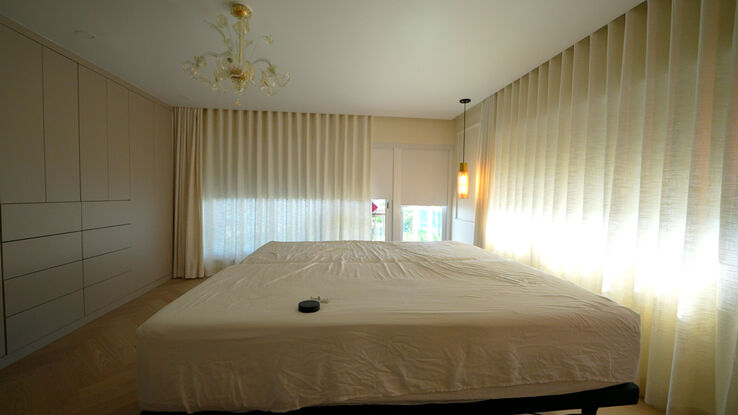
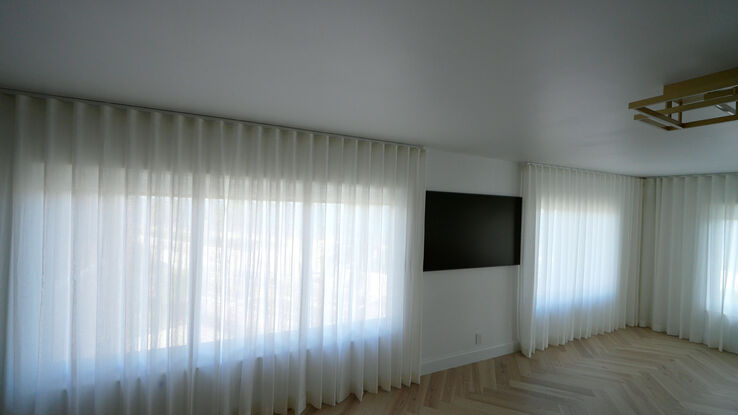
Linen's slight slub reads best in an even, repeating wave. We usually call 120% fullness for oceanfront sheers, deep enough that the wave still reads when the panel is drawn. On a motorized track nobody pulls the fabric by hand, which keeps linen cleaner and the folds even. See ripplefold draperies.
Warm whites and soft greys, not stark white
Chalk, fog, rain, parchment. At the Ritz-Carlton Residences Miami Beach the children's rooms have Jean de Merry Mirage in Fog, a 100% Belgian linen, and Fabricut Composite in Rain, an open-weave linen sheer.
Blends that earn their place
Cotton-linen keeps the look with less movement: the Boca Raton oceanfront living room is Villa Nova Geneva in Chalk, 60% cotton and 40% linen. Wool-linen goes where a Roman needs body: Kravet Couture Spume (30% linen, 18% wool) at Landmark Ranch Estates. The newest blends mix linen with recycled polyester and organic cotton for stability.
Linen in front, blackout behind
Linen does not black out, and it should not try. The layered answer is a linen sheer or drapery for the day and a blackout roller in side channels behind it for the night, both on motors.
Relaxed headings
Ripplefold, a two-finger pleat tacked at the top, or a tailored inverted pleat under a recessed pocket. Where a heavier linen drapery is wanted, interlining gives it the weight and fall of a hotel suite.
Linen in South Florida: what the trend articles don't tell you
Most linen trend pieces are written for a dry, grey climate. Ours is humid, bright and salty, and linen notices.
It moves with humidity
Linen can take up around 20% of its weight in moisture before it feels damp (Sew Unordinary), so a 100% linen panel grows in wet weather and draws back in dry air. A panel that is perfect at install can change after a few weeks of sun, humidity and gravity (Workroom Tech). Our fix: floors are rarely level in an older building, so we cut to the shortest measurement of the opening and steam the panels in place. Linen that kisses the floor looks right; linen cut to touch it will break. A cotton-linen blend moves much less.
It reacts to sun
Florida UV fades and weakens natural fibres, and an unlined linen panel on a west window is the classic expensive mistake. A lining takes the ultraviolet before it reaches the face fabric and keeps the panel hanging plumb instead of clinging to the glass. On an ocean-facing or west wall, the better plan is a solar screen behind the linen doing the sun work, and the linen doing the softness.
It needs the height
Our clients' ceilings run 10 to 12 ft, and glass walls run 20 ft and more. Wide-width linen, sewn seamless and cut to the room, is what makes a linen sheer look intentional at that scale.
Romans need a stabilizer
A linen Roman shade stretches under its own weight; a fused backing keeps the folds square.
What we would skip
- Unlined 100% linen on a west or ocean-facing wall
- Linen asked to black out a bedroom on its own (put a blackout roller behind it)
- Linen cut exactly to the floor, or puddled where people walk
- Ready-made linen curtains on a 10 ft or higher ceiling
- A linen Roman without a stabilizing backing
- Buying "linen" off a label without reading the composition (next section)
Seen at: Oceanfront condo, Boca Raton: the master has 100% linen in Kravet Basics 4843-1, a 118 in wide-width woven in France, on a recessed Somfy Irismo 45 track, with Berlin Snow White blackout rollers in side channels behind it; the living room is Villa Nova Geneva cotton-linen in Chalk. St. Regis Longboat Key: great-room sheers in Mitchell Meadow Breeze Winter at 120% fullness.
What "linen" on a label really means
We counted. Of the 438 fabrics in the Alendel sheer and drapery library we sell, 98 contain linen. Of those 98, 38 are 10% linen or less, 22 are half linen or more, and exactly one is 100% linen. A few more are simply coloured "Linen" and contain none. Always read the composition line, not the name.
| 100% linen | Linen-rich blend (50%+ linen) | Low-linen blend (10% or less) | Linen-look polyester | |
|---|---|---|---|---|
| Look and hand | The real slub and irregular weave | Close to pure linen | Linen tone, smoother hand | Printed or woven slub effect |
| Moves with humidity | Most | Less | Little | Least |
| Sun | Needs a lining or a screen behind it | Needs a lining or a screen behind it | Better | Best in solution-dyed or UV-stable weaves |
| Best for | Bedrooms, north and east glass, stationary panels | Living-room sheers on big glass | Secondary rooms, tighter budgets | West and ocean walls, pool houses |
| Where we used it | Boca Raton condo master (Kravet Basics 4843-1); Ritz-Carlton Residences Miami Beach (Jean de Merry Mirage) | Boca Raton condo living room (Villa Nova Geneva, 40% linen) |
What linen drapery costs
Custom sheers, linen included, are $85 per linear foot of track width on a manual track in a house and $95 in a condo unit: a 20 ft glass wall is about $1,700 or $1,900. A 12 ft motorized drapery track is about $1,452 track only, or $2,833 with a smart-hub motor, ceiling mount and lined drapery sewn in our workroom. Figures are budgetary and before tax; see custom draperies and the pricing guide.
Frequently asked questions
Is linen drapery still in style in 2026?
Yes. Natural fabrics and texture lead the designer trend lists for 2026, and on our own schedules linen and cotton-linen are the rising request for sheers.
Is linen a good idea in South Florida?
Yes, with the right build: lined or backed by a solar screen on sunny walls, cut to kiss the floor, and a cotton-linen blend where the room is humid or the panel must stay exact.
Does linen drapery shrink or stretch?
It does both with humidity. Expect the hem to move through the seasons; that is why we cut to the shortest point of the opening and steam in place.
Can linen curtains block light?
Not on their own. Pair a linen sheer or drapery with a blackout roller in side channels behind it.
Real linen or linen-look?
Real linen for the look and the hand in bedrooms and north or east rooms; a linen-rich blend for big living-room glass; a linen-look performance weave for west walls and pool houses.
Can linen go on a motorized track?
Yes. The Boca Raton condo's linen and cotton-linen sheers run ripplefold on recessed Somfy Irismo 45 tracks, and a motor keeps hands off the fabric.
Sources
- Alliance for European Flax-Linen & Hemp: economic observatory (2025 and 2026 figures)
- Alliance: European flax fibre market figures 2024
- Alliance: flax growing and expertise
- Sew Unordinary: humidity is not linen's friend
- Workroom Tech: working with challenging fabrics
- AOL: 8 window treatment trends for 2026, according to designers
- Homes & Gardens: curtain trends 2026
See linen in your own light
We bring the linen books to the house, hang a sample against your glass, and sew the panels in our own Fort Lauderdale workroom. Book a private, complimentary consultation, or start with the free guide: the 5 costly mistakes.