

Curtains vs Drapes: The Difference, and Which One Your Room Wants
September 23, 2026 · Guides · By David Martineau
Curtains and drapes hang in the same place and are not the same product. One is bought to a standard length and gathered on a rod; the other is cut to your ceiling, lined, pleated and hung on hardware chosen for its weight. This guide gives the difference in one sentence, then the parts that actually decide the result: lining, fullness, pleats, length, hardware, motorization, care and what each one costs in South Florida.
The short answer. Curtains are panels bought to a standard length, usually unlined, hung on a rod. Drapes, or draperies, are lined or interlined, pleated or ripplefold, cut and sewn to your opening and hung on a decorative rod or a track. Everyone uses the two words interchangeably, and that is fine until the ceiling is 10 to 12 ft: the longest curtain a store sells is 120 in, and nothing off a shelf reaches a ceiling track, holds a pleat across a wall of glass, or travels on a motor. Curtains cover a window. Draperies finish a room.
What is the difference between curtains and drapes?
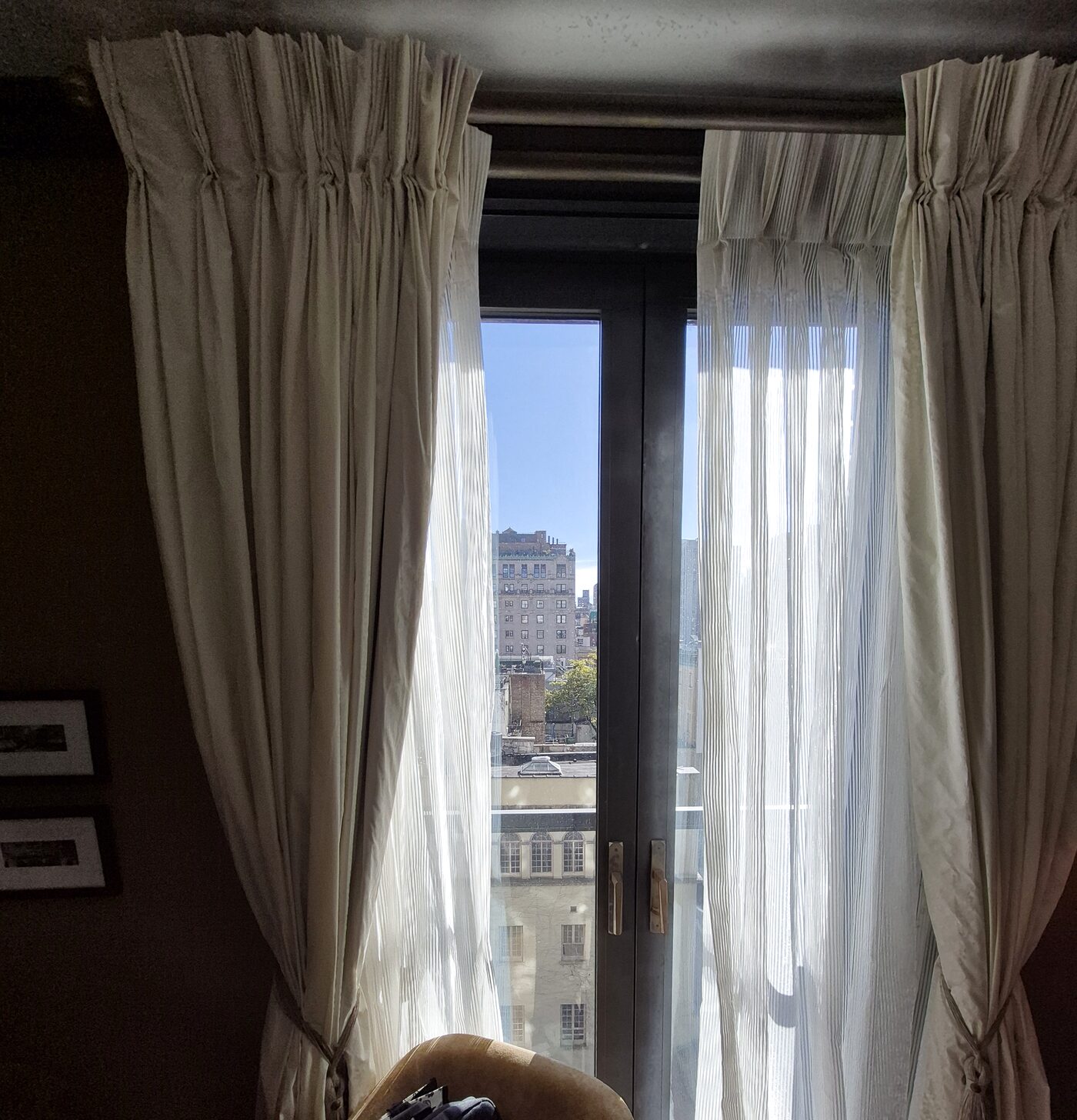
Curtains are fabric panels made to a standard length, usually unlined or lightly lined, hung from a rod through a pocket, tabs or grommets. The width is whatever the package says, the length is one of five sizes, and the panel is finished before it knows which window it is going to.
Drapes, or draperies, are cut and sewn to one opening. They are lined, often interlined, pleated by hand or snapped onto a ripplefold track, hemmed to the floor you measured, and hung on a decorative rod with rings or on a track that disappears into the ceiling. Every dimension comes off the hardware rather than the window, which is why the same room can take a 96 in curtain or a 139 in drapery.
In conversation the two words are interchangeable, and most of the people who call us about curtains are describing draperies. In a workroom they are two different things to make. Ours are cut and sewn by five in-house seamstresses in Fort Lauderdale, in the sheer, ripplefold, pinch pleat and blackout styles, from the Alendel range of 3,820 colourways in 438 patterns and the mills our designers bring us.
If you are still deciding between fabric panels and a shade or a blind at the glass, start with blinds vs shades vs drapes. All 17 treatments are defined and priced in the South Florida window treatment guide.
Curtains vs drapes: the comparison table
The table is the practical version of the difference. Prices are our own published figures, budgetary and before tax, from the pricing guide.
| Curtains (ready-made) | Draperies (sewn to your window) | |
|---|---|---|
| How it is made | Finished to a standard width and length before it meets the window | Cut and sewn to the rod or track you are hanging it on, in our own workroom |
| Lining | Unlined or a light backing sewn in at the factory | Lined, interlined or blackout-lined by choice; sheers stay unlined on purpose |
| Length | 63, 84, 96, 108 or 120 in, whichever is closest | Top of the rod or underside of the track to the floor, at a float, break or puddle |
| Fullness and header | Roughly the width of the window; rod pocket, tab or grommet | 2 to 2.5 times the width for pinch pleat, 2.5 to 3 for sheers, or 80 to 120% ripplefold on carriers |
| Hardware | A rod, hand-drawn | Decorative rods with rings, low-profile track, bent track, or a track recessed into the ceiling |
| Light and darkness | Filters light; leaks at the sides, the header and the hem | Sewn-in blackout lining with a return to the wall and a center overlap for a dark room |
| Heat and sound | Little of either | Lining plus interlining blocks solar gain on east and west glass and quiets a room of hard surfaces |
| Motorization | Only if the header suits the carriers | Built for the track: Somfy Glydea or Irismo, Lutron Sivoia QS, or our Essential tier |
| Care | Usually machine washable | Vacuum between dry cleanings; sheers can often be laundered |
| Cost | The least expensive way to cover a window | Sheers $85 per linear foot of width in a house, $95 in a condo; a 12 ft motorized track about $1,452 track only, about $2,833 with a smart-hub motor and lined drapery |
| Where it belongs | Guest rooms, rentals, short windows, standard 8 ft ceilings | Living and dining rooms, primary bedrooms, walls of glass, 9 to 12 ft ceilings, anything motorized |
What a workroom does that a package cannot
The gap between the two products is not the fabric. It is the eight or nine steps between the bolt and the wall.
- Lining. It carries the ultraviolet load, gives the face fabric body and keeps the panel hanging plumb instead of clinging to the glass.
- Interlining. A soft layer between face and lining: the step that gives silk and linen their weight, adds insulation against the sun and absorbs sound in a bedroom or a media room.
- A buckram header. A stiffened band the pleats are set into, so the top of the panel stays crisp for years rather than rolling forward.
- Hand-tacked pleats. Fingers tacked at the base so they break into deep, regular folds and do not splay.
- Weighted hems and matched seams. Hems weighted so the fabric hangs straight, patterns matched across widths, panels pressed and steamed before they leave.
- Wide-width goods, railroaded. Sheers run sideways off the roll so a 20 or 30 ft wall of glass has no seam in it at all.
- Cut to your ceiling. At Landmark Ranch Estates the sheers run to sixteen feet and finish flush to the stone floor, on wired Somfy Glydea 60 tracks buried in ceiling pockets.
Pleats, waves and headers: the top of the panel decides the look
Pinch pleat, also called the French pleat, gathers the fabric into fingers tacked by hand at the base. Two fingers read lighter and more contemporary, three fingers give the fuller formal classic, and a top-tacked Euro or Parisian pleat is the same construction finished differently. Fullness is 2 to 2.5 times the rod or track width. This is the header for decorative rods and formal rooms. See pinch pleat draperies.
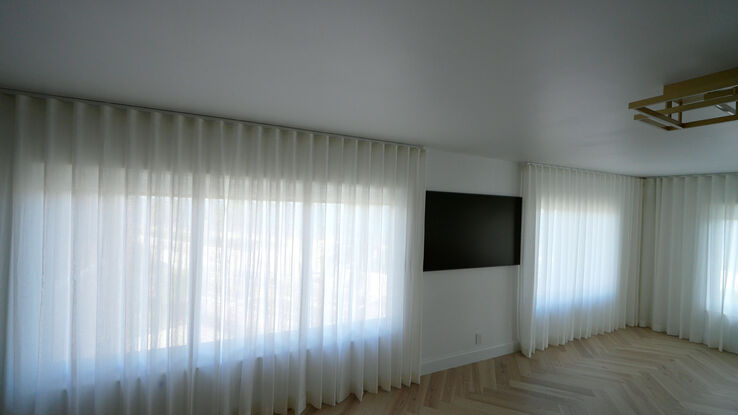
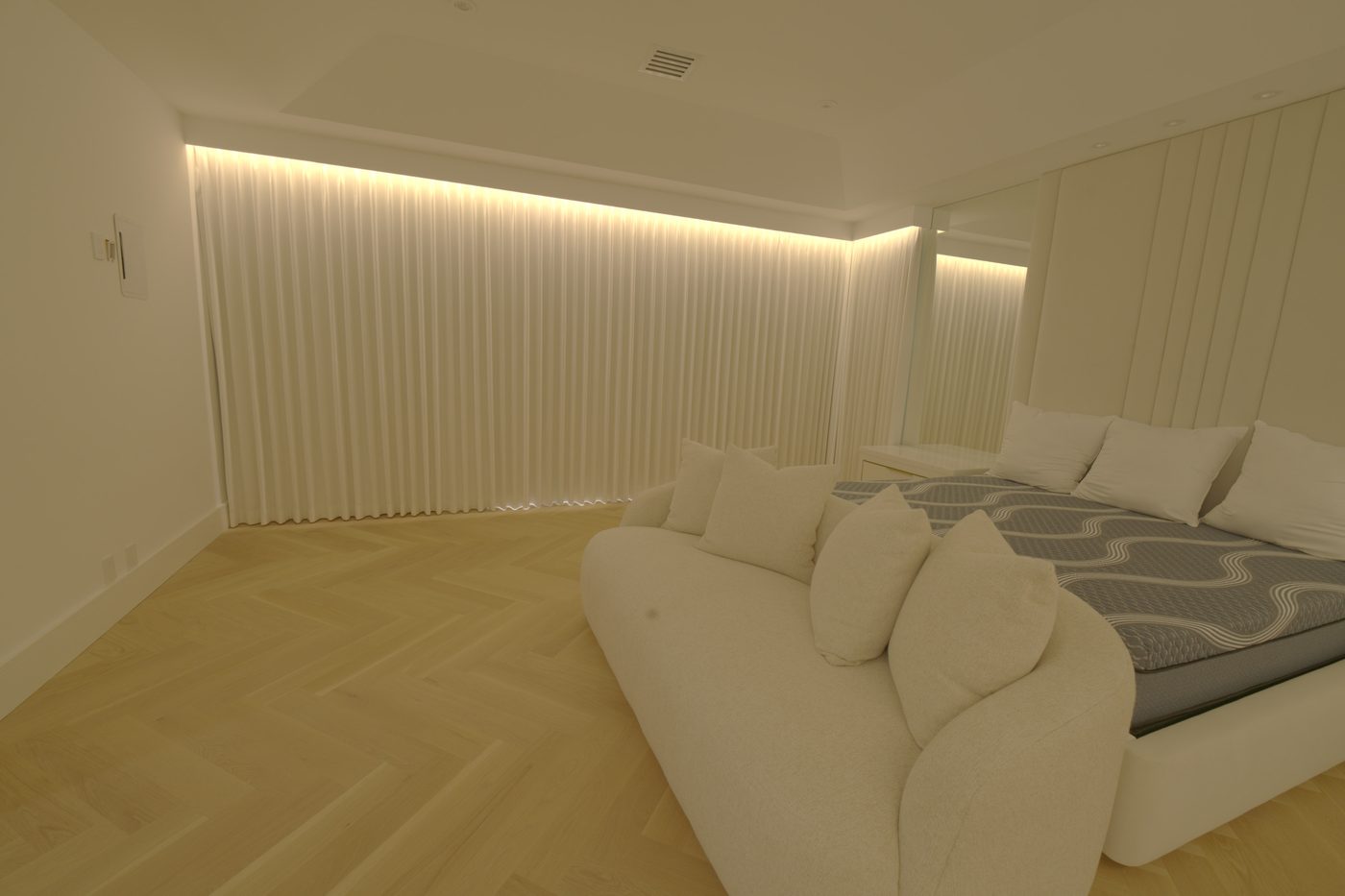
Ripplefold has no pleats at all: a snap tape sewn to the heading clips onto carriers riding in a low-profile track, and the fabric stands in one continuous S-wave from end to end. The carrier spacing sets the fullness, 80% for a shallow contemporary wave, 100% for the standard, 120% for deep folds and our usual recommendation for sheers on oceanfront glass. It stacks tightly, rides a bent track around a corner and motorizes naturally. See ripplefold draperies.
Sheers are sewn at 2.5 to 3 times the width, because a thin fabric at low fullness looks like a flat panel and at high fullness looks like light itself. At Turnberry Ocean Club they are wide-width Romo goods; in a Boca Raton oceanfront condo they are a Villa Nova Geneva in 60% cotton and 40% linen. See sheer draperies and the Alendel sheer range.
Rod pocket, tab top and grommet headers are what most ready-made curtains use. They are made to be pushed open by hand and they never traverse cleanly, which is the first thing people notice when they try to put a store panel on a motorized track.
How long should they be, and why ready-made lengths fail here
Draperies are measured from the hardware, not from the window, so the first decision is where the rod or the track goes: 4 to 6 in above the frame on a standard window, higher in a tall room, or at the ceiling on floor-to-ceiling glass, and at least 6 in past the frame on each side so the open panels stack on the wall instead of on the view.
Then the length, from the top of the rod or the underside of the track to the floor:
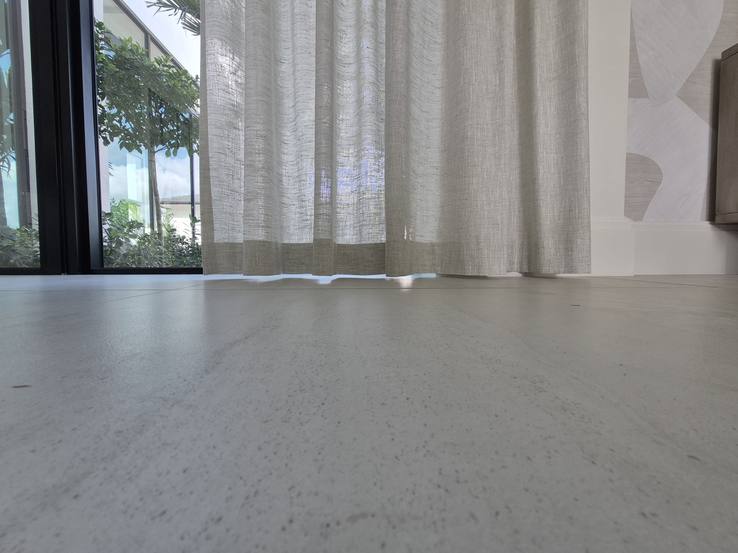
- Float, the floor minus 1/2 in, or 1 in on carpet: anything that opens and closes every day, and the cleanest line on tile and wood.
- Break, the floor plus 1 to 2 in: stationary panels and formal rooms, and it hides a floor that is not perfectly level.
- Puddle, the floor plus 3 to 6 in: stationary panels only, in silk, linen or velvet, where nobody walks.
- Sill or apron: over a counter, a radiator or a piece of furniture.
Ready-made curtains come in 63, 84, 96, 108 and 120 in. On the 10 to 12 ft ceilings we work on every week, there is no length on that list that reaches a ceiling-mounted track, and a panel that stops 6 in short of the floor is the detail that makes a whole room look rented. The full method, with the diagrams, is in how to measure.
Which is better for South Florida sun, humidity and salt air?
Lined draperies, and it is not close. Sun here is relentless, the humidity is constant and salt gets into everything within a mile of the water. Three things carry it: the lining, which takes the ultraviolet before it reaches the face fabric; the interlining, which adds insulation on east and west exposures; and the fabric itself, a performance voile or linen chosen for coastal exposure rather than a delicate weave that will fade and sag in a season. An unlined panel on a west window is the expensive mistake, and it is exactly what a store sells.
The better answer on a hot wall is two layers: a solar screen or a blackout shade at the glass, a drapery in front of it. The shade handles heat and glare all day, the fabric handles softness, privacy at night and the scale of the window. More on fabric for the coast in custom draperies for coastal living.
What custom draperies cost, and what a store panel costs
Our published figures, budgetary and before tax, September 2026:
- Custom sheers: $85 per linear foot of width on a manual track in a house, $95 in a condo unit, where the installation takes more time. A 20 ft glass wall is about $1,700 in a house and about $1,900 in a condo.
- Motorized track, track only: about $1,452 for a 12 ft track with a rechargeable motor, remote and installation, on our track calculator.
- Motorized track with drapery: about $2,833 for the same 12 ft track with a smart-hub motor, ceiling mount and lined drapery sewn in our workroom.
- Motorized blackout drapery in a recessed pocket: about $3,691 on a 16 ft track with smart-hub control.
A ready-made curtain is the cheapest way to put fabric on a window, and that is a real answer for a guest room or a rental. What you are buying with a custom drapery is the length, the fullness, the lining and the hardware that carries it, which is the difference between fabric at a window and a finished room. Price your own opening on the track calculator or the instant price tool, or read the full tables on the pricing guide.
Rods or tracks, and what motorization changes
Hardware is where drapery succeeds or fails, and it is decided before the fabric. A decorative rod with rings is meant to be seen: metal and finials chosen with the rest of the room's hardware, drawn by hand. A low-profile track disappears above the panels and carries weight a rod cannot. A recessed track in a ceiling pocket shows nothing at all but fabric, which is how a modern glass wall is dressed. Bent track takes a corner, a bay or a radius in one continuous run.
Motorization changes what the panel has to be. The header must suit the carriers, the weight and the run decide the motor, and the fabric is fabricated to the finished track length:
- Somfy Glydea, hardwired: up to 132 lbs on a single motor, runs to 36 ft, and a true silent mode under 38 dBA for bedrooms and media rooms.
- Somfy Irismo WireFree: battery motorization for finished homes and condos where getting power to the track means opening a ceiling.
- Lutron Sivoia QS and our Essential tier: the integrated estate on one system, or reliable everyday automation on a straightforward run.
Real rooms: Crestron QMT tracks travel the drapery open to the terrace at St. Regis Longboat Key; a white Fabricut sheer runs on a recessed Crestron track in the primary suite at Trump Tower III; at a Boca Raton home a blackout drapery closes as one line around three angled windows on two bent motorized tracks. More at motorized curtain tracks and motorized drapes.
Room by room: curtains, drapes or neither
| Room | What we hang | The common mistake |
|---|---|---|
| Living room with a view | Sheers on a track, ripplefold at 120%, over a solar shade | Heavy lined panels that eat the light and the view |
| Primary bedroom | Blackout drapery with a return to the wall and a center overlap, or sheers over a blackout shade | An unlined curtain and the expectation of a dark room |
| Dining room | Pinch pleat draperies on a decorative rod, lined and interlined | Bare glass at night, or panels hung at frame height in a tall room |
| Media room | Interlined blackout panels over a channeled blackout shade | Fabric alone: the light comes in around it |
| Guest room | A ready-made curtain is a fair answer here, on a simple rod | Spending the drapery budget where nobody sleeps twice a year |
| Kitchen, bath, laundry | Neither: faux wood blinds or a washable roller shade | Fabric panels next to a sink, a stove or a shower |
| Condo slider | Ripplefold sheers on a battery track, stacked on the fixed side | A rod-pocket panel that blocks the door you use every day |
| Double-height glass or a stairwell | Custom panels on a ceiling or recessed track, engineered traverse | Two standard lengths sewn together |
Can you hang drapes over blinds or shades?
Yes, and the rooms we are proudest of almost always do. Sheers over a solar roller is the pairing we install most: the shade takes the heat and the glare by day, the fabric gives softness and night privacy. A blackout drapery over a screen shade turns an oceanfront bedroom from a view at breakfast into a dark room at ten. The rule is one system at the glass and one in front of it, both on the same control, so shades, blinds and drapery tracks answer the same keypad. On a new build, the shade pocket and the drapery track are drawn into the ceiling together: see recessed window treatments and blinds vs shades vs drapes.
Quick decision guide
- Ceiling at 8 ft, guest room or rental: ready-made curtains are a fair answer
- Ceiling at 9 to 12 ft, or a ceiling track: custom draperies, cut to the hardware
- Wall of glass or a slider: ripplefold on a track, stacked off the glass
- Formal living or dining room: pinch pleat on a decorative rod, lined and interlined
- The room has to be dark: blackout lining, return to the wall, center overlap, ideally over a shade
- You want it on a schedule or a keypad: a motorized track, with the drapery made for it
- Kitchen, bathroom or laundry: neither; use a blind or a washable shade
- Not sure yet: hang the shade now and plan the track, so the drapery can come later without redoing the ceiling
Frequently asked questions
What is the difference between curtains and drapes?
Curtains are unlined or lightly lined panels made to a standard length and hung on a rod. Drapes, or draperies, are lined and often interlined, pleated or ripplefold, and cut and sewn to your opening, then hung on a decorative rod or a track. In conversation the words are interchangeable. In a workroom they are two different products, and the difference shows in how the fabric hangs.
Are curtains and drapes the same thing?
In everyday speech, yes, and most people who call us about curtains are describing draperies. The useful distinction is construction: a panel bought to a standard length, or a panel cut to your rod height with a lining, a buckram header and a weighted hem.
Do drapes have to be lined?
No, and sheers never are. Lining is what carries the ultraviolet load, gives the face fabric body and keeps a panel hanging plumb, so any opaque drapery on a sunny South Florida wall is better lined. A sheer works unlined because it is meant to filter light, not stop it.
What is interlining and do I need it?
Interlining is a soft layer sewn between the face fabric and the lining. It adds body, insulation and quiet, and it is what makes silk and linen hang the way they do in photographs. It belongs on formal rooms, bedrooms and media rooms; it is optional everywhere else.
Should curtains touch the floor?
Yes, or nearly. Float is the floor minus 1/2 in, 1 in on carpet, and it is the right choice for panels that open and close every day. A break of 1 to 2 in suits stationary panels and hides an uneven floor. A puddle of 3 to 6 in belongs only where nobody walks.
How much fullness do curtains need?
Pinch pleat draperies are sewn at 2 to 2.5 times the track or rod width, sheers at 2.5 to 3 times. Ripplefold is set by the carrier spacing on the track: 80% for a shallow wave, 100% for the standard, 120% for deep folds, our usual choice for sheers on oceanfront glass. A ready-made panel is usually the width of the window, which is why it looks flat when you close it.
Are ready-made curtains ever the right answer?
Yes: a guest room, a rental, a short window over a counter, or any opening where the standard lengths of 63, 84, 96, 108 and 120 in happen to fit. They stop being the answer on 10 to 12 ft ceilings, on wide glass, on a motorized track, and anywhere the panel has to hold a pleat.
Which blocks more light, curtains or drapes?
A lined drapery, by a wide margin. Real darkness needs a sewn-in blackout lining, a return that carries the panel back to the wall and a generous center overlap where the pair meets. An unlined curtain leaves light through the fabric and around every edge.
Can curtains be motorized?
The track is what motorizes, not the panel, so almost any drapery can move. We hang ours on Somfy Glydea or Irismo, Lutron Sivoia QS or our Essential tier. A light ready-made panel will travel on a motorized track, but the header has to be made for the carriers, which is where most off-the-shelf curtains stop.
How do I clean drapes?
Vacuum lined panels with a brush attachment between dry cleanings. Sheers can often be laundered. A drapery that is pressed, steamed and hung straight stays cleaner, because it is not sitting against the glass collecting condensation.
What fabric holds up to South Florida sun and salt air?
Performance voiles and linens, solution-dyed and treated weaves, and anything with a lining between the face fabric and the window. Unlined silk on a west wall is the expensive mistake. Our fabric partners publish the full ranges, and we bring the swatches to the house before anything is cut.
Fabric on your windows, cut to your room
We bring the swatch books to the house, measure the hardware before the fabric, and sew the panels in our own Fort Lauderdale workroom. Book a private, complimentary consultation, or start with the free guide: the 5 costly mistakes.