

Pleated vs Cellular Shades: Why Cellular Wins Most Rooms
September 27, 2026 · Guides · By David Martineau
From across the room, a pleated shade and a cellular shade look like the same thing: crisp folds of fabric that stack neatly at the head of the window. Turn one sideways and they are nothing alike. This guide shows the difference in one picture, then everything it changes: privacy at night, darkness, heat, cords, motors, care and cost, with a source for every figure. We offer both, and we will tell you which one belongs where.
The short answer. A pleated shade is a single layer of pleated fabric, and its lift cords run through a small hole punched in every pleat. A cellular shade, also called a honeycomb shade, is two layers of pleated fabric bonded into hollow cells, with the cords hidden inside. That one difference decides the rest: no pinpoints of light, a darker blackout, and a layer of still air at the glass that Lutron rates from R 2.8 to R 4.4 across its honeycomb fabrics. For bedrooms, west-facing rooms, anything motorized and anything that has to be dark, we recommend cellular. A pleated shade earns its place where the fabric itself is the point and the room asks little of the shade.
What is the difference between pleated and cellular shades?
A pleated shade is one layer of fabric pressed into permanent pleats, usually 1 in pleats on an ordinary window and 2 in pleats on a large one. To raise it, lift cords run from the headrail to the bottom rail through a small route hole in each pleat. The single layer is what makes a pleated shade light, affordable and endlessly decorative, and it is also why it does very little else.
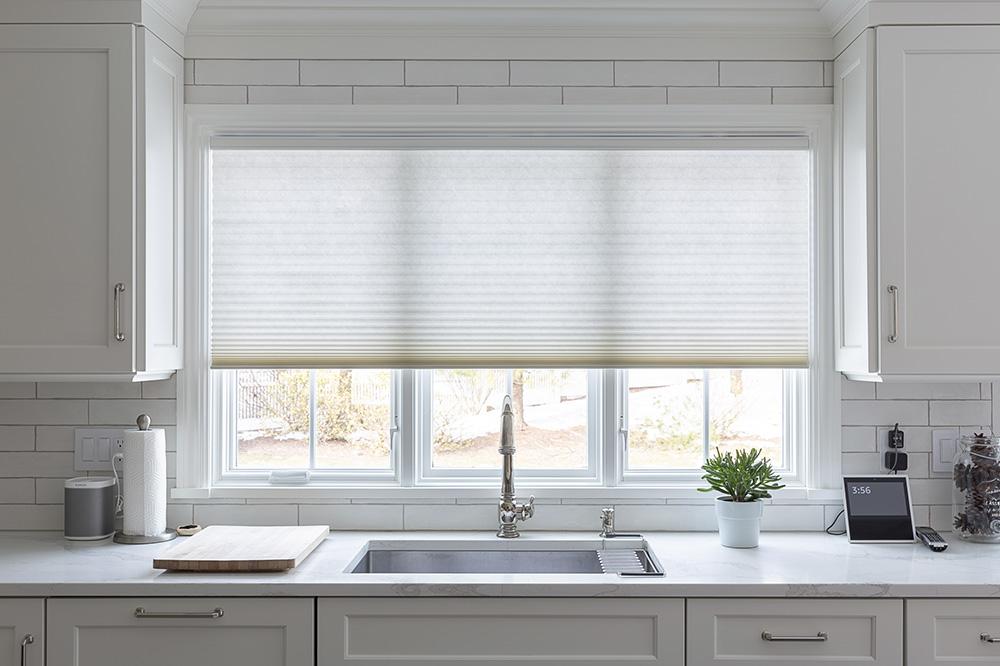
A cellular shade takes the same pleated fabric, doubles it, and bonds the two layers into a row of hollow cells that look like a honeycomb from the side. The cords travel inside the cells, so neither face of the shade has a hole in it. Cells commonly run from 3/8 in to 1 1/4 in; Lutron makes its standard honeycomb with a 9/16 in cell and its Architectural honeycomb with a 3/4 in cell. A double-cell shade stacks two rows of smaller cells for a little more insulation and a more opaque face.
Honeycomb and cellular are two names for the same shade. Pleated is the older, single-layer design it grew out of. Everything below follows from that one difference in construction.
Pleated vs cellular shades: the comparison table
The practical version of the difference. Figures are the makers' published values for the products named, listed under Sources at the end.
| Pleated shade | Cellular (honeycomb) shade | |
|---|---|---|
| How it is made | One layer of pleated fabric | Two layers bonded into hollow cells, single or double cell |
| Lift cords | Through a route hole punched in every pleat | Inside the cells, hidden from both faces |
| Pinpoints of light | Yes, at every route hole, even with a blackout liner | None through the face |
| Darkness | Blackout only with a liner, and the route holes still pass light | Light-filtering, room-darkening and blackout cells; the edges are the only leak |
| Insulation | No cells, so no layer of still air | Lutron rates its honeycomb fabrics R 2.8 to R 4.4 |
| South Florida sun | Shades the glass | Shades the glass, holds still air against it, and Lutron's standard honeycombs carry a white reflective backing |
| Fabric choice | The widest: prints, textures, metallics, sheers | Solids and textures in a good colour range, fewer prints |
| Look | Crisp, tailored folds | Soft, rounded cells |
| Opens from the top | Top-down/bottom-up available | Top-down/bottom-up available; we build it cordless or motorized |
| Motorization | Somfy Cord Lift WireFree motors in the headrail; no pleated shade in Lutron's current line | Somfy Cord Lift WireFree, or Lutron Triathlon and Serena honeycomb on Caseta, RadioRA 3 or HomeWorks |
| Inside-mount depth | The same as cellular in the same headrail | The shallowest shade we make: about 1 in to fit, 1.5 to 2 in to sit flush |
| Care | Vacuum with a soft brush | Vacuum with a soft brush; blow dust out of the cells on a cool setting |
| Cost | Usually the less expensive of the two | Usually more; the gap narrows once both are motorized, because the motor is the same |
| Where it belongs | Rooms that ask little, where the fabric is the point | Bedrooms, nurseries, media rooms, west-facing rooms, skylights, anything automated |
The route hole: why pleated shades leak light and privacy
Every pleated shade has to get its lift cords from the headrail to the bottom rail, and the only way through a single layer of fabric is a hole. The holes line up in a column at every lift cord, and when the sun is behind the shade each one is a pinpoint. One pleated maker sells its darkest liner for exactly this reason, so that objects stop appearing even as silhouettes from outside, and still notes in its own specification that light will filter through the route holes.
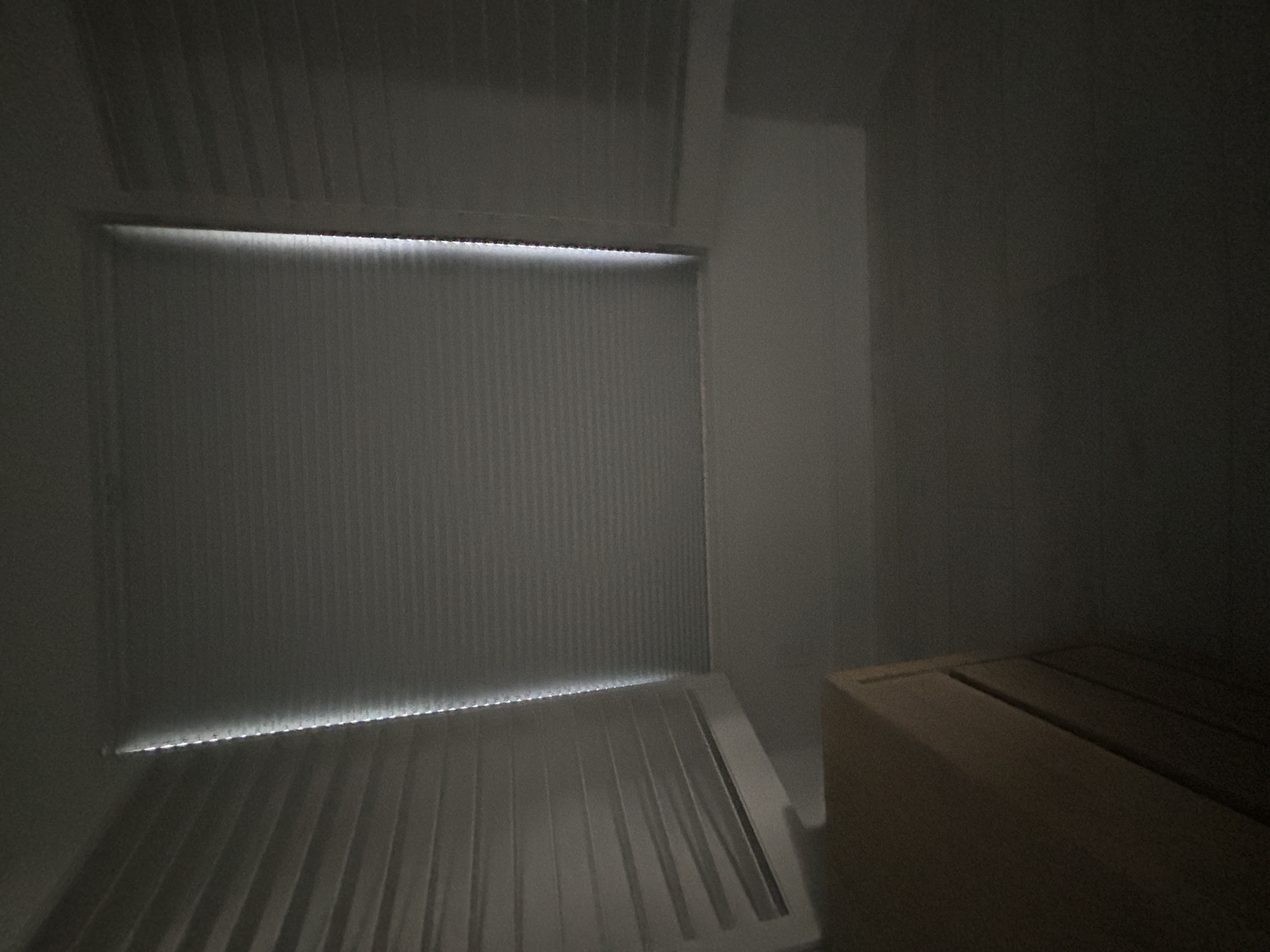
In a living room at noon nobody notices. In a primary bedroom at six in the morning, a nursery at nap time or a media room, it is the first thing you see. A cellular shade has nothing to line up: the cords run inside the cells and the face is one continuous piece of fabric. The only light a blackout cellular lets in comes around the edges, and that has a fix.
The edge gap. Any shade mounted inside the frame needs a small clearance at each side so it can travel without rubbing; Lutron specifies 1/8 in per side on its Architectural honeycomb. In a daytime room it does not matter. In a room that has to be dark, we mount the shade outside the frame so it overlaps the opening, or add side channels, and the room goes dark. More in inside vs outside mount and blackout shades.
Which is more energy efficient in South Florida?
Cellular, and it is the whole reason the design exists. Still air is an insulator, and the cells hold a layer of it against the glass. Lutron publishes the values for its honeycomb fabrics: R 3.5 for single-cell light-filtering Rio, Monaco and Cyprus, R 3.6 for double cell, R 4.3 for room-darkening, and R 4.4 for Kyoto and Madrid Blackout. A pleated shade has no cells: its single layer shades the glass but holds no still air against it. The full list is on our Lutron honeycomb fabrics page.
Most comparisons are written for a cold-state winter, where the job is keeping heat in. Here the job is keeping the sun's heat out for most of the year, and three habits matter more than the product name: close the shade on the sun side before the sun reaches the glass, keep a light, reflective face towards the window, and fit the shade close to the frame so the air in the cells stays still. Lutron gives its standard honeycombs a white reflective backing for that reason, and a white-backed fabric also gives a condo tower the uniform street view many associations ask for.
How much does it save? The best measured number we know comes from the U.S. Department of Energy's Lab Homes at Pacific Northwest National Laboratory: in a two-week cooling-season test with the coverings kept closed, an opaque multi-cell shade cut the test home's heating and cooling energy by 13.3% compared with an identical home fitted with vinyl blinds, and by 10.4% when both homes opened and closed their coverings on a schedule. That was Washington state, not Broward County, and your result depends on the glass, the exposure and how often the shade is down, so we do not promise a dollar figure. The direction is not in doubt.
Comparing two products? Look for the Attachments Energy Rating Council (AERC) label. AERC rates interior cellular and pleated shades with a Cool Climate and a Warm Climate number; in South Florida, read the Warm Climate one. Anything above zero can save energy compared with a bare window, a higher number means more savings, and some labels show a better rating with automation, because a motor closes the shade on time every day.
When to use neither. On a wall of glass with a view, a pleated or a cellular shade hides the view whenever it is down. A solar screen roller keeps it and cuts the glare; the trade-offs are laid out in roller shades vs honeycomb shades.
Light control, from a glow to blackout
Both come in sheer, light-filtering, room-darkening and blackout fabrics. The difference is what happens at the holes and the edges. A light-filtering cellular gives a soft, even glow with daytime privacy, which is why we like it in offices and street-facing rooms. Room-darkening cells use an opaque face; a little light can still enter at the edges. Blackout cells, such as Lutron's Kyoto and Madrid Blackout, stop light through the fabric completely. A pleated shade reaches blackout only with a liner, and its route holes still let the light through.
Top-down/bottom-up, cordless and motorized
Both designs can open from the top, from the bottom, or both. Top-down/bottom-up is the answer for a bathroom, a home office or a street-facing bedroom: privacy below, sky above. We build it in cellular, cordless by hand or motorized.
Cordless is our default on every shade a hand can reach, and motorized when the windows are tall, wide or many. Cord rules are tightening: the voluntary ANSI/WCMA A100.1-2022 standard already prohibits accessible, free-hanging operating cords longer than 8 in on custom window coverings, and on September 24, 2026 the U.S. Consumer Product Safety Commission proposed updating the window covering cord rules on its Substantial Product Hazard List to that 2022 standard, operating cords on custom window coverings included, naming cellular and pleated shades among the products covered. A cordless or motorized shade is the one that will not need rethinking.
This is where cellular pulls furthest ahead. Lutron's current residential line has honeycomb shades and no pleated shade, so in a house that runs on Lutron the choice between the two is already made: Triathlon on batteries or low-voltage wiring, or Serena, on Caseta, RadioRA 3 or HomeWorks, motorized up to 96 in wide and stopping within 1/8 in so a row of shades lines up. Lutron lists three to five years of battery life for its wire-free Triathlon honeycomb, on estimates that assume two up-and-down cycles a day.
Somfy's Cord Lift WireFree battery motors fit inside the headrail of either type, from $135.65 for the TLW25 RTS to $173.50 for the TLW25 Zigbee, retail, product only; see the Somfy cord lift and top-down bottom-up motors. Because the motor costs the same for both, motorizing narrows the price gap between pleated and cellular. More on drives in Lutron motorized shades and motorized shades.
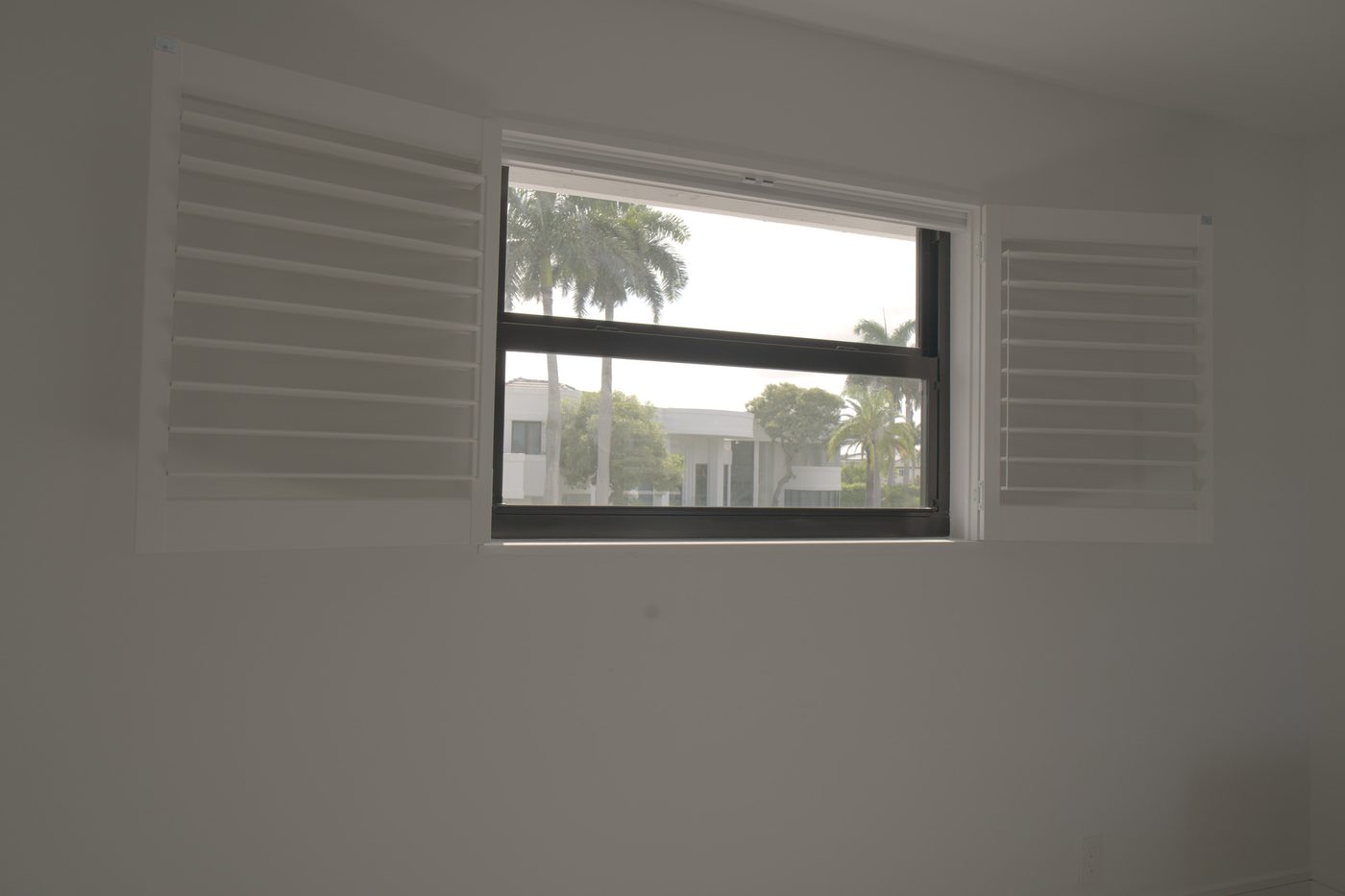
Seen at a golf course home in Boca Raton. The owner wanted plantation shutters for the look and a completely dark morning, which louvers alone cannot give. We fitted a blackout honeycomb behind each shutter, Coulisse Edmonton in White, on Somfy Cord Lift WireFree CL32 RTS motors. The windows sit 18 feet up, with a staircase in the way and no power at the openings, so Somfy solar panels on the glass keep the batteries charged. Shutters open, the honeycomb disappears; both closed, the room is dark. The whole project is in the golf course home case study.
Where a pleated shade still makes sense
We offer pleated shades and we will quote one when it is the right call. It usually comes down to four situations:
- When the fabric is the point. Pleated shades come in the widest range of prints, textures, metallics and sheers, and the crisp fold reads more tailored than a soft cell.
- When the budget has to stretch across a whole house. A pleated shade usually costs less than a cellular shade of the same size, so a sensible plan puts cellular in the bedrooms and the west rooms and pleated where the room asks little.
- In rooms that never need to be dark or cool: a hallway, a laundry, a guest room used a few nights a year, a window with no direct sun on it.
- Behind a drapery that does the night work, where the shade only has to soften the daylight.
Where we would not put one: a primary bedroom, a nursery, a media room, any room the AC fights in the afternoon, any street-facing room at night, and anywhere the house runs on Lutron.
Single cell or double cell?
For most South Florida rooms, single cell is enough. Double cell adds a small insulation gain, R 3.6 against R 3.5 in Lutron's Rio and Monaco, and a more opaque face; single cell is lighter, stacks smaller and comes in more colours and in room-darkening. Cell size is mostly about scale: a small cell suits an ordinary window, a larger cell reads better across big glass, the same logic that puts 2 in pleats on large pleated shades.
Care in humidity and salt air
Both are fabric shades for air-conditioned rooms. Vacuum them with a soft brush attachment; on a cellular shade, a hair dryer on the cool setting blows dust and the occasional insect out of the cells. Neither belongs on an open lanai, where humidity and salt air work on any fabric; that is a job for outdoor shades.
What pleated and cellular shades cost
Both are made to measure, and we quote both per window after the free measure, because size, cell, fabric and drive move the number more than the type does. As a rule a pleated shade is the less expensive of the two in the same size and fabric grade, and the difference shrinks once both are motorized: the Somfy cord lift motor is the same $135.65 to $173.50, retail, product only, whichever shade it lifts, with installation quoted at the measure. The shades we do price online are on the pricing guide and the instant price tool.
If the budget is the deciding factor, do not split the difference evenly across the house. Spend on cellular where a shade works hardest, the bedrooms and the sun-facing rooms, and save where it does not.
Room by room: pleated, cellular or something else
| Room | What we would fit | Why |
|---|---|---|
| Primary bedroom | Blackout cellular, outside mount or side channels | Dark without pinpoints, still air at the glass |
| Nursery | Blackout cellular, cordless or motorized | No cord within reach, no holes, dark at nap time |
| Media room | Blackout cellular in side channels, or a channeled blackout roller | The edges are the only leak left, and the channels close them |
| West-facing living room | Light-filtering cellular on a schedule | Insulation where the AC works hardest, closed before the sun reaches the glass |
| Living room with a view | Neither: a solar screen roller shade | Keeps the view and cuts the glare; a cellular hides the view when it is down |
| Home office | Light-filtering cellular, top-down/bottom-up | An even glow without screen glare, privacy below |
| Bathroom | Top-down/bottom-up cellular | Privacy below, daylight above |
| Street-facing room at night | Room-darkening cellular | An opaque face: no silhouettes, no pinpoints |
| Behind plantation shutters | Blackout cellular | The shutters give the look, the cells give the dark |
| Skylight | Cellular in tensioned side tracks | Holds flat overhead, closes on a schedule over the hottest hours |
| Hallway, laundry, guest room | Pleated is a fair answer | Little to insulate or darken, so the fabric can lead |
Quick decision guide
- The room has to be dark: blackout cellular, outside mount or side channels
- The AC struggles in the afternoon: cellular, closed on the sun side on a schedule
- The house runs on Lutron: cellular, because Lutron's current line has no pleated shade
- Privacy below and sky above: top-down/bottom-up cellular
- The view is the point: neither; a solar screen roller
- The fabric is the point and the room asks little: pleated
- The budget has to cover the whole house: cellular where it works hardest, pleated where it does not
- Not sure: we bring both to the house, so you see them side by side in your own light
Frequently asked questions
What is the difference between pleated and cellular shades?
A pleated shade is one layer of pleated fabric, and its lift cords run through a small hole punched in every pleat. A cellular shade is two layers of pleated fabric bonded into hollow cells, with the cords hidden inside. From the front they look alike; the cells are what give a cellular shade its insulation, a darker blackout and a face with no pinpoints of light.
Are honeycomb shades and cellular shades the same thing?
Yes. Honeycomb describes the shape of the cells seen from the side and cellular describes the construction. Makers use either name for the same product. Pleated is the older, single-layer design it grew out of.
Are cellular shades worth the extra cost over pleated?
In any room that has to be dark, cool or private at night, yes: of the two, only the cellular shade holds an insulating layer of air, reaches blackout without pinpoints and comes in a Lutron version. In a hallway or a guest room that asks little of a shade, a pleated shade is a fair saving.
Do pleated shades give privacy at night?
With its darkest liner, mostly, but light still comes through the route holes. One pleated maker's darkest liner is sold to stop objects showing even as silhouettes from outside, and the maker still notes that light filters through the route holes. A room-darkening or blackout cellular shade has an opaque face and no holes.
Which is better for a bedroom, pleated or cellular?
Cellular, in blackout. The fabric stops the light, there are no route holes to leak it, and an outside mount or side channels close the edges. Lutron rates its Kyoto and Madrid Blackout honeycomb fabrics at R 4.4, the highest value in its range.
Do cellular shades keep a house cooler in Florida?
They help most in the rooms the sun hits. The cells hold still air at the glass and a white reflective backing sends part of the sun back out. In a two-week cooling-season test at the U.S. Department of Energy's PNNL Lab Homes, with the coverings kept closed, cellular shades cut the test home's HVAC energy by 13.3% compared with vinyl blinds, and by 10.4% on an open-and-close schedule. Results depend on the glass, the exposure and how often the shade is down, so we do not promise a dollar figure.
Can pleated and cellular shades be top-down/bottom-up?
Both designs can be built that way. We build top-down/bottom-up cellular shades, cordless or motorized, for bathrooms, home offices and street-facing bedrooms: privacy below, sky above.
Can pleated and cellular shades be motorized?
Yes. Somfy's Cord Lift WireFree battery motors fit inside the headrail of either type. Lutron's current residential line has honeycomb shades, on Triathlon and Serena, and no pleated shade, so in a house that runs on Lutron the choice is cellular.
Single cell or double cell?
Single cell is enough for most South Florida rooms. Double cell adds a small insulation gain, R 3.6 against R 3.5 in Lutron's Rio and Monaco fabrics, and a more opaque face; single cell is lighter, stacks smaller and comes in more colours and in room-darkening.
How do you clean cellular shades?
Vacuum both faces with a soft brush attachment. On a cellular shade, a hair dryer on the cool setting blows dust and the occasional insect out of the cells.
Are pleated shades out of style?
Not out of style so much as out-performed. The crisp pleat and the range of prints still suit some rooms, but for insulation, darkness and privacy the cellular shade does the job better, which is why it is the one we show first.
Do you sell pleated shades?
Yes. We offer both, measure every window ourselves and install with our own team, and we will quote a pleated shade when it is the right call. We show the cellular version next to it first, because in most rooms it is the better shade.
Sources
- Lutron: Triathlon honeycomb shades (9/16 in cell, up to 96 in wide, 1/8 in stopping accuracy, white reflective backing)
- Lutron: Serena and Triathlon Architectural Honeycomb specification 085745 (3/4 in cell, 1/8 in side light gaps)
- Lutron: residential shading product offerings
- Lutron honeycomb fabric R-values, from Lutron's fabric specifications (our fabric library)
- Lutron: Triathlon wire-free honeycomb shades (D-cell or AA batteries, three to five years)
- Lutron Application Note 561: optimizing battery life (estimates assume two cycles a day)
- Bali: pleated shades (1 in and 2 in pleats, Midnight liner, light through the route holes)
- Bali: cellular and pleated shades measuring guide (cell sizes, mounting depths)
- Pacific Northwest National Laboratory: Evaluation of Cellular Shades in the PNNL Lab Homes, PNNL-24857 Rev. 1 (2015; Richland, Washington)
- Attachments Energy Rating Council: reading the residential label
- Attachments Energy Rating Council: rated product categories (cellular and pleated shades)
- Federal Register, September 24, 2026: CPSC proposed rule on window covering cords
- Somfy Cord Lift WireFree 2026 retail prices (our Somfy library)
See both in your own light
We bring pleated and cellular samples to the house, hold them up to your windows at the hour that matters, and measure every opening ourselves. Book a private, complimentary consultation, or start with the free guide: the 5 costly mistakes.