

Frankenstein Shades: What Happens When a Motorized Roller Shade Is Built From Parts Made for Something Else
A roller shade is a small machine: a motor, a crown and a drive, a tube, an idler, two brackets, and on wide glass a coupler and an intermediate bracket between every pair of tubes. When those parts come from different makers, none of them designed for the others, the trade has a name for the result. Here is why a Frankenstein shade rattles, why coupled panels skip, what the makers' own installation guides require, and how we build every motorized shade from one system.
What a Frankenstein shade is, and why it is never quiet for long
A Frankenstein shade is a motorized roller shade assembled from parts that were never designed for each other: a Somfy or other motor pushed into a tube from one supplier, held by brackets from a second, turning on the idler out of a manual chain-clutch kit and, on a wide opening, joined to the next shade by a coupler that was made for a different tube. Every piece "fits", in the sense that the pin drops into the slot, and the shade runs on the day it is installed. Then the tube, which a motor turns at up to 28 rpm (Somfy's figure for a Sonesse 30) every time a schedule fires, finds every bit of play in the assembly and makes it audible.
The makers say so in their own fabrication notes. Somfy's Sonesse 30 data book: "Operational noise level is reduced when motor, tube, and mechanical accessories are properly adapted" to motorized applications, and "Free play must be minimized between the accessories and the end product tube to ensure quiet performance of the motor." Crestron's coupler guide: all mounting brackets "level and on the same plane", all shades "aligned along a single axis (no off-angle positioning)". Lutron's coupled-shade guide: the coupled tubes should form "as straight a line as possible". A shade built from one system meets those lines by design; a shade built from three catalogues meets them by luck.
- The idler: the idler of a manual clutch shade is not the idler of a motorized shade. The motor systems sell their own, usually on a bearing and matched to their own bracket; the clutch idler is a spring pin made to be turned by hand a few times a day.
- Coupled shades: two to six tubes on one motor need the system's own intermediate bracket, with its bearing, and a coupler keyed to that tube profile. Anything else rattles at every start and stop and lets the second panel skip and drift out of line.
- The brackets: a motor bracket and an idler bracket from one system put the tube on one centreline. Mixed brackets put the motor's axis and the idler's axis a few millimetres apart, and the fabric telescopes.
- What doing it right costs: next to nothing against the motor. On Somfy's 2026 list an idler bearing is $0.83, a steel ball bearing for a 10 mm idler pin $3.10, an anti-vibration idler end cap holder $14.04 and a heavy-duty idler bracket $40.77; the Sonesse 30 RTS motor itself is $288.60.
We install Lutron, Somfy, Crestron and Vertilux, and we buy our roller hardware as systems built around the motor. Every quotation on this page is linked to the maker's document under Sources; the field observations are our own, from the shades we replace as much as the ones we install.
The parts of a motorized roller shade, and who makes each one #
From the drive end to the idler end. In a system, one maker, or one fabricator building around one motor, designed every part on this list to turn on one axis with the least play. The right-hand column is what we find when nobody did.
Swipe sideways to see every column.
| Part | What it does | In a matched system | In a Frankenstein build |
|---|---|---|---|
| Motor bracket | Holds the motor head, which never turns. It fixes the axis of the whole shade. | Made for that motor head. Somfy publishes LT50, LT60, 400 series and universal motor brackets, and adaptor plates for RollEase SkyLine and R8 hardware.Somfy motor and idler brackets | A bracket for a different head, with a shim or a bent tab. The head sits a few millimetres off the idler's centreline. |
| Crown and drive | The crown is the ring the tube rides on at the motor head; the drive wheel at the output shaft turns the tube. | Cut to the tube's profile. Somfy publishes a crown and drive for every tube it supports: its own, RollEase, Acmeda, Louvolite, Shangri-La, ZMC and Rollerbat, and writes that the crown adapter "is required to ensure concentric operation of motor".Somfy crowns and drives | The nearest round crown, packed with tape, or a drive wheel from a tube with a different groove. The tube runs eccentric to the motor. |
| Tube | Carries the fabric; its profile locks the drive wheel and, on coupled shades, the coupler. | Sized to the width and the drop, profiled for the drive.How wide one roller shade can be | Whatever was on the shelf, often the clutch system's tube a size down. It bows across a wide window and telegraphs into the fabric. |
| Idler end | The second bearing point of the tube: the end plug and pin, or the bearing, that turns in the idler bracket. | The motor system's own idler. Somfy lists nylon and steel ball bearings for its idler pins, an anti-vibration idler end cap holder and a heavy-duty idler bracket; ZMC lists a CM idler per tube profile in its motor series and a swivel ball bearing "for smooth operation of motorized shade".Somfy tubes, end caps and idlers | The spring-pin idler out of the manual clutch kit, plastic on plastic, made to be turned by hand a few times a day. |
| Idler bracket | Holds the idler at the same height and projection as the motor bracket. | Designed as the pair of the motor bracket, on one centreline. Lutron's guide has the installer verify the bracket-to-bracket distance with a tape and the two brackets level with each other before the tube goes up.Lutron 045970 | A bracket from another catalogue. The centrelines match by chance or not at all. |
| Coupler (coupled shades) | Joins the end of one tube to the start of the next so one motor turns both. | Keyed to the tube profile, and retractable so the tube can be fitted. ZMC's retractable coupler with a metal spindle is a different part for its 1 1/2 in RS-2TU, 1 1/2 in T46 and 1 3/4 in 3TU tubes; Lutron's coupler shaft is screwed through both shafts and its hub set screws are torqued to 6.0 in-lbs; Crestron's pin seats in three detent positions.ZMC catalogueLutron 045707Crestron 7582B | A generic coupler that holds a round tube by friction or two set screws. It slips a few degrees under load, every cycle. |
| Intermediate bracket (coupled shades) | Carries the joint between two tubes. | Holds the bearing the spindle runs in: Crestron, "the retractable pin traverses the bearing in the coupler bracket, which provides support for the adjoining bands". ZMC lists CM intermediate brackets for right control, left control and ceiling mount.Crestron 7582BZMC catalogue | A plain bracket with a hole, or two end brackets back to back. The spindle knocks in it at every start and stop. |
| Levelling (coupled shades) | Keeps two to six hembars in one line, and lets the installer put them there. | Built into the system. Lutron: a levelling screw in each idler and set screws in the coupler hub. Crestron: a ring on the idler or first intermediate band, locked against a hard stop, checked after two full cycles.Lutron 045707Crestron 7582B | None. The panels are levelled once by eye, and drift. |
A Somfy motor in another maker's tube is not the problem. Somfy designed for it. Its catalogue carries a crown for the Louvolite and ZMC RS Series 1 5/8 in tube, a collapsible end plug for the Louvolite System 40 and the ZMC RS Series, a take-up reel for RollEase and ZMC XL Series tubes, and adaptor plates that let a Somfy motor sit in RollEase SkyLine and R8 brackets. Those are matched parts, published by the motor maker with a part number. The Frankenstein shade is the part nobody matched: the clutch idler on the motorized tube, the bracket from the third catalogue, the coupler gripping a tube it was not cut for.
A copy of a Somfy part is a different question again, answered on original parts vs generic copies. This page is about parts that are each perfectly good, from makers that are each perfectly good, assembled into a shade none of them designed.
Nobody designs a Frankenstein shade. It gets built three ways #
1 · The shop
A manual-shade shop adds a motor
A fabricator with a shelf of clutch hardware, tubes, idlers and brackets for chain shades, takes an order for a motorized shade, buys a motor and builds it on the hardware it has. The clutch comes out, the motor goes in, the idler and the brackets stay. Crestron's own guide for converting its manual roller shade to a motor says what has to change: "Replace the manual clutch with the motor", and for its ARCH5 hardware, "Replace the CSA-ARCH5 manual clutch and idler bracket with new brackets." The motor is not a drop-in for the clutch. The ends of the shade change with it.
2 · The cart
The kit is bought in pieces
A motor from one online seller, a "universal" tube and bracket kit from a second, a coupler from a third. Each seller is right that its part fits a 1 1/2 in tube. None of them designed the three to share an axis, and none of them wrote the sentence Somfy puts in its installation guide: "Before installation, check that this product is compatible with the associated equipments and accessories." The same guide adds that "Any use outside the sphere of application specified by Somfy is not approved."
3 · The van
A part is substituted on site
The motorized idler was not in the van; the manual one was. It goes in "for now", the shade runs, and the installer leaves. It will be the first part to tick, because it is the only part in the assembly that was rated for a hand and is now being driven by a motor on a schedule.
The common thread is that the shade works at the hand-over. Every problem on this page is cumulative: the pin wears, the play grows, the coupler slips a little further, and the sound gets louder over months, not minutes. By the time the owner calls, the motor is usually blamed. The motor is usually the one part in the shade that was doing its job.
A manual shade's idler is not a motorized shade's idler #
The idler is the small plastic or metal end at the far side of the tube from the motor. It looks the same in a chain shade and a motorized one. It is not asked to do the same work.
Manual clutch shade
Turned by a hand, a few times a day
You pull a chain; the clutch at the control end turns the tube a few revolutions at the speed of your hand, and the chain side takes the effort. The idler at the other end is an end plug with a spring pin that drops into a slot in the idler bracket. It carries half the weight of a light shade, slowly, and it rests between uses. A little play and a little friction cost nothing you can hear.
Motorized shade
Turned by a motor, on a schedule
The motor head is locked in the motor bracket and never turns; the tube turns around the motor on the crown and is pushed by the drive wheel. The idler is now the only other bearing point of a tube that turns at up to 28 rpm, under the full weight of the roll, on a schedule: two moves a day is more than 700 cycles a year before anyone touches a remote. It has to hold the tube's axis in line with the motor's axis, carry the load with the least friction and leave almost no end play. That is why the motor systems sell a different idler: Somfy lists nylon and steel ball bearings for its idler pins, an anti-vibration end cap holder and a heavy-duty idler bracket; ZMC's motor series lists a CM idler for each of its tube profiles, separate from the idlers of its RS, XR, XL and ST clutch lines, and a swivel ball bearing "for smooth operation of motorized shade".
Off the axis. A manual idler in a manual bracket seats the tube at that system's height and projection; the motor bracket seats the motor head at its own. A few millimetres between the two axes and the tube runs at a slight angle to the motor, against the crown, on every turn. Somfy requires the crown adapter "to ensure concentric operation of motor"; an idler on a different axis undoes the concentricity the crown provides. The fabric answers the angle by walking to one side as it rolls, which the trade calls telescoping. Lutron's guide for its manual roller says the same thing from the other direction: "excessive telescoping may result if the shade is not level", and it has the installer verify the bracket-to-bracket distance with a tape measure and the brackets level with each other before the shade goes up. Its idler pin is designed so closely to its own bracket spacing that the guide uses it as the gauge: "If the idler pin (shiny metal) is visible between the idler and idler receiver, the mounting brackets are too far apart."
Noise. A plastic pin in a plastic seat, turning under a motor's load, ticks once a revolution where it is tight and squeals where the end play lets it rub. Somfy's data book is written for exactly this: "Free play must be minimized between the accessories and the end product tube to ensure quiet performance of the motor."
End play. A spring pin has travel. Under a motor the tube uses it, shifting toward the motor as the load comes on at the start and back at the stop. The clack you hear at every start is that.
Wear. The manual idler was rated for a hand. At motor speed, on a schedule, it wears a groove in months, the play grows, and every symptom above gets louder.
Swipe sideways to see every column.
| Somfy part | SKU | 2026 retail |
|---|---|---|
| Idler Bearing for 12 mm Shaft | 1781015 | $0.83 |
| Nylon Bearing for idlers with 10 mm pin | 2003599 | $1.03 |
| Steel Ball Bearing for idlers with 10 mm pin | 2003600 | $3.10 |
| LT50 Idler Bracket with 12 mm Hole Nylon Bearing | 9410633 | $6.97 |
| Idler End Cap Holder (Anti-Vibration) | 9540786 | $14.04 |
| RollEase "Silent Pin" Idler Bracket, wall and ceiling mount | 9016859 | $18.43 |
| Heavy Duty Idler Bracket with Idler End Cap Holder | 9430603 | $40.77 |
| RollEase "Silent Pin" Idler End Pin | 9016857 | $50.72 |
Coupled shades: where mixed parts fail loudest #
On a wall wider than one piece of fabric, two to six shades share one motor through couplers (how wide one roller shade can be). The second panel has no motor of its own. It follows the first exactly as well as the coupler and the intermediate bracket let it, and everything the makers write about coupling is about one straight axis and no slack.
The rattle
Where the spindle meets the bracket
In a system, the spindle runs in a bearing. Crestron: "The retractable pin traverses the bearing in the coupler bracket, which provides support for the adjoining bands." The coupler is locked to both tubes: Lutron threads two coupler screws through the joined shafts and has the hub set screws re-tightened to 6.0 in-lbs (0.7 N·m). In a Frankenstein run the spindle sits in a plain hole, or in a bracket from another make with clearance around it. At every start, stop and reversal the slack takes up with a knock, and while the motor runs its vibration crosses the loose joint into the bracket and the pocket. A 22 ft run has two joints. You hear both.
The skip
Where the coupler meets the tube
A coupler keyed to the tube's profile cannot turn without the tube. ZMC sells a different coupler for each of its tube profiles, Lutron screws its coupler shaft through both shafts, Crestron's pin seats in detents. A generic coupler that holds a round tube by friction or two set screws slips a few degrees under load each time the motor starts. The second panel hesitates, then catches up with a jerk: the skip. After a few weeks of slipping the same way its hembar sits out of line with the first panel, which is why the systems build the levelling in (Lutron's levelling screw in each idler and its hub set screws; Crestron's ring, checked after two full cycles), and why a run with no levelling lock is a run that gets re-levelled by hand, again and again.
The bind
Where three brackets meet one axis
A coupled run is one shaft in three or more bearings. Crestron: "Ensure that all mounting brackets are level and on the same plane" and "All shades must be aligned along a single axis (no off-angle positioning)." Lutron: the coupled tubes should form "as straight a line as possible", and it has the drive shade adjusted first and each panel adjusted before the next is added. Brackets from different catalogues put the centrelines at different heights; the shaft binds in the bearings. A Sonesse ULTRA 50, which Somfy rates to drive up to six shades, has the torque to drag it through, so the run moves, loudly, with the motor working against the hardware, and the panel that is off the axis telescopes.
How many shades on one motor. Lutron: "A total of 6 panels may be coupled, including the drive shade and coupled idler panel", "subject to limitations based on drive capacity, panel sizes, and fabric selection". Crestron: up to six roller shades on one QMT motor, "depends on shade width and fabric selection". Somfy: the Sonesse ULTRA 50 has the torque "to power up up to six shades". Every one of those figures assumes the system's own hardware. A binding run spends part of that torque on friction before it lifts any fabric.
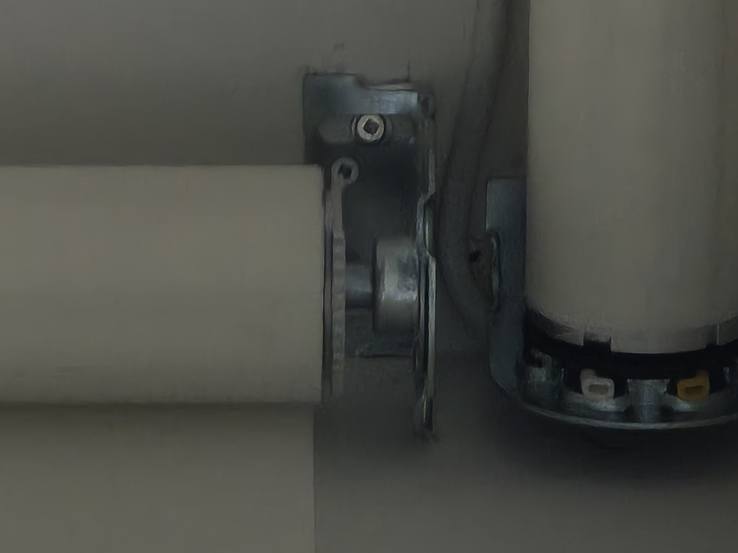
What a Frankenstein shade sounds and looks like #
A shade built right makes the motor's own sound and nothing else. Anything you can hear over the motor is a part that moved.
Swipe sideways to see every column.
| What you notice | What it usually is |
|---|---|
| A tick once per revolution, faster as the shade speeds up | The idler pin turning in a seat it was not made for, or a crown packed out to a tube it was not cut for. Somfy's note on free play is the whole diagnosis. |
| A clack at every start and stop | End play: the tube shifting on a spring pin as the motor takes up the load, or slack in a coupler taking up at each reversal. |
| A buzz through the pocket or the fascia while it runs | The motor's vibration crossing a loose joint into a bracket that is not carrying the shaft on a bearing. |
| Fabric that walks to one side (telescoping) and was straight on the day of the install | The motor's axis and the idler's axis are not one line, or the brackets are not level; or the tube is too small for the width and bows. Lutron: "excessive telescoping may result if the shade is not level". |
| Two coupled panels whose hembars no longer line up; one panel starts a beat late | A coupler slipping on its tube, and no levelling adjustment to lock the panels once they are set. |
| A motor that stalls or stops hot on a run it used to finish | It is lifting the fabric and fighting the hardware: a bound coupled shaft, an idler dragging, a tube rubbing a bracket. |
How we build a motorized shade #
Our experience Six rules, in the order they come up on a job.
- One system per shade. The motor, the crown and drive, the tube, the idler and both brackets come from one system: the motor maker's own list for that tube (Somfy publishes its crowns, drives, tubes and brackets by tube profile), or a fabricator that builds its hardware around the motor, the way ZMC's motor series is built around Somfy's Sonesse 40 and Sonesse ULTRA 50, and the way Lutron, Crestron and Vertilux build their own. No part crosses from the clutch catalogue into a motorized shade.
- The idler from the motor system, on a bearing. Never the spring-pin idler of a chain shade. On anything wide, tall or heavy, the steel ball bearing and the heavy-duty idler bracket.
- The tube sized to the width before the motor is chosen. 1 1/2 or 2 in on ordinary windows, 2 1/2 in past about 8 ft, and the drive matched to it; the rules are on how wide one roller shade can be. A small tube on a wide window telescopes on its own, whatever the idler.
- Coupled runs on the system's own intermediate brackets and couplers, keyed to that tube: on a shade built on ZMC hardware, ZMC's retractable coupler with its metal spindle for that tube profile and its CM intermediate bracket; on Lutron, Lutron's coupler and sub-brackets; on Crestron, Crestron's coupler bracket. Every joint cut to land on a mullion, one straight axis set with a laser, the drive shade adjusted first and each panel as it is added, the way Lutron's guide orders it.
- Brackets level, in one plane, at the spacing the system gives, verified with a tape and a level before a tube goes up, which is Lutron's own sequence for its manual roller and the one we use on every shade.
- Run it before we leave. Two full cycles, every hembar re-checked for level (Crestron's instruction), and a listen. A quotation from us names the system the shade is built on; ask us which part comes from where and we will tell you.
Four questions to ask before you buy a motorized shade #
When you invest in a motorized system you want to do it right, once. These four questions take a dealer two minutes to answer, or they do not get answered at all.
1
"Which system are the brackets, the idler and the tube from?"
The answer is a name and a parts list: Somfy LT50 brackets with the 12 mm idler bearing, ZMC's CM motor system, Lutron Sivoia QS, Crestron QMT. "Universal" is not a system, and "it's all compatible" is not an answer.
2
"Is the idler a motorized idler?"
Ask whether it turns on a bearing and whether it is the one the system lists for that motor and that tube. If the shade was priced off a manual price list with "motor" added as a line, ask what else changed at the two ends of the tube. The right answer is: the brackets and the idler.
3
"On a coupled run, what is the coupler keyed to, and how do you level the panels?"
The right answer names the tube profile and the adjustment: hub set screws, a levelling ring, a levelling screw in the idler. "We'll shim it" is the wrong answer, and so is a quote for a 16 ft wall that does not say the word coupler.
4
"Who publishes these parts?"
A dealer who can show you the maker's own page for every part is building a system. Our Somfy library lists every bracket, crown, drive, tube and idler Somfy sells, with its 2026 retail price, for exactly that reason.
Frankenstein shades: questions
What is a Frankenstein shade, or a Frankenstein blind? #
Trade slang for a motorized roller shade assembled from parts of different makers that were never designed for one another: a motor from one, a tube from another, brackets from a third, the idler out of a manual chain-clutch kit and, on a wide opening, a generic coupler at the join. Each part fits in the sense that the pin drops into the slot, and the shade runs on the day it is installed. The name will not appear on any quote, which is part of the problem; the way to find one is to ask which system the brackets, the idler and the coupler come from.
Is it a problem to put a Somfy motor in another brand's tube or brackets? #
Not by itself. Somfy publishes crowns, drives, end plugs and adaptor plates for RollEase, Acmeda, Louvolite, Shangri-La, ZMC and Rollerbat tubes and for RollEase SkyLine and R8 brackets, so those combinations are designed by the motor maker and carry its part numbers. ZMC builds its motor series around Somfy's Sonesse 40 and Sonesse ULTRA 50 the same way. The problem is the part nobody matched: a manual clutch idler on a motorized tube, a bracket from a third catalogue, a coupler gripping a tube profile it was not cut for. A copy of a Somfy part is a different question again, answered on our original parts vs generic copies page.
What is the difference between a manual roller shade idler and a motorized one? #
A manual idler is an end plug with a spring pin that turns in a slot at the speed of your hand, a few times a day, with the chain and clutch taking the effort. A motorized idler is the only bearing point of the tube besides the motor's crown, on a tube that turns at up to 28 rpm (a Somfy Sonesse 30), under the whole weight of the roll, on a schedule. It has to hold the tube on the motor's axis, carry the load with the least friction and leave almost no end play, so the motor systems sell their own: Somfy lists nylon and steel ball bearings for its idler pins, an anti-vibration idler end cap holder and a heavy-duty idler bracket, and ZMC lists a CM idler per tube profile in its motor series, separate from its clutch idlers, with a swivel ball bearing for smooth operation of motorized shades.
Why does my motorized roller shade click or rattle when it starts and stops? #
Almost always play somewhere between the motor and the tube, not the motor itself. A tick once per revolution is an idler pin in a seat it was not made for, or a crown packed out to a tube it was not cut for. A clack at every start and stop is end play, the tube shifting on a spring pin as the load comes on, or slack in a coupler taking up at each reversal. A buzz through the pocket is motor vibration crossing a loose joint into a bracket. Somfy's data book puts it in one line: free play must be minimized between the accessories and the tube to ensure quiet performance of the motor. We service the systems we installed; on a shade someone else built, that sentence is where its installer should start.
Why does my roller shade fabric telescope, or walk to one side? #
Three usual causes. The motor's axis and the idler's axis are not one line, which happens when the two brackets come from different systems or the idler is a manual one in a motor bracket's company; the shade is not level, which Lutron's own installation guide names, excessive telescoping may result if the shade is not level; or the tube is too small for the width and bows under the fabric. Crestron adds a rule of thumb for tall shades: keep the height within about three times the width, because a tall narrow shade rolls crooked more easily. The fix is the right tube on one axis, set level, not a wrap of tape on the roll.
What is a coupled roller shade, and how many shades can one motor drive? #
Two or more roller shades on one motor: the tubes are joined end to end with couplers that run through intermediate brackets, so the whole wall starts, stops and stays level together. Lutron couples up to six panels including the drive shade, subject to drive capacity, panel sizes and fabric; Crestron up to six on one QMT motor, depending on width and fabric; Somfy's Sonesse ULTRA 50 is rated to power up to six shades. A coupled run shows a light gap of about 1.5 in at each joint (Lutron's figure), hidden by a fascia or a pocket, and every hembar has to be set to the same height.
Why do my coupled shades end up uneven, or one panel lags behind the other? #
A coupler that is slipping on its tube. A coupler keyed to the tube profile cannot turn without the tube; a generic coupler holding a round tube by friction or two set screws slips a few degrees under load each time the motor starts, so the second panel hesitates, catches up with a jerk and, after a few weeks of slipping the same way, sits out of line with the first. The systems build the correction in, Lutron with a levelling screw in each idler and set screws in the coupler hub torqued to 6.0 in-lbs, Crestron with a ring on the idler or intermediate band locked against a hard stop and checked after two full cycles. A run with no levelling lock gets re-levelled by hand, again and again. Brackets that are not level and in one plane cause the same drift from the other side, by binding the shaft.
Can my existing manual roller shade be motorized? #
Sometimes, with the system's own motor kit. The clutch comes out, the motor goes in, and the brackets and the idler change with it, which is why Crestron's guide for converting its manual roller shade to a motor replaces the manual clutch and idler bracket with new brackets rather than only the clutch. A motor pushed into a chain shade's tube, on the chain shade's idler and brackets, is the Frankenstein build. On most homes we quote a new motorized shade on the right tube and hardware rather than a conversion; we build new shades and service the systems we installed.
Is the noise coming from the motor or from the hardware? #
Compare it with the motor's own rating. Somfy lists the Sonesse 30 at 47 dB on its current sheet and the Sonesse ULTRA 50 at 35 to 38 dB depending on the model, and its Sonesse 30 data book adds that the operational noise level is reduced when motor, tube and mechanical accessories are properly adapted to motorized applications. A shade noticeably louder than its motor's figure, or one that ticks, clacks or buzzes in time with its movement, is adding the rest in the hardware. Our ranking of the quietest roller shade motors has the published figures by brand.
How much more does it cost to build the shade from one system? #
Very little. On Somfy's 2026 retail list the idler bearing for a 12 mm shaft is $0.83, the steel ball bearing for a 10 mm idler pin $3.10, the anti-vibration idler end cap holder $14.04, the LT50 idler bracket with its nylon bearing $6.97 and the heavy-duty idler bracket $40.77, against $288.60 for the Sonesse 30 RTS motor itself. On our published price list a 72 by 84 in motorized roller shade is $833 to $2,287 depending on the system, measured, made, installed and programmed. The hardware that makes the shade quiet is a rounding error on that figure; what costs money is building the shade twice.
Where the numbers come from #
All documents accessed 23 October 2026. Quotations are reproduced as the maker prints them in its installation guide, data book or catalogue; Somfy part prices are Somfy's 2026 retail list as published on our Somfy library, product only, before tax; installed prices are from our own published price list. Makers revise their documents, and we will update the page when a line changes.
- Somfy Systems, Sonesse 30 Databook (April 2013), Fabrication Recommendations: "Operational noise level is reduced when motor, tube, and mechanical accessories are properly adapted"; "Free play must be minimized between the accessories and the end product tube to ensure quiet performance of the motor"; "A motor crown adapter between motor and end product tube is required to ensure concentric operation of motor"; drive stop and screw recommended to prevent noise and drive wheel separation; speed regulation for the alignment of adjacent shades. service.somfy.com
- Somfy, Sonesse 30 installation guide (ref. 5063397A, 09/2009): "Before installation, check that this product is compatible with the associated equipments and accessories"; "Any use outside the sphere of application specified by Somfy is not approved"; troubleshooting: verify "The crown is properly fitted to the tube". service.somfy.com
- Lutron, Inline-Coupled Roller Shade Addendum, mounting and adjustment guide (P/N 045707 Rev B, 05/2019): sub-brackets at the specified bracket-to-bracket distances, "Verify that all sub-brackets are level and aligned"; the coupled shade tubes to form "as straight a line as possible"; coupler screws through the joined shafts; coupler hub set screws re-tightened to 6.0 in-lbs (0.7 N·m); a levelling screw in each idler; the drive shade adjusted first and each panel before the next is added; "A total of 6 panels may be coupled, including the drive shade and coupled idler panel", subject to drive capacity, panel sizes and fabric selection. assets.lutron.com
- Lutron, Wall/Ceiling/Pocket-Mount Contract Roller and Optional Fascia Mounting and Setup Guide, manual roller CHR-C (P/N 045970 Rev A, 04/2024): verify the bracket-to-bracket distance with a tape measure and that the brackets are level with each other; "If the idler pin (shiny metal) is visible between the idler and idler receiver, the mounting brackets are too far apart"; "excessive telescoping may result if the shade is not level". assets.lutron.com
- Crestron, QMT5 Series Shade Coupler Installation Guide (Doc. 7582B, 04.16): couplers "allow a single motor to drive multiple shades"; "Ensure that all mounting brackets are level and on the same plane"; "All shades must be aligned along a single axis (no off-angle positioning)"; "The retractable pin traverses the bearing in the coupler bracket, which provides support for the adjoining bands"; three detent positions; levelled after installation by the ring on the idler or first intermediate band, locked against its hard stop; two full cycles, then re-check. fr.crestron.com
- Crestron, Manual Roller Shade to Motor Upgrade Installation Guide (Doc. 7931A, 10.16): "Replace the manual clutch with the motor"; "Replace the CSA-ARCH5 manual clutch and idler bracket with new brackets"; limits set after installation. de.crestron.com
- ZMC Window Covering Supplies, Woodbridge, Ontario, "a leading supplier to independent fabricators of private label window covering products"; Motor Series built on the Somfy Sonesse 40 and 40WF, the Sonesse ULTRA 500 AC and DC and its own Z-Motion lithium motors, with the features "Swivel Ball Bearing for Smooth Operation of Motorized Shade" and "Soft Lock to Prevent Motor Damage and Injury". www.zmc.ca
- ZMC product catalogue: CM Motor System (Architectural Series) with CM Idlers for the 1 1/2 in RS-2TU, 1 1/2 in T46 and 1 3/4 in RS-3TU tubes and CM Motor Brackets (ceiling mount, wall mount right and left control); under its Somfy motorized categories, CM Intermediate Brackets (right control, left control, ceiling mount) and the Retractable System with Metal Spindle, a CM Retractable Coupler for each of those tubes and for the 1 1/2 in groove motor tube, plus Indexable and EZ Adjustable couplers in 10 and 12 mm; the RS, XR, XL and ST clutch systems listed separately under Manual. www.zmc.ca
- Somfy 2026 retail list, as published on our Somfy library: roller tubes, end caps and idlers (idler bearings, anti-vibration end cap holder, heavy-duty idler bracket), motor and idler brackets (LT50 idler brackets with nylon bearings, RollEase Silent Pin idler bracket, SkyLine and R8 adaptor plates), crowns and drives (adaptors for RollEase, Acmeda, Louvolite, Shangri-La, ZMC and Rollerbat tubes), the Sonesse ULTRA 50 (35 to 38 dB, up to six shades on one motor) and the Sonesse 30 RTS at $288.60.
- Exotic Shades & Draperies: Landmark Ranch Estates case study (coupled runs on Somfy Sonesse 50 dry-contact motors), how wide one roller shade can be (coupled-shade limits per maker, tube rules, telescoping), published price list (72 by 84 in motorized roller shade, $833 to $2,287 by system).
Discerning homeowners, designers, and developers across South Florida trust Exotic with their most important spaces.
“I’m absolutely blown away and in love with my ripple food curtains !! Everything about them from the install to the fabric and quality . My house feels so much more like a home I couldn’t have asked for anything better . I recommend to everybody !”
“I couldn’t believe how much of a change these new drapes could make! This company upgraded my apartment overlooking the water and it now has a fresh, art deco’ish vibe I can only picture in my head. The space feels modern and elegant without losing its at home feeling. From start to finish top notch work. I highly recommend them if you want your place to look like something out of a magazine.”
“I’m really happy with my new curtains! The team from Exotic Shades came to my place helped me choose the right fabric, and guided me through the whole process. Everything happened exactly as it was supposed to. Great service and beautiful results. Highly recommend A+”
Exotic Shades & Draperies, Fort Lauderdale and Miami Beach
Exotic Shades & Draperies is a South Florida window-treatment company that designs, sews and installs its own work: Lutron and Somfy motorized shades, custom draperies sewn in our Fort Lauderdale workroom by five in-house seamstresses, plantation shutters and blinds. Established in South Florida in 2024, backed by more than 20 years of window-treatment manufacturing and installation experience. Lutron certified dealer, Somfy Expert, Crestron and Control4 integration. The same in-house team measures, installs and programs every project; when shading has to integrate with another control system, we bring in our smart-home partner Adom Smart Home.
Fort Lauderdale workroom and showroom
4539 Powerline Rd, Fort Lauderdale, FL 33309 · 954-881-9331
Miami Beach showroom
500 South Pointe Dr #150, Miami Beach, FL 33139 · 954-872-9007
Where we install
Miami-Dade, Broward and Palm Beach counties: Miami Beach, Sunny Isles and Aventura through Hollywood, Fort Lauderdale and Pompano Beach to Boca Raton, Delray Beach and West Palm Beach, with projects in the Caribbean and New York.
How a project runs
Free in-home measurement, a written quote from the same engine as our published prices, fabrication in our own workroom, installation and programming by our own team, and service on the systems we install.
Motorized and coupled shades built from one system, from Miami to Palm Beach
Lutron, Somfy, Crestron and Vertilux roller shades on the makers' own brackets, idlers and couplers, measured, built, installed and programmed by one in-house team from Miami Beach to West Palm Beach, from the 22 ft coupled runs in Southwest Ranches to the fourteen walls of glass on Hillsboro Mile.
Investing in motorized shades? Do it once.
One free hour with our team routinely saves owners thousands in avoidable mistakes. Book a private, complimentary consultation - we tell you which system every part of your shade comes from, and why.