

Ripplefold Explained: Fullness, Snap Tape Spacing, Carriers, Wave Tape and the Stack
A ripplefold quote has five numbers behind it that almost nobody prints: the carrier pitch, the snap spacing, the fabric multiplier, the carrier type and the stack. Here is what each one does to the wave you look at every day, with Lutron's, Somfy's, Forest's and Silent Gliss's own figures, and how we build ours.
What decides how a ripplefold looks? Five numbers, and the fabric
Ripplefold has no sewn pleat. The wave is made by two pieces of hardware: a snap tape sewn along the top of a flat panel, and carriers that ride in the track, tied to each other by a cord at a fixed pitch. The pitch of the cord sets the fullness. The spacing of the snaps on the tape sets the size of each wave. The fabric decides whether the wave at the floor matches the wave at the track. Everything else on a ripplefold quote, the stack, the pocket, the yardage, the weight on the motor, follows from those three.
- Fullness is the carrier cord. Carriers 2 5/8, 2 3/8, 2 1/8 or 1 7/8 in apart are sold as 60, 80, 100 and 120 percent fullness; on standard tape that is 1.6, 1.8, 2.0 and 2.3 times the track width in fabric. Lutron's specification says it plainly: fullness is set by the string length between carriers, and the ratings assume 4.25 in snap spacing. Changing the fullness means a different carrier set and a remade panel.
- The tape is the wave. Every ripplefold snap tape sold in North America puts the snaps 4 1/4 in apart, so every wave is made of 4 1/4 in of fabric. Ours are built on 6 in tape: 6 in of fabric in every wave, about 40 percent more, and a wave about 6 in deep instead of 4 to 4 1/2. Eight-inch waves exist, but as a hook-pocket setting (Forest Easyflex), not as a snap tape.
- Depth is the fabric per wave. Silent Gliss and Forest both publish that the stacked wave is as deep, front to back, as the fabric in it, and that this is the ceiling space a pocket needs: 4 1/4 in for standard tape, 6 in for ours, 8 in for an 8 in hook setting.
- Carriers come as wheels or glides, one piece or two. A two-piece carrier is a wheeled body with a separate snap pendant that clips in and swivels (Forest sells both lines; Somfy's runners ship with the pendant fitted). A one-piece carrier molds the snap into the body. We install Lutron Sivoia QS and Somfy Glydea tracks, both snap systems, with Somfy's silent runner set where the drapery moves while people sleep.
- Wave tape is Europe's version of the same idea: hooks into a pocketed tape, gliders on a 60 or 80 mm cord, fullness 2.1 to 2.3, re-hookable after sewing. Snap tape is the norm in the United States and Canada; both hang just below the track.
- The stack is bigger than the brochures say. Lutron's drawn example and the published stack guide put a lined 100 percent ripplefold at 27 to 30 percent of the track, 33 percent at 120. Unlined sheers and 60 to 80 percent panels come in nearer a fifth. Size the track by the stack, not by the window.
How ripplefold works: a flat panel, a snap tape and a cord of carriers #
Ripplefold was a Kirsch trademark, registered in 1969 for "drapery tape with snaps, and drapery carriers spaced apart by an attached cord" and expired in 2010, which is why Lutron, Somfy, Crestron and every workroom now use the word. That one clause from the trademark file is still the whole mechanism.
The panel itself is flat: a lined or unlined width of fabric with a straight hem at the top, no pleats sewn into it and normally no buckram, because the stiffened nylon tape carries the heading. A strip of tape with a snap every few inches is sewn along the back of that top hem. In the track, small carriers hang in a straight line, and a cord joins them so that the distance between any two carriers is fixed. Each snap on the tape clicks onto one carrier. Because more fabric runs between two snaps than the space between the two carriers they hang on, the fabric has to go somewhere: it bows out toward the room between one pair of carriers, then back toward the glass between the next, and so on down the track. Rowley's workroom guides call these the front folds and the back folds, and the seams of a wide panel are planned to land on the back folds where nobody sees them.
Two carriers do a different job. The master carrier at the leading edge is the one the belt pulls on a motorized track, and on a center-opening drapery the arms fitted to the two masters decide whether the leading edges meet edge to edge (butt arms, so the wave runs unbroken across the middle) or cross each other (overlap arms, for a bedroom that has to be dark). The last snap at each end hooks onto a return snap or stationary carrier in the end cap, which turns the panel back to the wall. The whole heading hangs just below the track: Lutron places the bottom of the track 3/4 to 1 1/4 in above the top of the panel, and Silent Gliss says its curtain "hangs directly below the track", which is why a ripplefold track is recessed in a ceiling pocket, run above a cornice or simply left to show as a slim line, and never hidden behind the heading the way a rod-pocket curtain hides a rod.
Fullness: the carrier cord sets it, and the label on the box is a rounding #
In pinch pleat, fullness is a sewing decision: the workroom folds two or two and a half widths of fabric into the pleats. In ripplefold it is a hardware setting. The carriers come on a cord cut to one of four pitches, each sold under a percentage, and the panel is sewn to fit that cord.
Swipe sideways to see every column.
| Fullness label | Carrier pitch | Fabric vs track width | Carriers per foot | The look, and where we use it | Source |
|---|---|---|---|---|---|
| 60% | 2 5/8 in | 1.6 times (4 1/4 divided by 2 5/8 = 1.62) | about 4 1/2 | A tight, minimal wave; the least fabric and the least stack. Sold by Forest and Rowley; Lutron and Somfy do not list it | Forest Group USA carrier list |
| 80% | 2 3/8 in (60 mm) | 1.8 times (1.79) | 5 (Somfy) | A shallow contemporary wave; the national retailers' default. Our choice for a tight, minimal look | Somfy Glydea / Irismo databook |
| 100% | 2 1/8 in (54 mm) | 2.0 times (2.00) | 6 (Somfy) | The balanced standard: the panel measures double the track. Our usual recommendation for most rooms | Lutron chassis specification |
| 120% | 1 7/8 in (48 mm) | 2.2 to 2.3 times (2.27; some suppliers print 2.2, 2.4 or 2.5) | 7 (Somfy) | Deep, generous folds and the biggest stack. Our usual call for sheers on oceanfront glass | Somfy Curtain Databook 2026 |
Why the published multipliers disagree. With the snaps fixed at 4 1/4 in, one wave uses 4 1/4 in of fabric across one carrier pitch, so the fabric in the panel is 4 1/4 divided by the pitch: exactly 2.0 at 100 percent, 1.79 at 80 and 2.27 at 120. That is why one supplier prints 2.2 for 120 percent, another 2.4 and a third 2.5. Do the division and ignore the label. Lutron's rule of thumb for what the number does: "Lower fullness results in smaller stackback size when open and more spread when closed. Higher fullness results in larger stackback size when open and less spread when closed."
What it means for the yardage. The panel width is the track section plus the returns and any overlap, times the multiplier. Lutron's minimum return on a wall bracket is 4.68 in (9.68 in on a dual bracket) and its overlap closures are 4.6, 6.0 or 7.0 in; a butt closure is its default for ripplefold. A workroom example from Helser Brothers: a 120 in track at 2.2 times needs 264 in of finished width, which on 54 in goods is five widths, each cut 130 in long for a 120 in drop, or about 18 yards before lining. Fullness cannot be changed on site: a 100 percent panel on an 80 percent cord has snaps left over, and an 80 percent panel on a 100 percent cord does not reach the end of the track.
Snap tape spacing: 4 1/4, 6 and 8 inches, and what each one does to the wave #
Ann K. Johnson, who teaches ripplefold fabrication to workrooms, put it in one sentence: "All the snaps on all snap tapes are 4.25-inches apart from the center of the snaps." Lutron specifies "4.25 in (108 mm) between snaps", Somfy sells its Ripple Snap Tape at 4 1/4, Forest's US tape is 4 1/4 in on center and Rowley's is "4 1/4 in between snaps". That number has not changed since the system was patented, and it is the one figure on a ripplefold quote almost nobody questions.
Swipe sideways to see every column.
| Tape | Fabric per wave | Multiplier on 2 1/8 in carriers | Wave depth, front to back | Who sells it | Source |
|---|---|---|---|---|---|
| 4 1/4 in snap tape (108 mm), the North American standard | 4 1/4 in | 2.0 times | about 4 to 4 1/2 in stacked; roughly 3 in drawn closed | Lutron writes its ratings to it; Somfy, Forest, Rowley and the theatrical suppliers sell it; the retailers who ship ready-made ripplefold build on it | Lutron: "standard 4.25 in (108 mm) snap spacing" |
| 6 in snap tape, what we build on | 6 in | about 2.8 times | about 6 in stacked; roughly 4 1/2 in drawn closed | No mainstream US hardware brand sells a 6 in tape. The only manufacturer tape in this class we found is Forest Group's Easysnap XL at 15.75 cm (6.2 in), sold in Europe | Forest FES brochure: Easysnap 10.75 or 15.75 cm |
| 8 in, a hook-pocket setting, not a snap tape | 8 in | 2.0 times on a 4 in pitch; 3.0 times on a 2 5/8 in pitch | about 8 in stacked, and 8 in of ceiling space | Forest Easyflex marks 4, 6 and 8 in fold depths on a 3 in pocket tape; Silent Gliss hooks run 100 to 160 mm (4 to 6 5/16 in). Hook tapes can be re-hooked to change the wave | Forest 2016 US catalog: Easyflex fold depths 4, 6 and 8 in |
What the spacing changes. The fabric between two snaps is the fabric in one wave, so the tape decides the size of the wave and nothing else does. On a 4 1/4 in tape the stacked wave stands about 4 to 4 1/2 in off the track line, front to back; the retailers who ship standard panels all measure it there. Silent Gliss publishes its wave depths as exactly the hook spacing, 100, 120, 140 or 160 mm, and Forest says the ceiling space a wave needs "is equal to the spacing between the hook placement in the Easyflex tape", 10.75 or 15.75 cm for its two snap tapes. Drawn closed, the wave relaxes to roughly three quarters of that: Gerster's published pleat depths run 9 to 14 cm for 12 to 17 cm of fabric per wave. More fabric per wave means a rounder, deeper curve that reads as a column of fabric rather than a ripple on the surface, a stack that stands further off the wall, and a pocket that has to be wider.
Where 6 and 8 inches come from. No mainstream US hardware brand sells a 6 in or an 8 in snap tape. The only manufacturer snap tape in the 6 in class we could find is Forest Group's Easysnap XL, with snaps at 15.75 cm (6.2 in) centers, sold in Europe alongside the regular 10.75 cm (4.23 in) tape. Eight-inch waves exist as hook settings: Forest's Easyflex is a 3 in transparent tape with a pocket every 9/16 in, marked for 4, 6 and 8 in fold depths, and the hooks go wherever the workroom chooses; Silent Gliss's Wave hooks run 100 to 160 mm (4 to 6 5/16 in) on a 60 or 80 mm glider cord; and workrooms can splice or fold standard tape to shift a snap. A hook tape has one real advantage over a snap tape: the wave can be re-hooked after the panel is sewn. A snap tape has one spacing for life.
How we build ours, and the honest arithmetic. Every ripplefold panel sewn in our Fort Lauderdale workroom is built on 6 in snap tape, hung on the same carriers and the same carrier pitch as a standard panel. Do the division and you see what that means: on the 2 1/8 in cord sold as 100 percent, a 6 in panel holds about 2.8 times the track width in fabric; on the 2 3/8 in cord sold as 80 percent, about 2.5 times. The fullness label on the carrier box describes a 4 1/4 in panel; on our tape the real multiplier is higher, and that extra fabric is the point, because it is what the wave at the floor is made of. It also costs more: more yardage, more widths to seam, more weight for the motor to pull and a stack we size for your fabric at the measure. To keep a true 2 times fullness with 6 in snaps you would need carriers 3 in apart, which no US brand stocks; the nearest off-the-shelf equivalent is Forest's European 8.0 cm carrier under its 15.75 cm tape. When a designer wants a specific fold depth or a deeper wave on a decorative rail, we build it on the Forest Easyflex hook system instead. The long version of why we switched is on our 6-inch snap tape page.
The fold: why ripplefold has no pleat, and why some waves loosen at the hem #
A pinch pleat is sewn: buckram in the heading, fingers tacked by hand, folds that are set for decades and read as tailored columns. A ripplefold is not sewn into shape at all. The panel is flat, the fold is made by the hardware, and the drapery looks the same from the room and from the garden. That is its elegance, and it is also where it can go wrong.
At the heading the carriers do the work: every snap is pulled to the line of the track whether the fabric wants to be there or not, so the top of a ripplefold is always even. Every inch below the track the fabric is on its own, holding the curve with nothing but its own weight and its own body. The complaint, as a homeowner once posted it on Houzz, is that "ripple fold drapes flare out as they get closer to floor"; steaming and pinning had not helped. The workroom answer in that thread is the trade's standard account: ripplefold usually carries less fullness than a pleated drapery, longer panels need more fullness than short ones, a chain-weighted hem helps and sometimes a double chain is needed, some fabrics need a bottom memory stitch, and metallic-thread and polyester fabrics are less trainable. The European wave makers say the same from the other side of the Atlantic. Silent Gliss: "Even Wave curtains will require some dressing and training." Bradley Collection's make-up guide: "If the fabric does not fall into the wave at the bottom, use lead weight cord in the hem and fabric side weights." Forest: "Lead weight tape and side weights can improve appearance," and stiffer fabrics "tend not to lend themselves well" to the system.
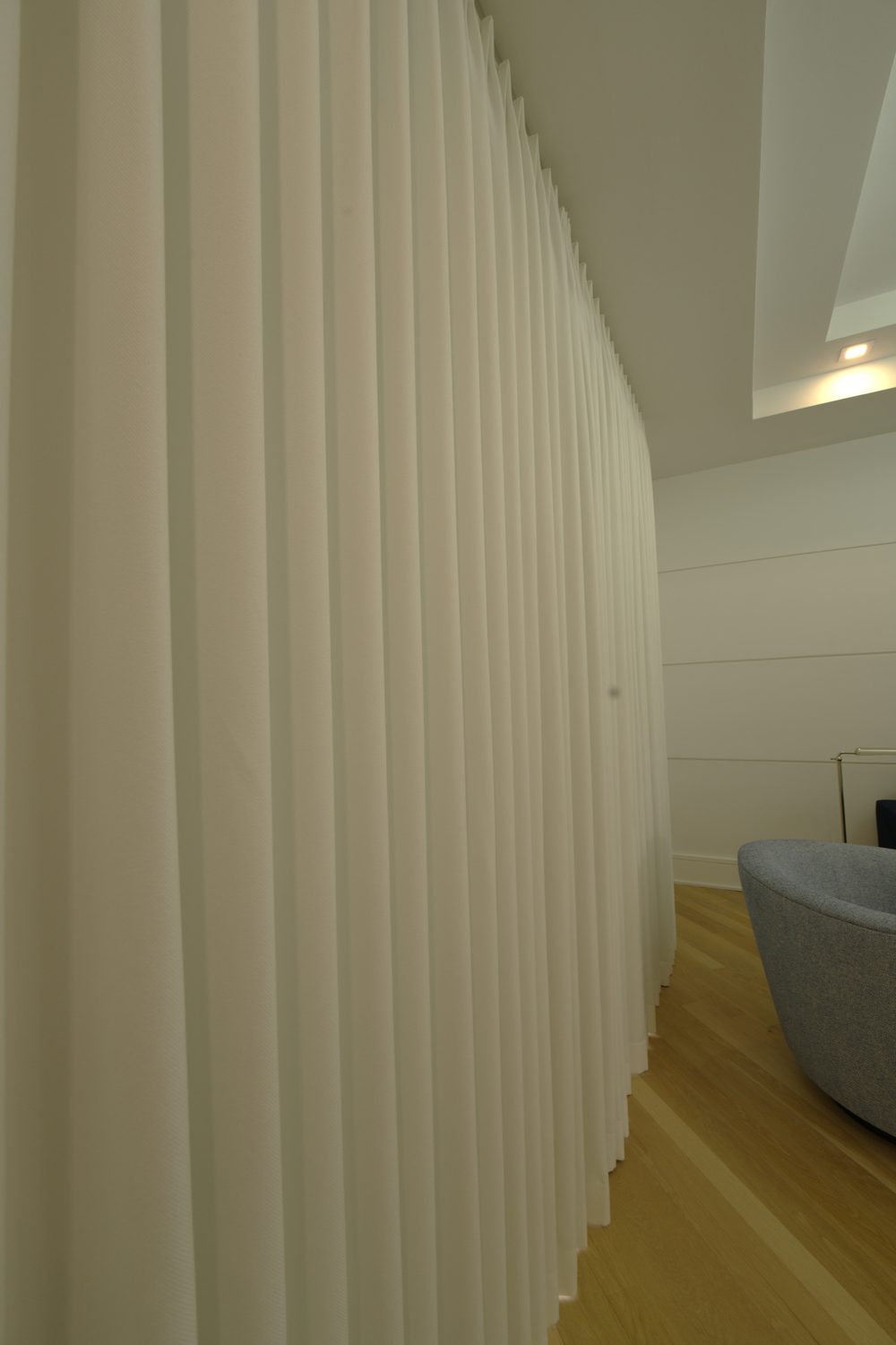
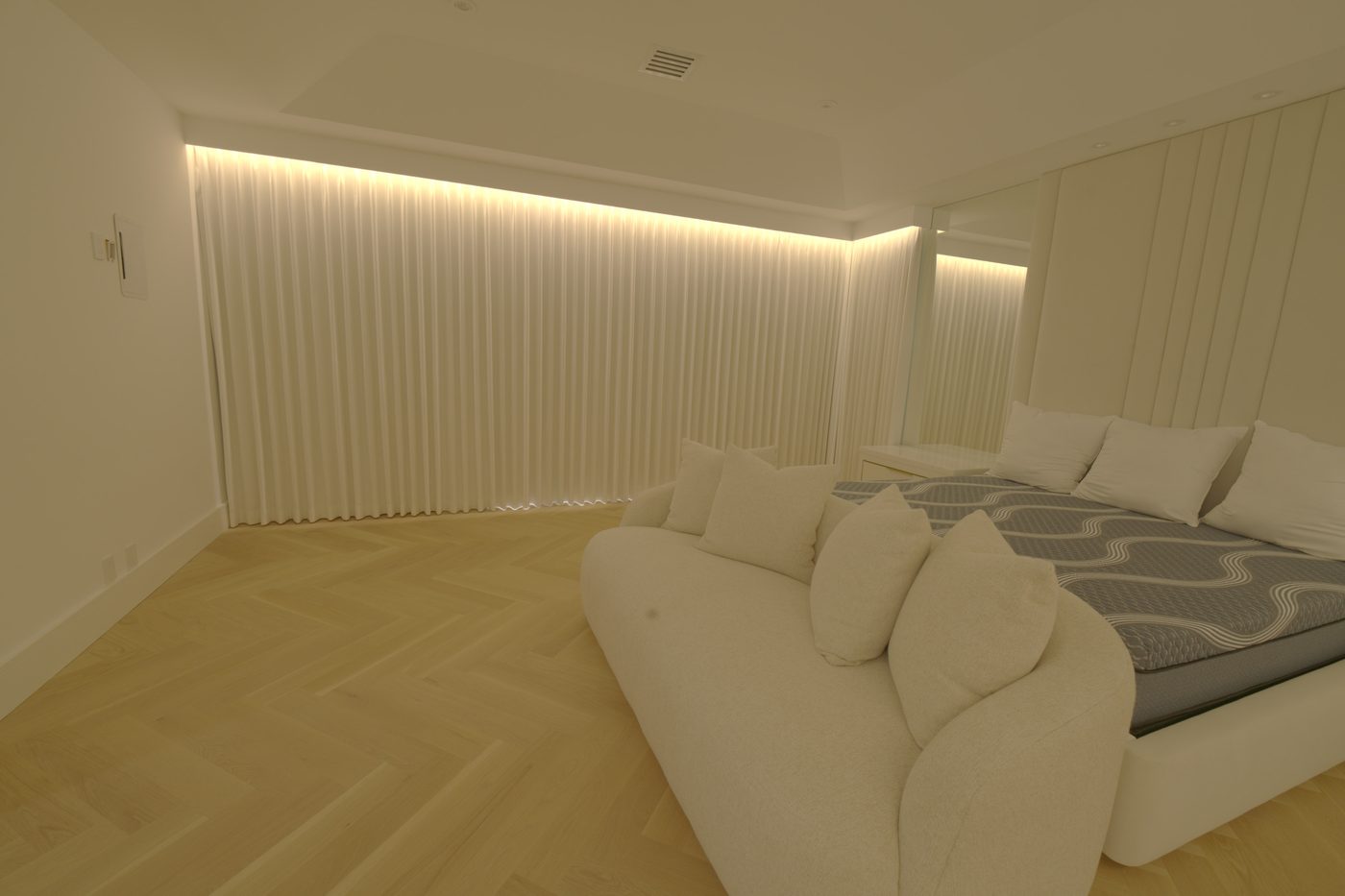
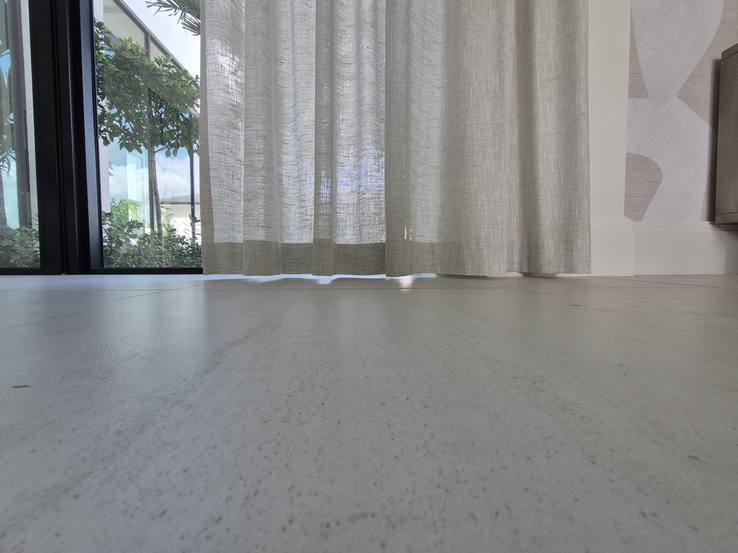
The manufacturers prescribe weight, fabric and training. The one remedy they do not write about is the one we use, and it is a workroom remedy: more fabric in each wave. Parkway Window Works, a Michigan workroom, has run custom snap spacing since at least 2012 so that "extra long panels have enough fabric in each fabric column to hold their shape the full length of the panel", and that is exactly the reasoning behind our 6 in tape. A 4 1/4 in wave has little fabric in it, and by the bottom third of a 10 ft sheer it has relaxed: some waves flatten, some drift toward their neighbours, and the rhythm you see at the top is gone by the hem. A 6 in wave carries about 40 percent more fabric in every curve, so the curve is rounder and has the body to hold itself to the floor, with a weighted double hem and a fabric chosen for how it falls doing the rest. No manufacturer has published a side-by-side of the two tapes at the hem; what we have is twelve years of hanging both, and the photographs below. Look at the last two feet above the floor.
Fabric: hand matters more than weight #
The manufacturer fabric lists agree with each other, and they are about how a cloth falls, not what it weighs. Silent Gliss names voiles, lined cotton, interlined silk and blackout lining as suitable, and "stiff fabrics, heavy embroidery, irregular vertical stripes, metallic threads" as not. Its test is the one we use at the measure: hold the top of the fabric and see whether it follows a soft wave pattern without too much effort.
Sheers and voiles
The natural ripplefold fabric
A sheer has no body to fight the wave, so it takes the S-curve perfectly and holds it if the hem is weighted. Wide-width European voiles and linens, 110 to 126 in wide, are railroaded so a whole window wall runs without a vertical seam. We specify polyester voiles on the ocean side, where salt and sun are hardest on fibre, and sew sheers at 120 percent for oceanfront glass, with deep double hems weighted to hang plumb; the trade uses chain weight rather than lead squares in a sheer.
Linen and cotton
Beautiful, and they move
Linen waves well and relaxes well; it also grows. A US retailer warns that 100 percent linen "can stretch up to 2 in after hanging", and a Pennsylvania workroom measured a linen job at 100 in on the table and 101 in installed. We cut linen to the shortest point of the opening and steam it in place, and we line it, because a lining steadies the fabric and takes the sun. Synthetics, in James Dunlop's words, "maintain a stable formation over large windows" while natural fibers "fall in a more relaxed manner".
Velvet, wool and blackout
Heavy is fine, stiff is not
Weight alone does not disqualify a cloth: ripplefold is sold in 300 gsm velvets and 430 gsm chenilles, and a coated blackout waves if it is soft. What fails is stiffness, which Parkway describes exactly: "If the material is too stiff, the fabric will billow out and fail to hold its shape." Every drapery we make is lined, our blackout draperies carry a 3-pass lining, and interlining is the step that gives a silk or a thin cotton the body to wave like a heavier cloth. Lining options.
Weight is also a hardware limit, and it bites sooner on ripplefold. Somfy allows 1.5 kg (3.3 lb) per runner; Forest rates its standard tape at 10 kg per metre of track; Silent Gliss rates its standard wave tape at 2.5 kg per metre. Lutron's Sivoia QS drives carry up to 175 lb per system, but the ripple fold capacity falls with width (the D105 peaks at 85 lb between 68 and 108 in and drops to 10 lb at 180 to 216 in), and on its Alena track a ripple fold panel over 56 in is limited to 45 lb where a pinch pleat panel may weigh 80. An interlined velvet at 120 percent on a 20 ft track is a motor sizing question before it is a fabric question, and it is one we settle with the track comparison in hand.
Pattern and seams. Because the pitch is fixed, the position of every seam in the wave is predictable, so the workroom plans the cut widths so that each seam lands on a back fold, turned toward the glass. A pattern repeat is planned the same way, so that the motif that shows on the front folds is the one the designer chose.
Carriers: one-piece, two-piece, wheels, glides and the silent set #
The carrier is the part you never see and hear every day. It rides inside the aluminum channel, it holds one snap, and a cord ties it to its neighbours at the pitch that sets your fullness. Two things about it vary: how it moves, on wheels or on a glide, and whether the snap is part of the body or a separate piece.
Two-piece
A body and a snap pendant
The running body, usually wheeled, has a slot; a separate pendant with the snap socket slides into it from the side and hangs below the track. A 2022 US patent describes exactly this "two-piece ripplefold carrier", with the pendant releasable from below so the drapery can come down without damaging the hardware, and Forest Group sells "Two-Piece Connected Snap" carriers as a line of their own. The pendant swivels on its vertical axis, which the old Kirsch system guide credits with eliminating flat areas in the drapery; a broken pendant is a part that costs cents, not a carrier; and the panel unsnaps for cleaning. The known weakness, recorded in a 1986 Graber patent, was pendants pulling out of early carriers under a sideways tug, which the later designs retain with a clip. Somfy's runners ship "complete with pendant".
One-piece
The snap molded into the body
What workrooms call a one-piece carrier has the snap stud as part of the running body. No catalog uses the phrase, but the type is easy to recognise: Fabtex's "friction carriers", a glide with the stud molded in, sell at about a third of the price of its wheeled carriers. Nothing to pull out and nothing to replace, but nothing swivels either, so the fabric has to twist to the wave rather than the snap turning to the fabric, and a glide body is the economy choice for a heavy panel. Neither form has a published noise figure: the only decibel numbers in the trade are motor figures (Lutron, no more than 50 dB at 3 ft; Somfy, under 38 dBA in silent mode), and the sound of a drapery is dozens of carriers in the channel.
Wheels versus glides is the other choice. Wheeled bodies are the heavy-duty, smooth-running option and cost more; glides are quieter in some tracks and, one dealer notes, cross a spliced joint better. Somfy is the one maker that sells a second, silent runner set for the same track in the same three spacings, and it is what we specify in bedrooms and theatres and on any sheer that opens at sunrise over someone still asleep. The master carriers are a separate decision again: Lutron publishes eight dimensioned ripple fold masters (butt, 4.6 in overlap, 6.0 and 7.0 in extended overlap, side draw, tandem and pull-to-start versions); Somfy sells its Butt Master Arms kit for sheers that should meet edge to edge and its Overlap Arm kit for blackout. The full account of arms and silent runners is in our Somfy, Lutron and Crestron track comparison; the Somfy parts themselves are listed on the Somfy drapery track components page.
Swipe sideways to see every column.
| System | Running carrier | Fullness options and pitch | Masters and ends | Published limits | Source |
|---|---|---|---|---|---|
| Somfy Glydea and Irismo tracks | Wheeled runner, "each carrier comes complete with pendant"; a second Silent runner set in the same three spacings | 80 / 100 / 120% at 2 3/8, 2 1/8 and 1 7/8 in; 5, 6 and 7 per foot | Heavy Duty master; Butt Master Arms kit, Overlap and Straight Arm kits; Return Snap at the ends | 1.5 kg (3.3 lb) per runner, no more than 100 mm between runners; motors 77 to 132 lb | Somfy Curtain Databook 2026 |
| Lutron Sivoia QS | Carrier body not described in the public spec; fullness ordered as the cord length S | 80 / 100 / 120% at S = 2.375, 2.125 and 1.875 in | Eight dimensioned ripple fold masters: butt (the center-draw default), overlap 4.6 in, extended 6.0 and 7.0 in, side draw, tandem, pull-to-start | Up to 175 lb per system; ripple fold on straight track only; drive rated at no more than 50 dB at 3 ft | Lutron chassis specification |
| Forest FES / Easyfold | Two lines: Wheeled Connected Snap and Two-Piece Connected Snap (square base); Easyflex carriers take a hook or a snap | 60 / 80 / 100 / 120% at 2 5/8 to 1 7/8 in | Butt master with snaps, overlap and underlap snap masters, end hooks | 10 kg per metre (6.7 lb per ft) on the standard tape; roller versions higher | Forest Group USA EasyFold catalog |
| Silent Gliss Wave (hook system) | Two-component gliders, hard body and a soft filling, on a glider cord; roller glider cord for heavy curtains | 60 mm or 80 mm glider cord; fullness 2.1 to 2.3 by the hook pocket | Enhanced Wave extension arms for the first and last wave | 2.5 kg per metre (1.7 lb per ft) on the standard tape | Silent Gliss Wave workroom guide 2024 |
| Crestron CSS-DRAPERY | Not published; runners must all face the same way, slits away from the window | 80 / 100 / 120%, pitch not published | Three-piece master with belt holders; overlap or straight arms | 145 lb single track to 240 in, 290 lb tandem; pocket 6 1/8 in single, 10 7/8 in dual | Crestron CSS-DRAPERY specification |
Wave tape vs snap tape: the European heading and the North American one #
Walk into a London workroom and the same S-curve is made a different way. Silent Gliss's Wave, the system the rest of Europe copied, sews a 75 mm (3 in) transparent tape full of small pockets along the heading. Curtain hooks go into every fifth to eighth pocket, and the hooks hang on gliders that a cord holds at 60 or 80 mm. The pocket you choose sets the wave; the cord sets the pitch; and the two together give a fullness of 2.1 to 2.3 and a wave 100 to 160 mm (4 to 6 5/16 in) deep.
Swipe sideways to see every column.
| Snap tape (ripplefold) | Wave tape (hook and cord) | |
|---|---|---|
| How the panel attaches | Snaps on a 7/8 to 1 in stiffened tape click onto the carriers | Hooks drop into the pockets of a 3 in transparent tape and hang on gliders |
| Where the wave size is set | By the tape: 4 1/4 in standard, 6 in ours; one spacing per tape | By the pocket you hook: Silent Gliss 100 to 160 mm, Forest Easyflex 4, 6 or 8 in |
| Where the fullness is set | By the carrier cord: 60 / 80 / 100 / 120%, fixed when the panel is sewn | By the glider cord (60 or 80 mm) and the hook spacing; can be re-hooked after sewing, within the bracket depth |
| Taking it down | Unsnap it; the panel lies flat | Unhook it; the glider cord stays in the track |
| Heading | Hangs just below the track (Lutron: the track bottom sits 3/4 to 1 1/4 in above the top of the panel) | Hangs directly below the track; no track-hiding heading is documented by either system |
| Tape weight limit | Forest standard tape 10 kg per metre (6.7 lb per ft); Somfy 1.5 kg per runner | Silent Gliss standard tape 2.5 kg per metre (1.7 lb per ft); roller glider cord for more |
| Where it is the norm | United States, Canada, the theatrical trade; the Lutron, Somfy and Crestron motorized tracks are snap systems | United Kingdom and Europe (Silent Gliss, Gerster, Goelst, De Ploeg, Forest EU); Australia uses both under the name S-fold |
The two systems trade one thing for another. A snap tape has a single spacing and a fixed fullness, and the panel can never be anything but what it was sewn to be; in return it unsnaps in a minute and lies perfectly flat for cleaning, and the snap is a positive mechanical lock. A wave tape can be re-hooked to change the depth or the fullness after sewing, within the depth of the brackets, and the curtain unhooks while the glider cord stays in the track; in return it carries a lower tape weight limit (Silent Gliss rates its standard tape at 2.5 kg per metre and moves heavier curtains to a roller glider cord) and it needs the workroom to count pockets rather than measure tape, because "many fabrics reduce in width as they are sewn". Both need a cord-linked track made for them, both hang just below the track, and neither hides it. The US hook variants, sold as "wave fold" or a "belt hook" heading, follow the European pattern, and one dealer who sells both says its hook version can be adjusted "anywhere from 50% to 130%" fullness by hook spacing alone.
We build on snap tape because the motorized tracks we install, Lutron Sivoia QS and Somfy Glydea, are snap systems, because a snapped panel comes off flat for cleaning, and because our 6 in tape already gives the wave the depth a hook tape would be re-hooked to get. Forest's Easyflex is the bridge between the two worlds: a hook-pocket tape whose US carriers run on the same 60 to 120 percent pitches and accept a hook or a snap, so a designer who wants a specific fold depth on a Forest track can have it.
Stacking: how much wall the open drapery takes, and why it is more than a fifth #
When a ripplefold opens, the carriers slide together until each one touches the next and the fabric folds between them like an accordion. The stack is therefore the carrier count times a small allowance per carrier, plus the master. The published Ripplefold stack guide grows about 0.55 in per carrier above a fixed start, which is why it can print one number for every fabric and still warn that "type of fabric used could alter these measurements".
Swipe sideways to see every column.
| Track | 80% fullness | 100% fullness | 120% fullness | Center split, per side |
|---|---|---|---|---|
| 10 ft track (120 in) | 34 in | 36 in | 40 in | 17 / 18 / 20 in |
| 16 ft track (192 in) | 55 in | 58 in | 64 in | 27 / 29 / 32 in |
| 20 ft track (240 in) | 68 in | 73 in | 80 in | 34 / 36 / 40 in |
| Share of the track | 28% | 30% | 33% | half each side |
Three things follow. Higher fullness means more carriers per foot, so each 20-point step adds about 2 1/2 to 3 percentage points of track to the stack: Lutron's own example runs 28, 30 and 33 percent at 80, 100 and 120. A bigger wave at the same fullness means fewer carriers, so the stack gets narrower and deeper: Silent Gliss's 80 mm wave stacks 180 mm per metre of track against 230 mm for its 60 mm wave, while projecting 160 mm instead of 120. Our 6 in tape on the standard pitch keeps the carrier count of a standard panel, so the stack width is close to a standard panel's and the stack is deeper, with about 6 in of fabric folded at every carrier instead of 4 1/4; we measure it for your fabric at the consultation and size the pocket to it. And the comparison with pinch pleat is less flattering than the brochures: at an 84 in track the stack guide puts a 100 percent ripplefold and a 2.5 times pinch pleat at the same 25 in. Ripplefold stacks tighter at 60 and 80 percent and with unlined sheers, which is where the "about a fifth of the track" rule of thumb on our ripplefold page comes from. For a lined panel at 100 percent, plan on 27 to 30.
Where the stack goes is decided per opening. A center split parks half the fabric at each end; a one-way draw puts the whole stack on one side, the right call where the view is on the other; and extending the track past the glass by the stack width is what lets a 20 ft ocean wall open to clear glass. A recessed track needs a pocket long enough for the stack and wide enough for the wave: Crestron publishes 6 1/8 in for a single track and 10 7/8 in for a dual, Lutron's pocket drawings carry a 6 in minimum for a single track and 5.5 in between a sheer track and a blackout track, and a 6 in wave needs the room Forest describes, ceiling space equal to the snap spacing. More on pockets, bends and track lengths is on our recessed curtain tracks page.
How to read a ripplefold quote #
Two ripplefold quotes can list the same fabric, the same track and the same motor and describe two different draperies. These are the numbers to ask for. We answer every one of them on our quote, and we show the samples in your own light so you choose with your eyes rather than a spec sheet.
- The fullness, and the carrier pitch behind it. "100 percent" should come with "2 1/8 in carriers" or a multiplier you can check. If the quote says 120 percent and the yardage says 1.8 times the track, one of them is wrong.
- The snap tape spacing. The answer is almost always 4 1/4 in, because that is what every brand sells. If it is anything else, ask to see the tape and measure between two snaps. On an existing drapery, turn the heading over and measure: 4 1/4 in is standard, 6 in is ours.
- The real fabric multiplier. Divide the fabric in each wave by the carrier pitch. 4 1/4 over 2 1/8 is 2.0; 6 over 2 1/8 is 2.8. The yardage on the quote should agree with the result.
- The carriers and the track. Brand, wheeled or glide, standard or silent set, and whether the carriers are the track maker's own. Carriers are not interchangeable between brands even though the tape is.
- The masters. Butt arms for sheers and panels that frame a view, so the wave runs unbroken across the middle; overlap arms for a bedroom, a theatre or any blackout drapery.
- The hem, the lining and the stack. A weighted double hem, chain for sheers; a lining on every panel that is not a sheer; and a stack figure for your fabric, with the track length that follows from it, not from the window.
"I have been making curtains for 12 years, and this is my hack. Six-inch snap tape costs me more fabric and more labor on every panel, and I would not build a ripplefold any other way."David Martineau, founder, Exotic Shades & Draperies
Ripplefold fullness, tape, carriers and stack: questions
What does 100 percent fullness mean on a ripplefold drapery? #
That the finished panel measures about twice the width of the track it covers. In ripplefold the figure is a hardware setting: the carriers are tied together on a cord 2 1/8 in apart, and with the standard snap tape at 4 1/4 in between snaps, 4 1/4 divided by 2 1/8 is 2.0. The other settings are 2 5/8 in carriers for 60 percent (1.6 times), 2 3/8 in for 80 percent (1.8 times) and 1 7/8 in for 120 percent (about 2.3 times). Lutron's specification states that fullness is set by the string length between carriers and that its ratings assume 4.25 in snap spacing.
Why do the carriers set the fullness and not the tape? #
Because the tape is the same on every panel. Every ripplefold snap tape sold in North America puts the snaps 4 1/4 in apart, so the only way to put more or less fabric into a foot of track is to hang those snaps closer together or further apart, and that is what the carrier cord does. Carriers 1 7/8 in apart gather 4 1/4 in of fabric into less than 2 in of track; carriers 2 5/8 in apart gather the same 4 1/4 in into 2 5/8 in of track. The carrier set is bought per fullness and cannot be changed without remaking the panel.
What is the difference between 4 1/4 inch and 6 inch snap tape? #
The amount of fabric in each wave. On 4 1/4 in tape every wave is made of 4 1/4 in of fabric and stands about 4 to 4 1/2 in off the track when stacked; on 6 in tape every wave carries 6 in of fabric, about 40 percent more, and stands about 6 in deep. Hung on the same carrier pitch, the 6 in panel holds more fabric in total (about 2.8 times the track width on the 2 1/8 in cord, against 2.0 for the standard tape), needs a wider pocket and weighs more, and in our experience holds its wave to the floor where the small wave loosens in the bottom third. We build every ripplefold on 6 in tape.
Is there an 8 inch ripplefold snap tape? #
Not from any mainstream North American hardware brand; the snap tapes are all 4 1/4 in, and the only manufacturer tape we found in the 6 in class is Forest's Easysnap XL at 15.75 cm (6.2 in), sold in Europe. Eight-inch waves are made on hook-pocket tapes instead: Forest's Easyflex marks 4, 6 and 8 in fold depths on a 3 in pocket tape, and Silent Gliss's Wave hooks run 100 to 160 mm (4 to 6 5/16 in). An 8 in wave needs about 8 in of front-to-back room and is normally hung on a wider carrier pitch so the fullness stays near 2 times; we build deep hook waves on the Forest Easyflex system when a designer asks for one.
Does a deeper wave change the fullness? #
Only if the carrier pitch stays the same. Fullness is the fabric in each wave divided by the distance between carriers. Keep the 2 1/8 in carriers and move from 4 1/4 in to 6 in of fabric per wave, and the panel goes from 2.0 to about 2.8 times the track width; that is how our 6 in panels are built, and the extra fabric is deliberate. Widen the carrier pitch to 3 in with the same 6 in tape and you are back to 2.0 times, with fewer, bigger waves and a narrower, deeper stack. That second route is the European deep wave: Silent Gliss's 160 mm hooks on an 80 mm glider cord.
What is a two-piece ripplefold carrier? #
A carrier made of a running body, usually on wheels, and a separate snap pendant that slides into it from the side and hangs below the track. The pendant swivels so the snap turns to the fabric, it releases so the drapery comes down without damaging the hardware, and if it breaks it is replaced for cents. A 2022 US patent describes the design under that name and Forest Group sells Two-Piece Connected Snap carriers as a separate line from its wheeled ones; Somfy's runners ship complete with the pendant fitted. A one-piece carrier, in workroom language, molds the snap stud into the body, with nothing to pull out and nothing that swivels.
Are wheeled carriers better than gliding carriers? #
Wheeled carriers are the heavy-duty, smooth-running option and cost more; glide or friction carriers are the economy option, and one dealer notes that a glide crosses a spliced track joint better than a wheel. Nobody publishes a noise figure for either; the only decibel numbers in the trade are motor ratings. Somfy is the one track maker that sells a second, silent runner set in the same three fullness spacings, and it is what we fit in bedrooms and theatres. Carriers are molded for their own track channel, so they are not interchangeable between brands even though the snap tape is.
What is wave tape, and how is it different from snap tape? #
Wave tape is the European heading for the same look: a 3 in transparent tape full of pockets is sewn along the top of the panel, curtain hooks go into every fifth to eighth pocket, and the hooks hang on gliders that a cord holds 60 or 80 mm apart. The pocket you hook sets the wave depth (100 to 160 mm on Silent Gliss) and the cord sets the pitch, for a fullness of 2.1 to 2.3. The practical differences: a wave tape can be re-hooked after sewing to change the wave, and the curtain unhooks while the cord stays in the track; a snap tape has one spacing for life, but unsnaps in a minute, lies flat for cleaning and carries a higher tape weight limit. Snap tape is the norm in the US and Canada, wave tape in the UK and Europe, and Australia uses both under the name S-fold.
How much stack does a ripplefold drapery need? #
More than most brochures say. Lutron's drawn example for a 216 in center-draw track stacks 30 5/8, 32 11/16 and 36 1/8 in per side at 80, 100 and 120 percent, which is 28 to 33 percent of the track; the published Ripplefold stack guide gives 25 in of stack for 84 3/8 in covered at 100 percent. Unlined sheers and 60 to 80 percent panels come in nearer a fifth of the track. On a 20 ft track at 100 percent that is about 73 in of stack, or 36 in at each end on a center split, and the track should be that much longer than the glass if the open drapery is to clear it.
Does ripplefold stack tighter than pinch pleat? #
At 60 and 80 percent fullness and with unlined sheers, yes. At 100 percent the published charts put the two about level: on an 84 in track the Ripplefold stack guide gives 25 in for a 100 percent ripplefold and the matching pinch pleat guide gives 25 in for a 2.5 times pinch pleat drawn one way. Ripplefold's real advantages are a stack that is predictable and even, a heading that cannot tip or sag, and carriers that glide with almost no resistance, which is why it is the heading for motorized tracks.
Can ripplefold go on a curved or bent track? #
It depends on the system. Lutron's capacity specifications state that ripple fold is not available with curved track; its bends are pinch pleat only. Somfy publishes a minimum bending radius of 300 mm (11.8 in) and we have bent Somfy tracks around the angled walls of a master bedroom with a ripplefold on them. Forest states that its Easyfold carriers work in horizontally curved tracks. Every bend reduces the weight the motor can pull, so a bent ripplefold is sized on the curve, not on the straight rating.
Which fabrics work best for ripplefold? #
Soft ones. Silent Gliss lists voiles, lined cotton, interlined silk and blackout lining as suitable and stiff fabrics, heavy embroidery, irregular vertical stripes and metallic threads as not; Forest says stiffer fabrics do not lend themselves to the system. Weight is not the limit: ripplefold is sold in 300 gsm velvets, and a coated blackout waves if it is soft. Synthetics hold the wave over large glass while linen and cotton relax and move with humidity, so we line natural fibres, cut linen to the shortest point of the opening and steam it in place. The test at the measure is to hold the top of the fabric and see whether it falls into a soft S without being forced.
Why does my ripplefold flare out or go flat near the floor, and what fixes it? #
Because below the track the fabric holds the curve on its own, and a small wave in a light or springy fabric has not got the body to do it over a long drop. The trade's remedies are more fullness on long panels, a chain-weighted hem (sometimes a double chain), side weights, a bottom memory stitch sewn across the back of the hem, dressing and training the waves after installation, and a fabric that is soft rather than stiff or metallic. Our remedy is to put more fabric in every wave with 6 in snap tape, with a weighted double hem and a fabric chosen for how it falls; a Michigan workroom, Parkway Window Works, uses custom snap spacing for the same reason on extra-long panels. No manufacturer has published a comparison of the two tapes at the hem, so judge it with your eyes: look at the bottom two feet of any closed ripplefold.
Can my existing curtains be converted to ripplefold? #
Only if they are wide enough and flat enough. A ripplefold panel at 100 percent must measure twice the track width plus returns, so a pleated drapery sewn at 2 to 2.5 times fullness has the width but has to be unpicked, its buckram removed and a new heading made; a rod-pocket or grommet panel usually has too little fabric. The tape itself is cheap, a few dollars a yard, and it must match the carriers on the track. We re-hem, re-line and re-head draperies we made; for panels made elsewhere we quote a new drapery, because the fabric, the fullness and the hem all have to be right for the wave to hold.
Where the numbers come from #
All documents accessed 23 October 2026. Figures and quotations are reproduced as the track maker, the tape maker, the workroom or the retailer prints them; the Exotic Shades practice described on this page is the one published on our product pages. Makers revise their documents, and we will update the page when a figure changes.
- Lutron, Sivoia QS Drapery Track System Chassis Specification 086-123 (rev. 10.02.25): "Fullness is set by the string length between auxiliary carriers (S)... Ratings are based on standard 4.25 in (108 mm) snap spacing"; S = 2.375 / 2.125 / 1.875 in for 80 / 100 / 120 percent; butt closure default, overlaps 4.6, 6.0 and 7.0 in; minimum return 4.68 in wall, 9.68 in dual; track bottom 3/4 to 1 1/4 in above the panel; 175 lb; no more than 50 dB at 3 ft; the 216 in stackback example (30.625 / 32.6875 / 36.125 in per side). assets.lutron.com
- Lutron, Alena QS drapery specification 085327: "Lower fullness results in smaller stackback size when open and more spread when closed. Higher fullness results in larger stackback size when open and less spread when closed"; 45 lb per ripple fold panel over 56 in against 80 lb for pinch pleat. assets.lutron.com
- Lutron, D105 drapery capacity specification 086117: ripple fold capacity by track width (85 lb peak at 68 to 108 in, 10 lb at 180 to 216 in); ripple fold not available with curved tracks. assets.lutron.com
- Somfy, Glydea and Irismo drapery motor databook (US): RippleFold carriers 80% = 2 3/8 in, 5 per ft (1780903); 100% = 2 1/8 in, 6 per ft (1780902); 120% = 1 7/8 in, 7 per ft (1780901); "Each carrier comes complete with pendant"; carriers adaptable to Kirsch and Graber snap tape; Glydea 35e 77 lb, 60e 132 lb, Irismo 45 WireFree 99 lb. www.homecontrols.com
- Somfy, Curtain Databook version 21 (Australia, February 2026): runners at 60, 54 and 48 mm, about 17, 19 and 21 per metre; Silent and Heavy Duty runner sets; "Maximum load per runner is 1.5kg. Maximum distance between runners is 100mm"; Ripple Snap Tape 4 1/4 in, 100 yd reel; minimum bending radius 300 mm. service.somfy.com
- Forest Group USA, EasyFold catalog: Wheeled Connected Snap carriers and Two-Piece Connected Snap carriers at 60% = 2 5/8 in, 80% = 2 3/8 in, 100% = 2 1/8 in, 120% = 1 7/8 in on center; Easyflex tape 3 in wide with 9/16 in pockets, fullness 150 to 350 percent, "Ceiling space required is equal to the spacing between the hook placement in the Easyflex tape"; 10 kg per metre on the standard tape; carriers work in horizontally curved tracks. files.constantcontact.com
- Forest Group, FES brochure (EN, 30 April 2020): Easysnap snaps "at fixed centre-to-centre distances of 10,75 cm or 15,75 cm" with the same ceiling space, "matching the wave depth"; Easywave carriers 8.0, 6.0 and 5.4 cm; Easyflex 7.7 cm tape with 10, 15 and 20 cm depths; "Stiffer fabrics tend not to lend themselves well"; "Lead weight tape and side weights can improve appearance". www.forestgroup.com
- Forest Drapery Hardware, 2016 US catalog (via ONA Drapery): ripplefold snap tape 9003-25 at 4 1/4 in on center; Easyflex tape 9036-00, "Fold depths shown: 4 in, 6 in, and 8 in". www.onadrapery.com
- Silent Gliss, Wave Curtain Workroom Guide (August 2024): heading tape SG 6349 (75 mm), hooks SG 3582 every 5th to 8th pocket, glider cord 60 or 80 mm; fullness 2.1 or 2.3 and stack depth 100, 120, 140 or 160 mm by hook spacing; stack 230 mm per metre (60 mm) and 180 mm per metre (80 mm); standard tape 2.5 kg per metre of track; the curtain "hangs directly below the track"; "It is important to always count the pockets themselves rather than calculating the tape length". www.silentgliss.co.uk
- Silent Gliss, Wave Curtain Workroom Guide (2019): suitable fabrics "voiles, lined cotton, interlined silk, blackout lining"; unsuitable "stiff fabrics, heavy embroidery, irregular vertical stripes, metallic threads"; "Even Wave curtains will require some dressing and training"; the 80 mm wave is deeper, the 60 mm suits smaller recesses with a slightly larger stack. www.silentgliss.co.uk
- Bradley Collection, Gliderpole Wave Curtain Makeup Guide (October 2021): 160 mm (6 5/16 in) wave depth for 80 mm gliders and 120 mm (4 3/4 in) for 60 mm; "If the fabric does not fall into the wave at the bottom, use lead weight cord in the hem and fabric side weights". www.bradleycollection.com
- Rowley Company, Ripplefold Hardware Guide: snaps 4 1/4 in apart; carrier spacings 1 7/8 to 2 5/8 in with rod-width multipliers 2.2, 2, 1.8 and 1.6; header 1 in above the tape. s7d2.scene7.com
- Rowley Company, Fabricating a Ripplefold Panel: front folds and back folds; "Align the tape side to side so the join seams fall to the back folds"; hanging the carriers on the rod to mark the tape. rowleycompany.scene7.com
- Workroom Tech, episode 36 with Ann K. Johnson (2020): "All the snaps on all snap tapes are 4.25-inches apart from the center of the snaps"; workrooms can cut and splice or fold tape to shift a snap; prefers 80 percent for lined panels and 120 percent for sheers. www.workroomtech.com
- Parkway Window Works, Custom spacing for ripplefold panels (February 2012): custom snap spacing so that "extra long panels have enough fabric in each fabric column to hold their shape the full length of the panel"; seams hidden on the side of a fold. parkwaywindowworks.blogspot.com
- Parkway Window Works, Ripplefold Drapery (2022): custom spacing "allows us to adjust the fullness without increasing the stack back"; "If the material is too stiff, the fabric will billow out and fail to hold its shape". parkwaywindowworks.com
- Houzz discussion (about 2015), "Ripple fold drapes flare out as they get closer to floor", with the SK Designs answer: less fullness than pleated panels, more fullness on longer panels, chain-weighted hem or double chain, memory stitch, metallic and polyester fabrics less trainable, a 1/2 to 1 in break. www.houzz.com
- Precision Draperies, What is a bottom memory stitch: sewn to the back of the drapery near the top of the hem to stop the hem spreading; used on sheers, casements and light or springy fabrics; works on most styles including ripplefold; "doesn't always work". precisiondraperiesllc.com
- Ripplefold Stack Guide (published by Drapery Rods Direct, standard 4 1/4 in tape): covered width, factory snaps, tape length and stackback by fullness for butt and overlap masters; 40 snaps covers 84 3/8 in at 100 percent with 25 in of stack; "Stack size is estimated. Type of fabric used could alter these measurements". cdn.shopify.com
- Drapery Rods Direct, Ripplefold drapery installation guide: snapping the leading edge to the master and the last snap to the end cap; dressing the waves so "each pair of pendants should face each other" and "each S should take up about 4 in". cdn.shopify.com
- US Patent 11,399,650 B2 (Hou Sheng Ko, granted 2 August 2022): "two-piece ripplefold carrier", a wheeled carrier body with a separate pendant inserted sideways and released from the bottom, for removing the drapery without damaging the hardware. patents.google.com
- US Patent 4,584,737 (Graber Industries, 1986): prior-art pendants that "snap into laterally opening notches on carriers below the track", problems of "unintentional detachment of the pendants", and a pendant that "swivels about an upright axis" held by a retainer clip. patents.google.com
- Justia Trademarks, RIPPLEFOLD, serial 72298012, registration 871608 (Kirsch Company): filed 13 May 1968, registered 24 June 1969, first use 5 September 1967, goods "drapery tape with snaps, and drapery carriers spaced apart by an attached cord"; expired 31 January 2010. trademarks.justia.com
- Crestron, CSS-DRAPERY drapery track specification: 145 lb single track to 240 in, 290 lb tandem; pocket 6 1/8 in single and 10 7/8 in dual; 80, 100 and 120 percent ripplefold; minimum dual-track spacing 5.5 in. de.crestron.com
- KnollTextiles, How to Specify Drapery (2012): fullness defined as extra fabric as a multiple of the opening (0 percent covers it, 100 percent is double); "All seams shall be hidden behind the pleats"; string weights for sheers and light fabrics, 1 in square lead weights for others; drapery stacking width table. www.knoll.com
- Hello Alva, Ripple fold drapes: single-layer depth "about 4.25 - 4.5 in" and double layer 8.5 to 9 in; "100% linen drapery can stretch up to 2 in after hanging"; butt masters for sheers, overlap masters for blackout. helloalva.com
- Curtain Rod Connection, The difference between ripplefold and wavefold, and Ripplefold the Easy Way: a hook-tape wave on one carrier spacing adjusted "anywhere from 50% to 130%" fullness by hook spacing; slide carriers cross a spliced joint better than wheeled. curtainrodconnection.com
- Gerster, Newave wave tape (GB, October 2025): pleat depth 9 to 14 cm on 60 mm gliders and 12 to 18 cm on 80 mm; fullness markings for 200, 250 and 280 percent; unhook to wash while the cord stays in the track. www.gerster.com
- Helser Brothers, How to calculate fabric for ripplefold draperies: a 120 in rod at 2.2 times needs 264 in, five widths of 54 in goods cut 130 in long, about 18 yards; a 100 in window stacks in 27 in at 60 percent and 36 in at 120. www.helserbrothers.com
- S&K Theatrical Draperies, Ripplefold tape: 1 in wide nylon with snaps every 4.25 in; "More fullness creates a larger stack area and smaller pleats. Less fullness reduces stack space and widens the pleats". www.sktheatricaldraperies.com
- HD Supply, Fabtex ripple fold friction carriers (2 5/8 in, box of 100) and wheeled carriers (60 percent, box of 100): the glide and wheeled constructions and their prices. punchout.hdsupplysolutions.com
- James Dunlop Textiles, Choosing the right curtain header (2020): synthetics "maintain a stable formation over large windows" while natural fibers "fall in a more relaxed manner"; wide-width fabric runs without joins. jamesdunloptextiles.com
Discerning homeowners, designers, and developers across South Florida trust Exotic with their most important spaces.
“I’m absolutely blown away and in love with my ripple food curtains !! Everything about them from the install to the fabric and quality . My house feels so much more like a home I couldn’t have asked for anything better . I recommend to everybody !”
“I couldn’t believe how much of a change these new drapes could make! This company upgraded my apartment overlooking the water and it now has a fresh, art deco’ish vibe I can only picture in my head. The space feels modern and elegant without losing its at home feeling. From start to finish top notch work. I highly recommend them if you want your place to look like something out of a magazine.”
“I’m really happy with my new curtains! The team from Exotic Shades came to my place helped me choose the right fabric, and guided me through the whole process. Everything happened exactly as it was supposed to. Great service and beautiful results. Highly recommend A+”
Exotic Shades & Draperies, Fort Lauderdale and Miami Beach
Exotic Shades & Draperies is a South Florida window-treatment company that designs, sews and installs its own work: Lutron and Somfy motorized shades, custom draperies sewn in our Fort Lauderdale workroom by five in-house seamstresses, plantation shutters and blinds. Established in South Florida in 2024, backed by more than 20 years of window-treatment manufacturing and installation experience. Lutron certified dealer, Somfy Expert, Crestron and Control4 integration. The same in-house team measures, installs and programs every project; when shading has to integrate with another control system, we bring in our smart-home partner Adom Smart Home.
Fort Lauderdale workroom and showroom
4539 Powerline Rd, Fort Lauderdale, FL 33309 · 954-881-9331
Miami Beach showroom
500 South Pointe Dr #150, Miami Beach, FL 33139 · 954-872-9007
Where we install
Miami-Dade, Broward and Palm Beach counties: Miami Beach, Sunny Isles and Aventura through Hollywood, Fort Lauderdale and Pompano Beach to Boca Raton, Delray Beach and West Palm Beach, with projects in the Caribbean and New York.
How a project runs
Free in-home measurement, a written quote from the same engine as our published prices, fabrication in our own workroom, installation and programming by our own team, and service on the systems we install.
Ripplefold on 6-inch snap tape, from Miami to Palm Beach
Every ripplefold panel we sew in our Fort Lauderdale workroom is built on 6 in snap tape, on Lutron Sivoia QS and Somfy Glydea motorized tracks, manual tracks and recessed ceiling pockets, and the same in-house team measures, sews, installs and programs it from Miami Beach to West Palm Beach.
Comparing two ripplefold quotes?
Bring both. In one free consultation we read the fullness, the tape, the carriers and the stack on each, show you the two waves side by side in your own light, and tell you plainly which drapery you would be buying.