

Building a Home? The Window Treatment Mistakes We Find Too Late
October 7, 2026 · Guides · By David Martineau
Recently we measured a newly built $7.5 million house in Miami Beach, one of the nicest houses we have ever walked into: 12 ft ceilings, a recessed pocket above every window, and not one wire in any of them. In a house like that the shades cannot be manual, and every option left after the paint is a compromise. Doing it right would have cost a cable per window and an hour of coordination at framing. These are the mistakes we find at final measure in some of the best-built homes in South Florida, and the numbers to frame it right the first time.
The short answer. Decide the window treatments before the drywall, not after the paint. Every motor needs its own power at its own motor end: low-voltage cable for Lutron, Crestron and Somfy's 24 V motors, or its own boxed connection for a 120 V motor, never one 120 V cable for a row of windows. Every pocket is sized for its layers: about 4 in for a motorized roller shade of 9 to 10 ft and at least 4 in for each drapery track, so 8 in minimum for a shade and a drapery. It runs past the glass far enough to hold the drapery stack, it is level, it has wood to screw into, and a closure or fascia hides the roll.
1. Pockets everywhere, power nowhere
This is the one we saw in Miami Beach, and the one we see most. The architect drew the pockets, the framer built them, the plasterer finished them beautifully, and nobody told the electrician that a motor would live in each one.
At 12 ft, manual is not an option. A roller shade that high needs a chain loop hanging from the ceiling, held at the wall by a tension device, because the custom-product safety standard, ANSI/WCMA A100.1-2022, in force since June 2024, eliminated free-hanging operating cords. A drapery that tall is pulled with a long baton. A house with dozens of openings will not be opened and closed by hand twice a day, and in a pocket there is nothing to grab at all. The rules are in our child-safe window treatments guide.
What is left once the paint is on:
- Battery motors. Lutron's Triathlon runs three to five years on D batteries. Somfy rates its Li-ion motors at about a year, or 500 cycles, per charge on a 72 x 72 in shade cycled once a day, and a Somfy solar panel can top one up from daylight. Every battery change or recharge is a ladder at 12 ft and an open pocket. See Lutron Triathlon and Somfy WireFree.
- Battery drapery motors, within limits. Somfy's Irismo 45 WireFree and Glydea ULTRA 50 WireFree are rated 99 and 110 lb; Lutron's wired Sivoia QS drive pulls up to 175 lb. A lined drapery across a wall of 12 ft glass can need the wired one. The track comparison has every rating.
- New cable. An electrician can sometimes fish it to an open pocket. When he cannot, a finished ceiling is opened, patched and repainted.
At framing, the same problem is one cable per window.
2. One 120 V cable for a whole row of windows
The second thing we find looks like a pre-wire and is not one: a single 120 V cable dropped at one window, meant to serve the whole row, or the whole room. A 120 V circuit can feed several shade motors. The trouble is everything between that one cable and the other motors, because each motor has its own power lead, at its own end, in its own pocket. The installer is left with three ways to finish:
- splice the motor leads loose inside the pockets, when the National Electrical Code wants every splice in a box (300.15) and every box accessible, meaning it can be reached without damaging the building finish (314.29);
- run each motor's own cord from pocket to pocket through the ceiling, which the code forbids outright: a flexible cord may not substitute for the fixed wiring of a structure, run through holes in walls or ceilings, or be concealed by them (400.12);
- or call the electrician back to run cable from box to box, which in a finished ceiling means opening it.
Florida enforces the 2020 edition of the NEC, adopted with the 2023 Florida Building Code. And on the systems we install most, a 120 V cable is the wrong wire anyway: Lutron Sivoia QS, Crestron QMT and Somfy's quiet 24 V motors run on low-voltage cable from a central power panel, kept out of the 120 V boxes and raceways (725.136). The fix at rough-in costs almost nothing: one boxed 120 V connection or one low-voltage stub per motor, at the motor end, inside the pocket, with a 3 ft service loop. Cable types, gauges and run lengths for each system are in our pre-wire guide.
3. The right wire in the wrong place
Power at the wrong end of the pocket, at outlet height, or in a box above the drywall next to the pocket is nearly as bad as no power. The motor sits at one end of the roller, left or right, set by the way the fabric rolls, and the stub has to land at that end, inside the pocket, where the closure gives access. A box closed in above the ceiling is no longer accessible in the code's sense. We put left or right on a window-by-window schedule so nobody guesses on site.
4. No pocket at all
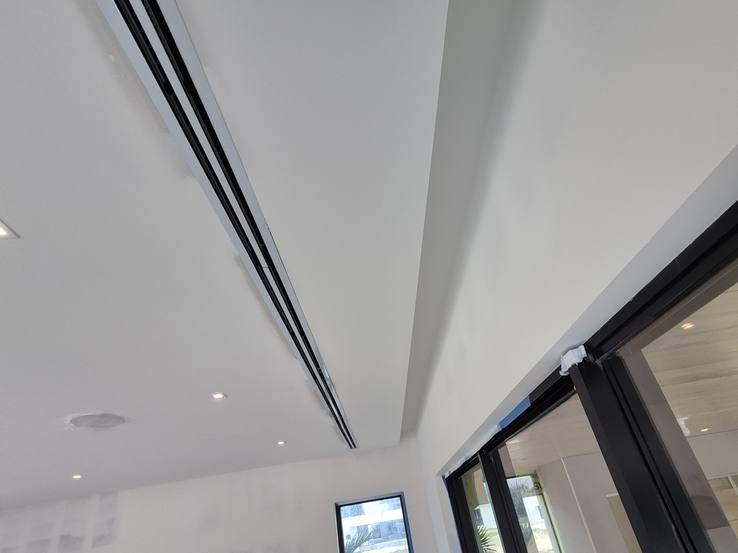
Forgetting the recess is the other way to lose a clean ceiling. When the glass runs to the ceiling, there is no wall above the window for a bracket, so a shade without a pocket hangs in a surface fascia or cassette, and a drapery runs on a track screwed to the finished ceiling. Both work. Neither looks like the rest of a house built to that standard. After the fact, the only way to hide them is a soffit built down from the ceiling along the glass. On a new build the pocket is one more line on the framing plan; see recessed shade pockets and recessed curtain tracks.
5. A pocket too narrow for the layers
The request we hear most in a house like this is a shade for privacy and sleep, and a sheer or a drapery for the room. Each layer needs its own width in the pocket, front to back, and the pocket is too often framed for one. An average motorized shade of 9 to 10 ft needs about 4 in. A drapery needs at least 4 in. A shade and a drapery need 8 in, minimum.
| In the pocket | Our minimum | Manufacturer figures |
|---|---|---|
| One roller shade, 9 to 10 ft drop | 4 in wide, 4 in deep | Lutron Roller 64 about 3.5 in, Roller 100 5 in; Blindspace S100 3.94 in square for rollers to about 94 in wide, S130 5.12 in to about 157 in |
| One drapery track | At least 4 in | Lutron: 7 in minimum for a single drapery system, for the stack-back |
| Shade + drapery | 8 in | |
| Sheer + drapery, two tracks | 8 in | Lutron: 11.5 in minimum for a dual-track system |
| Two shades on one dual bracket | As published | Lutron: 5.5 x 7.5 in for two Roller 64s, 7 x 11 in for two Roller 100s |
| Shade + sheer + drapery | 12 in |
Why 4 in for a shade: a 10 ft drop of a typical shade fabric, around 0.02 to 0.03 in thick, adds roughly an inch to the tube, so on a 1.5 to 2 in tube it rolls up to about 2.3 to 2.9 in across, and the brackets, the hembar and some clearance take the rest. Longer drops, heavier blackouts and wider shades move to 5 in. Why a drapery needs more than its track: open, the fabric stacks back and takes more depth than it does closed, and two tracks framed too close let one panel catch the other. That is why Lutron asks for 7 in on a single drapery system and 11.5 in on two tracks. Our 4 in per track is the floor. While the ceiling is open, frame to the larger number: three more inches of pocket cost nothing at framing.
SECTION THROUGH A SHADE + DRAPERY POCKET
6. A pocket that ends at the glass
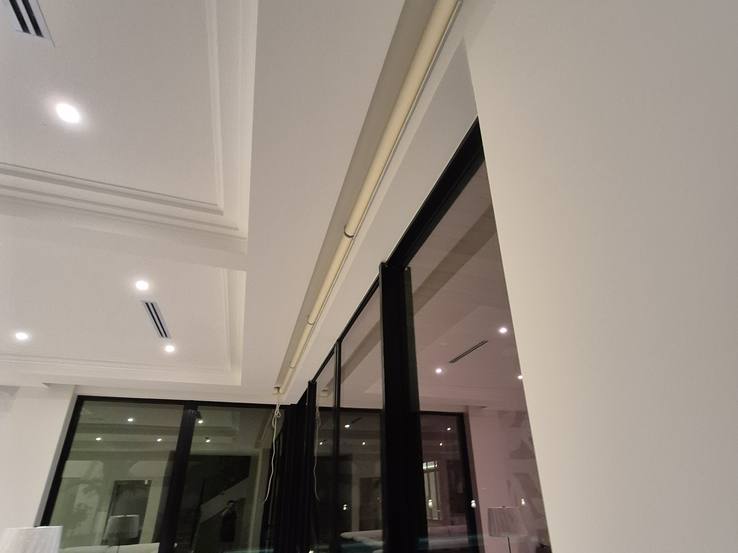
A drapery that opens has to go somewhere. Open, a ripplefold at 120% fullness stacks about a quarter of its track, by the per-width figures in our ripplefold stack table: on a 20 ft wall of glass, about 5 ft of fabric, 30 in at each end of a center-split pair. If the pocket stops at the edge of the glass, those 30 in hang in front of the view on both sides, every day. The pocket has to run past the glass by the stack, into the ceiling over the wall. Where the glass runs wall to wall, decide before framing where the stack lives: in a side pocket in the return wall, or on the glass, knowingly. The same logic holds for a blackout shade: a pocket a little longer than the opening lets the fabric overlap the glass at the sides, which is where light leaks.
PLAN: WHERE THE DRAPERY STACKS
7. An open pocket that shows the roll
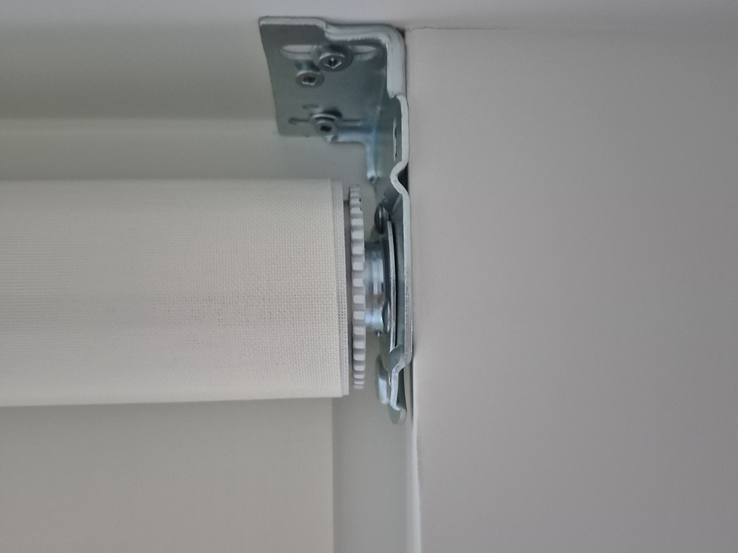
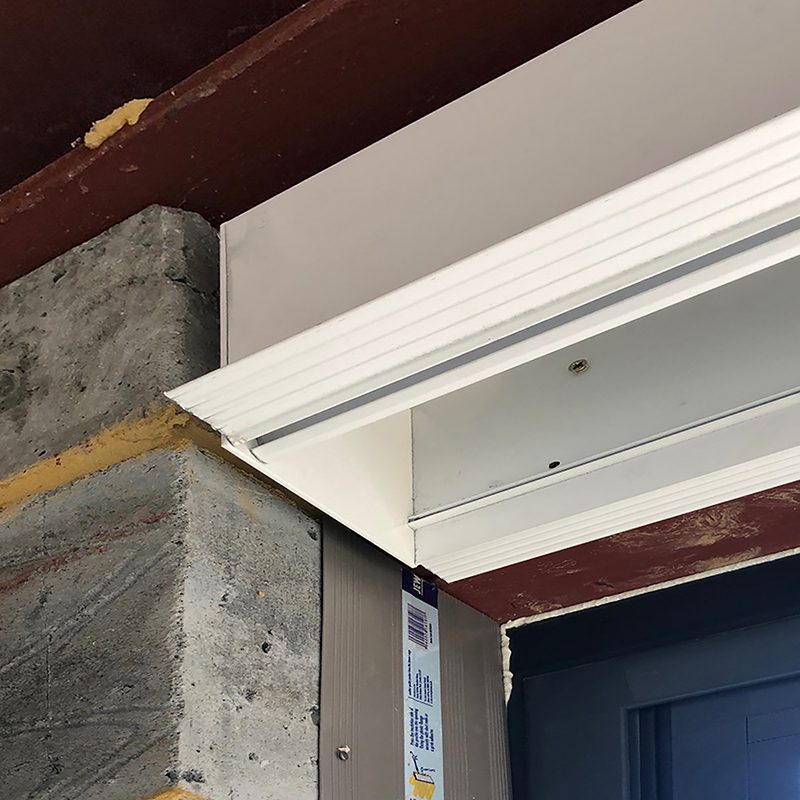
Look up from the sofa into an open pocket and you see the tube, the brackets and the motor. A pocket is only invisible when it is closed: a closure, a fascia or a soffit lip that leaves a slot just wide enough for the fabric and the hembar. A Blindspace pocket does it with a hinged cover flush with the plaster; a framed pocket does it with a drywall or wood lip. Lutron also recommends painting the inside of the pocket a dark, non-reflective color, so the slot reads as a shadow line. And the closure has to open: the motor, its connection and, on a battery shade, the battery all need to be reachable for service.
8. A pocket out of level, with nothing to screw into
A roller shade hangs from a level bracket. A pocket that runs out of level shows it as a tapered gap between the hembar and the slot, the whole length of the glass. CE Pro reported a large project where uneven framing left pockets standing up to 1 in proud; the integrator's target was under a quarter inch, the pockets came out, the headers went back and forth with the framer for weeks, and the job turned into a loss. Brackets and tracks also need wood behind the finish: solid blocking along the full length of every pocket and track, framed at the same time, because drywall alone will not carry a motorized track and a full-height drapery.
9. Everything else in the pocket line
The strip of ceiling along the glass is prime real estate, and every trade wants it: recessed lights, speakers, sprinkler heads, smoke detectors, linear supply diffusers. A light or a sprinkler head in the pocket line stops the pocket short; a diffuser blowing down the drapery line keeps a sheer moving all day. Window and door hardware counts too: handles, locks and sliding-door pulls decide how far from the glass the shade can drop, and so where the pocket goes. The pocket goes on the reflected ceiling plan first, and everything else moves around it.
10. Calling the window treatment company after the drywall
Window treatments are the last trade in and the first thing the owner touches, so they get planned last, and the bill for that arrives at framing. The order that works: the layers are decided room by room with the architect and the designer; we walk the framing, put the pocket dimensions on the wall and issue a window-by-window wiring schedule; the electrician wires from it, keypad boxes and the equipment closet included, with room for the power panel, an outlet, a network drop and some ventilation. After paint we measure every finished opening ourselves, make the shades and drapery in our Fort Lauderdale workroom and install them; shades take three to four weeks from the approved fabric schedule. More for project teams on our builders and GCs and architects pages.
Done right: at Landmark Ranch Estates in Southwest Ranches, not one treatment is surface-mounted. Every roller, drapery track and Roman sits in a ceiling pocket framed before the drywall closed, all measured on a live construction site.
Already built? What can still be done
- Pockets without power: battery motors for the shades, within the limits in mistake 1; wired drapery where the weight needs it, which means new cable.
- A pocket too narrow: two shades on one dual bracket, with the drapery on its own track in front of the pocket. See dual roller shades.
- A pocket that ends at the glass: extend it into the ceiling over the wall, or live with the stack on the glass.
- An open pocket: add a closure or a fascia lip, hinged or removable for service.
- No pocket: a surface fascia or cassette, or a soffit built down from the ceiling along the glass.
The framing checklist
Hand this to the builder before the ceilings close.
- The layers decided for every opening: shade, sheer, drapery, or a combination.
- Pocket width for those layers: about 4 in for a roller shade of 9 to 10 ft, 5 in for longer or heavier shades, at least 4 in per drapery track (Lutron: 7 in single, 11.5 in dual).
- Pocket depth: 4 in for a typical shade, 5 in for long drops and heavy blackouts.
- Pocket length: the glass, plus the drapery stack at each end, plus a little overlap for a blackout shade.
- A closure or fascia that leaves only a slot, painted dark inside, that opens for service.
- Level within a quarter inch, with solid blocking along the full length.
- Power for every motor at its motor end, inside the pocket: a low-voltage stub or a boxed 120 V connection, a 3 ft service loop, and no splices or cords between pockets.
- Keypad boxes, the equipment closet and a network drop on the electrical plan.
- Lights, sprinklers, detectors, speakers and diffusers kept out of the pocket line.
- The final measure after paint, by the people who make the shades.
Frequently asked questions
How big should a recessed shade pocket be?
About 4 in wide and 4 in deep for an average motorized roller shade of 9 to 10 ft, and 5 in for longer drops, heavier blackouts and wider shades. Published examples: Lutron's Roller 64 needs about 3.5 in and its Roller 100 5 in; Blindspace's S100 box is 3.94 in square for rollers to about 94 in wide, and its S130 box 5.12 in for rollers to about 157 in.
How wide should a drapery pocket be?
At least 4 in per drapery track by our working minimum, so 8 in for a shade and a drapery, or for a sheer and a drapery. Lutron asks for 7 in for a single drapery system and 11.5 in for a dual-track system, because the stacked fabric takes more depth than the closed drapery. While the ceiling is open, frame to the larger number.
Can several motorized shades share one 120 V cable?
A 120 V circuit can feed several motors, but each motor needs its own connection at its own motor end, in a box that stays accessible. One cable dropped at one window for a whole row leaves the installer with splices outside a box or cords run through the ceiling, both violations of the National Electrical Code (300.15, 314.29 and 400.12), which Florida enforces in its 2020 edition. Lutron Sivoia QS, Crestron and Somfy's 24 V motors need low-voltage cable to each window instead.
The house has shade pockets but no power. What now?
Battery motors for the shades: Lutron Triathlon runs three to five years on D batteries and Somfy's Li-ion motors about a year, or 500 cycles, per charge, and a Somfy solar panel can top one up from daylight, but every change is a ladder at the ceiling. Battery drapery motors are rated 99 to 110 lb against 175 lb for Lutron's wired drive, so heavy drapery may still need new cable fished to the pocket, or a ceiling opened and patched.
Why can't the shades be manual with 12 ft ceilings?
Because nothing is within reach. A roller shade that high runs on a chain loop from the ceiling held at the wall by a tension device under ANSI/WCMA A100.1-2022, a drapery that tall needs a long baton, and in a recessed pocket there is nothing to grab at all. With dozens of openings, motors are the only way the treatments actually get used every day.
How do you hide the roller in a ceiling pocket?
With a closure, a fascia or a soffit lip that narrows the opening to a slot just wide enough for the fabric and the hembar, with the inside of the pocket painted a dark, non-reflective color so the slot reads as a shadow line. The closure has to open, so the motor and its connection stay reachable for service.
How far past the window should a drapery pocket run?
Far enough to hold the stack beside the glass. A ripplefold at 120% fullness stacks about a quarter of its track: on a 20 ft wall of glass, about 30 in at each end of a center-split pair. Where the glass runs wall to wall, plan a side pocket in the return wall or accept the stack on the glass.
When should the window treatment company be involved in a new build?
When the electrical plan is drawn and before the ceilings close. We walk the framing, put the pocket dimensions on the wall and issue a window-by-window wiring schedule; after paint we take the final measure ourselves. Shades take three to four weeks from the approved fabric schedule.
Sources
- NEMA code alert, Florida: the 2020 NEC adopted with the 8th edition (2023) Florida Building Code, effective December 31, 2023
- EC&M (Mike Holt): NEC requirements for flexible cords, sections 400.10 and 400.12
- Mike Holt, Understanding the NEC: 314.29 and the definition of accessible
- EC&M: 300.15, a box at each conductor splice point
- Lutron Application Note #736: drapery pocket widths for stack-back, dark pocket interiors
- Lutron single and dual roller pocket sizes, on our Lutron motorized shades page; Blindspace box sizes, on our Blindspace S Series page
- Drapery stack-back per fabric width, from Forest Drapery Hardware's track brochures, on our ripplefold draperies page
- CE Pro: out-of-level shade pockets and the rework that followed
- Somfy Systems: the Sonesse Li-ion motor range and Lutron: Triathlon shades (battery life)
- Drapery motor ratings, on our motorized drapery tracks compared page; ANSI/WCMA A100.1-2022, summarized in our child-safe window treatments guide
Building now? Send us the plans before the drywall
We return the pocket dimensions for every opening and a window-by-window wiring schedule your electrician can build from. The cheapest moment to get this right is framing; start with the pre-wire guide.