

Crestron Horizontal Sheer Fabrics
26 colourways in 3 designs, each translucent or light-dimming: two sheer faces with tilting fabric vanes between them, on Crestron's horizontal sheer shade.
Two sheer faces, a vane that tilts, and two densities of cloth
A horizontal sheer is a different shade rather than a different weave. Crestron's Horizontal Sheer Shade, CS-SHADE-ROLLER-HSHEER, is built as a front and a back layer of sheer with 3-inch fabric vanes running across between them. Tilt the vanes open and about 1.5 inches of view shows between them, by Crestron's spec sheet; tilt them shut and they overlap. Keystone, Vail and Telluride are its fabric collections, and neither the Heritage book nor the Designer book includes them. Crestron describes each colourway as translucent or light-dimming, gives no openness factor and leaves them out of its Fabric Information Guide, so there is no composition, fire listing or solar figure to compare, and every colourway sits in Tier 4.
The colour cards are built two ways. Vail and Telluride make every colour in both densities, Desert Sands, Graphite, Moonstruck, Pearl Gray and Volcanic Ash on Vail and Dockside, Dove and Indigo Mood on Telluride, so one colour can run through a house while the density changes from room to room. Keystone keeps two separate cards: Snow, Pearl, Parchment, Mocha and Gray's Harbor in translucent, Arctic Ice, Eggshell, Natural Linen, Twilight and Gray's Harbor in light-dimming, which makes Gray's Harbor the one Keystone colour offered both ways. Across the page the split is even, half translucent and half light-dimming. Decide the density from what the room does, then the colour; the shade itself, its motor and its hardware are on the horizontal sheer shade page.
3 Crestron horizontal sheer designs, 26 colourways
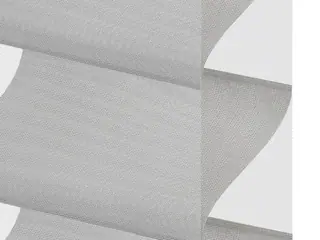
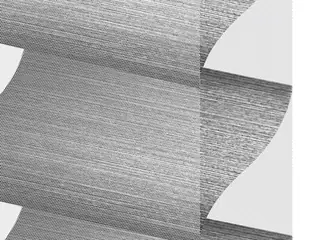
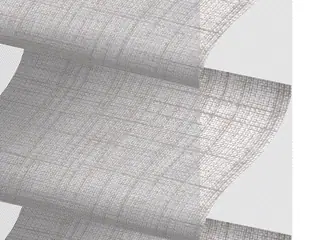
What the vanes and the two densities do
Translucent
The lighter cloth. With the vanes shut, daylight still comes through and the room stays bright while the view outside is lost in a soft glow. It suits a living room or a dining room where the shade stays down through the day for privacy and nobody wants the room dim.
Light-dimming
The denser cloth. Crestron describes it as blocking more light than translucent without being a blackout, so with the vanes shut the room goes dim rather than dark. It is the one for a bedroom used in the daytime, a study on a bright wall or a room with a television.
Open, tilted, shut
Open, the vanes frame a band of view, seen through the sheer face as through a light curtain. Tilted part way, they take the edge off direct sun. Shut, they overlap into one surface. And when the view is all you want, the whole shade still rolls up clear of the glass.
Edges and height
Like a roller shade, the horizontal sheer leaves a light gap of about 3/4 inch at each side. Unlike a roller, it has to be measured to the exact height of the opening, with none of the margin a roller is given, so we measure it that way from the start.
Care near the water
Crestron notes that salt air and rain coming through an open window age the fabric faster. Cleaning is gentle: a duster, a vacuum on low suction or a stream of cool air, and never ultrasonic cleaning on the light-dimming fabrics, which Crestron rules out.
Sizes, hardware, and where a horizontal sheer is the wrong answer
Crestron makes the shade up to 119.5 inches wide and 96 inches high, depending on the fabric, and no narrower than 17.5 inches. The width covers most single windows and many sliders; on floor-to-ceiling glass the height is the figure to check first. A wall wider than one shade takes two or more on one line, and that is where Crestron's vane alignment matters: identical shades ordered together can be matched to within a quarter inch on request, so the vanes run as one line across the glass. The shade hangs on Crestron's QMT3 Architectural hardware with the CSM-QMTDC-163-1 motor, wired on Cresnet or wireless on infiNET EX, or on a manual clutch that can take the motor later. It is finished with a fascia carrying a fabric insert, or a painted fascia in white, almond, gray, brown or black.
It is not a solar screen and not a blackout, and it is worth saying so before the samples come out. With no openness factor and no solar figures, it is the wrong tool for heat on hard west glass, where a solar screen with Crestron's published figures does the work. With the vanes shut, even the light-dimming cloth leaves a room dim rather than dark, so a bedroom that has to sleep takes a blackout roller. And with every colourway in Tier 4, the highest of Crestron's four tiers, it belongs where the vanes earn their place rather than across a whole floor. What it gives that no roller fabric in the programme can is three settings from one shade: a view through a sheer, filtered light with the room private, and the window clear.
What a Crestron horizontal sheer costs
Every horizontal sheer fabric sits in Crestron price Tier 4. Crestron's budgetary guide of June 2022 prices roller shades only and gives no figure for the Horizontal Sheer Shade, so we quote the finished shade at the measure, with the fascia, the motor or the manual clutch, and the control.
Horizontal sheers on our installations
We propose a Crestron horizontal sheer for the rooms on the coast that live with the windows shut: the living room of a Fort Lauderdale or Miami Beach condo where the sliders stay closed and softness matters as much as the view, a dining room on the street side of a house, a primary bedroom that wants the morning light softened, with a blackout roller for the night. Sliders that open to a terrace get a solar screen instead, since salt air through an open window ages the cloth. We bring Crestron's horizontal sheer sample book to the consultation so the translucent and light-dimming vanes can be judged in your own light, measure every opening to its exact height ourselves, and commission the shades with the integrator so the vanes tilt with the room's lighting scenes.
Horizontal sheers: frequently asked
What is the difference between translucent and light-dimming?
How much light the vanes let through when they are shut. Translucent keeps the room bright; light-dimming blocks more and brings it down to dim, though Crestron is clear that it is not a blackout. Open, both give the same band of view. In Vail and Telluride every colour comes both ways, but in Keystone only Gray's Harbor does, so on Keystone decide the density before falling for a colour.
Is a horizontal sheer private at night?
With the vanes shut, the overlap is what keeps the room private, and Crestron notes that it does so even at the very bottom of the shade, where the vanes do not close tightly. With the vanes open you are looking through a sheer, and after dark a lit room shows through a sheer. For a bedroom we lean to the light-dimming card; where the room also has to be dark, that is a blackout roller's job.
Can I start with a manual horizontal sheer and motorize it later?
Yes. Crestron offers the shade on a manual clutch that can be upgraded to a motor afterwards: the CSM-QMTDC-163-1 on the QMT3 Architectural hardware, wired on Cresnet or wireless on infiNET EX. If there is any chance of the upgrade, run the cable while the walls are open, a Cresnet home run for the wired motor or a power lead for the wireless one; our pre-wiring guide lists what the electrician needs.
Why is there no openness factor or solar data for these fabrics?
Because Crestron rates horizontal sheer fabrics by density, translucent or light-dimming, and covers them in the shade's own spec sheet and expectations guide rather than in its Fabric Information Guide, so no Ts, Rs, As or Tv is published for them and there is no figure to set beside a solar screen's. Where heat on hard west glass is the problem, a solar screen with published figures is the answer.
Will a horizontal sheer match the roller shades elsewhere in the house?
Closely. It hangs on the same QMT3 Architectural hardware family and Digital QMT motor as Crestron's smaller roller shades, its painted fascia comes in white, almond, gray, brown or black, the finishes of Crestron's roller fascia, or it takes a fabric insert instead, and it leaves about the same 3/4 inch light gap at each side as a roller. It joins the same keypads and scenes, so the two read as one installation.
Crestron horizontal sheers in Fort Lauderdale, Miami, Boca Raton & Palm Beach
Every fabric on this page is built into a Crestron shade to order from our measurements, installed by our own team and commissioned with your integrator from Miami to Palm Beach. Our showrooms in Fort Lauderdale (4539 Powerline Rd, by appointment) and Miami Beach (500 South Pointe Dr #150) have motorized shades running so you can judge the fabrics in motion.
Choose the fabric in your own light
Book a complimentary in-home consultation. Shortlist the designs you like and we bring samples, demo motors, and honest answers about openness, colour and exposure.