

Motorized Privacy Shades for Yachts: What Works at the Dock, at Anchor and Underway
October 6, 2026 · Guides · By David Martineau
Fort Lauderdale is our home port, and the question we hear from owners and captains is rarely "can you motorize the shades". It is "can the saloon be private at the dock without losing the view, can the master sleep at anchor, and will it still work on a steel hull next season". This guide is our answer, in the order we would walk a vessel: privacy first, then fabric, power, control, hardware, fire ratings and timing.
The short answer. Privacy on a yacht is two different problems. By day a 1% or 3% solar screen keeps the saloon private and the horizon sharp. The moment the lights come on, every screen turns see-through, so night privacy needs an opaque layer: a dual roller with a blackout or privacy fabric behind the screen, or lined curtains. Motorize on battery for a quick refit, on the vessel's 24V DC for a permanent one, and run a wired bus rather than radio through a steel or aluminum hull. Template every opening on board; nothing on a boat is square.
Privacy afloat is two problems, not one
In a marina slip the next boat lies a few feet off the beam and the dock walk runs past the saloon glass. At anchor nobody is looking in, but the sun is, from above and off the water. Underway the shades mostly need to stay up and stay put. A privacy shade that answers only one of those situations is a shade the crew will stop using.
By day, the screen does the work
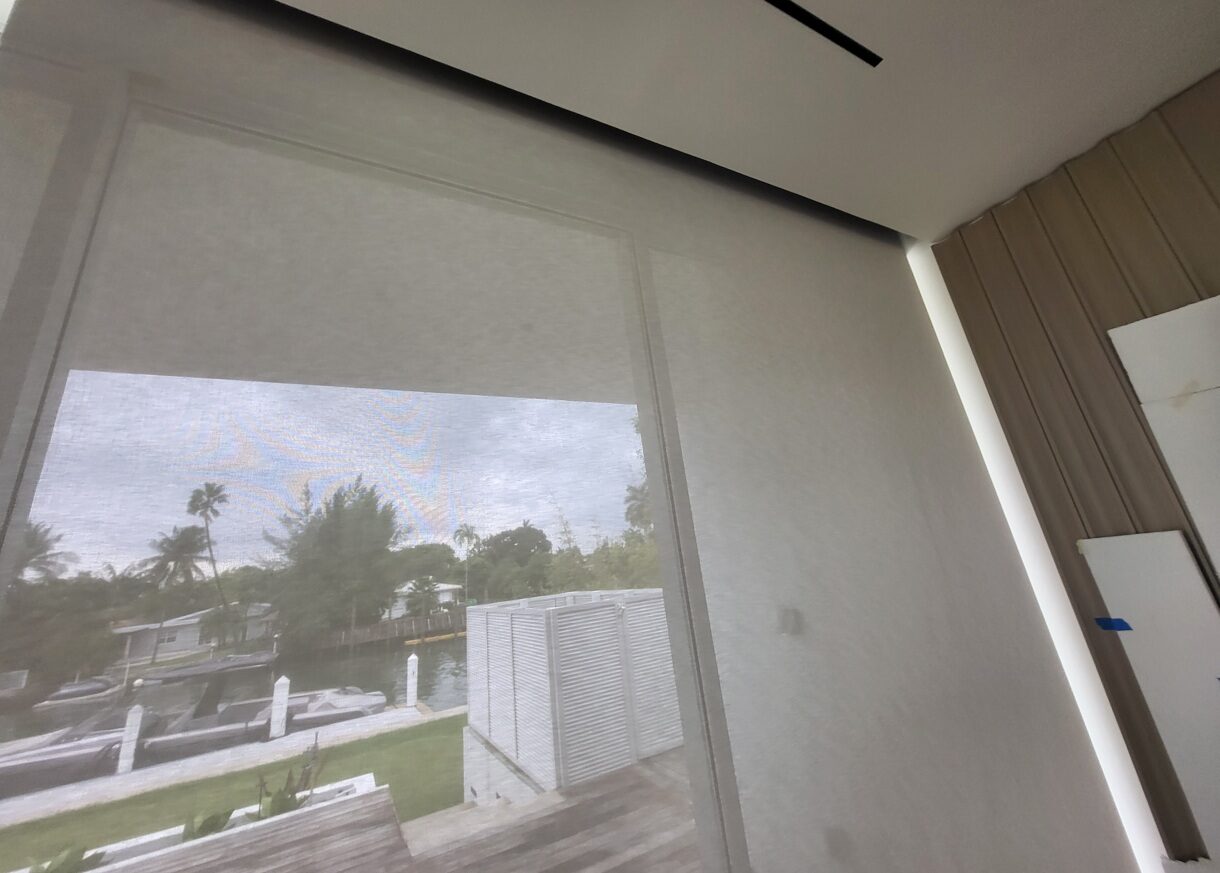
A solar screen behaves like a one-way mirror: you see through it from the darker side. In daylight the saloon is the dark side, so from the dock the glass reads as a dull surface while the people inside keep the view. The weave decides how good that view is. Lutron rates E Screen 3% in Charcoal/Grey at 42% view-through with 5% of daylight passing, the sharp horizon; the same fabric in White/White reflects 73% of the sun's energy and passes 13% of the light, cooler and brighter below deck but softer on the view. UV blockage follows the openness, not the colour: about 97% at 3% and 99% at 1% on Mermet's ratings. The full logic is in our openness guide and in dark or light solar shade fabric.
At night, no screen is private
Once the lamps come on, the saloon is the bright side and the physics reverses: every solar screen becomes transparent from the dock, whatever its colour or openness. This is the detail most articles on yacht privacy shades leave out, and it is the one that matters at 9 PM in a busy marina. Night privacy needs an opaque fabric: a blackout for the staterooms, a translucent privacy fabric for a saloon where the glow of the lamps should still pass, or lined curtains.
Two layers, one headbox
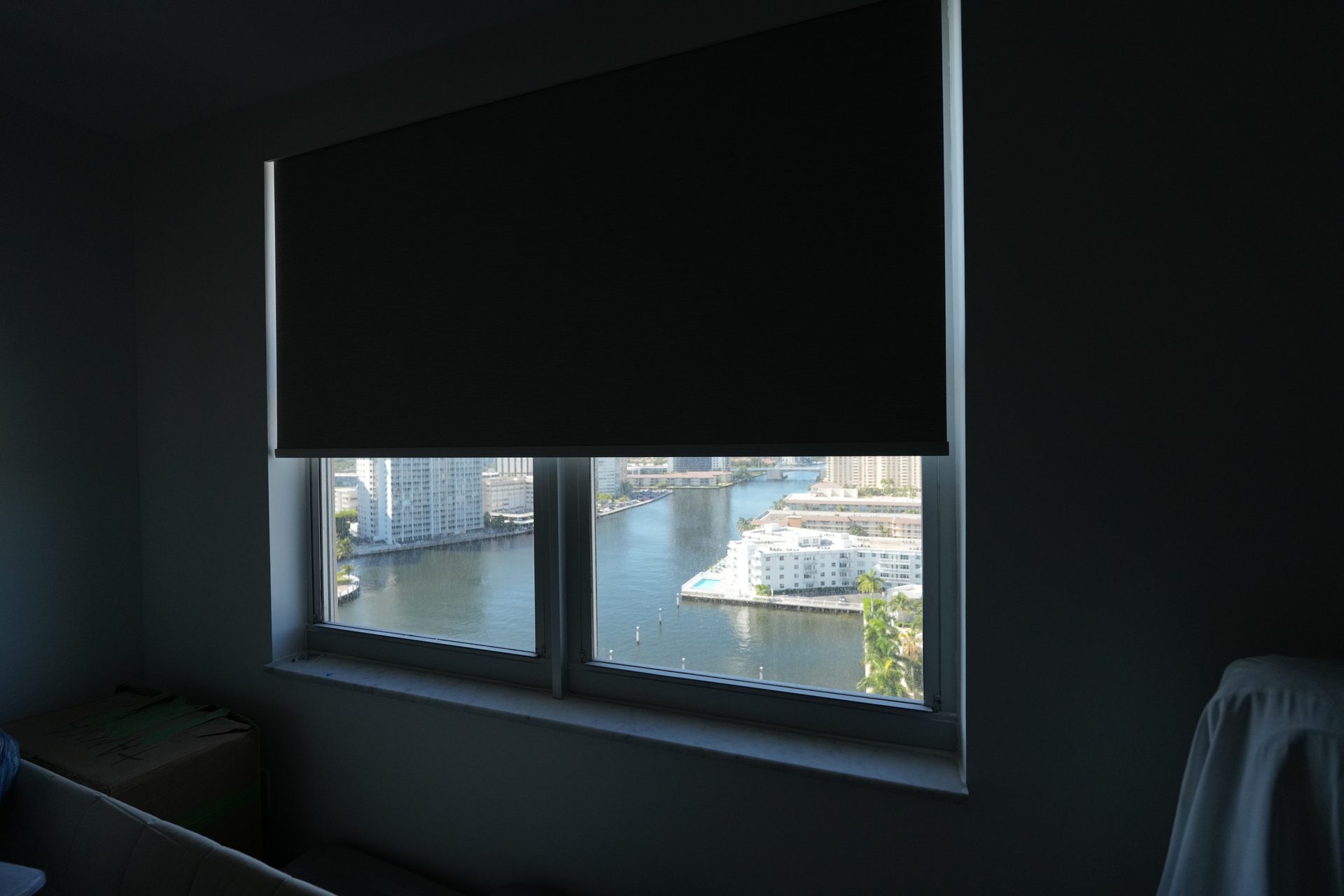
The answer on most saloon glass is a dual roller: a screen on the front tube for the day, a blackout or privacy fabric on the back tube for the night, both motorized, sharing one bracket set. On a vessel it earns its place twice. It templates into a tight valance as a single unit, and it gives the crew one scene per situation: screens down at the dock, blackouts down for the night, everything up and parked for sea.
Fabric: sun from above and from below
Afloat, light arrives twice, once from the sky and once off the surface, so glare and UV decide the saloon fabric before heat does. We take aboard the same performance screens we specify on oceanfront glass: vinyl-coated fiberglass weaves from Mermet and Phifer, and composite fabrics from Serge Ferrari, all engineered for UV, humidity and mildew, none of which absorb water, and all of which wipe clean. A 3% weave in a dark colour on the view glass, a 1% weave where the sun is brutal, a lighter colour where the cabin must stay cool.
For the staterooms the blackout layer should be built, not just bought: a blackout roller in side channels, because light leaks at the edges rather than through the fabric, or curtains with an FR blackout lining and an interlining, which is how yacht fabric schedules are usually written. Our blackout shades page and drapery lining guide cover the details.
Power: battery, 24V DC or the inverter
Battery, for the quick refit
No cable through a bulkhead, templated and fitted in one return visit. Somfy rates its rechargeable Li-ion Sonesse motors at roughly a year, or about 500 up-and-down cycles, per charge on a 72 x 72 in shade cycled once a day; Lutron's Triathlon runs three to five years on D batteries. Read those figures the way a boat is used: a charter saloon that cycles four times a day gets a quarter of that, and charging becomes a crew task. On most vessels that is an acceptable trade for a refit measured in days. See battery vs wired motors, Somfy WireFree and Lutron Triathlon.
24V DC, for the permanent install
The quiet motors we specify ashore are mostly 24V DC already: the Somfy Sonesse 30 in RTS, Zigbee, RS485, dry-contact and PoE versions, the Sonesse ULTRA 50 24V DC for large saloon glass, and Crestron's QMT motors, 24V DC on Cresnet or infiNET EX. A yacht already runs a DC house bank, so where the refit allows, a 24V power panel or a DC-DC converter puts the shades on the vessel's own power, with no inverter in the loop and nothing to charge.
120V AC, only where it is already there
AC motors work, but each one is a load on the inverter or the generator for the sake of a shade, and more hardware per opening. We would rather see them only where a refit has already run AC to the headbox.
Control: radio does not like a steel hull
On a fiberglass boat, radio behaves much as it does in a house. On a steel or aluminum yacht, every compartment is a metal box, and a remote that reaches across a living room ashore may not reach the next cabin. The plan we recommend has two versions. On a large vessel, a wired bus: Somfy SDN, an RS-485 network where every motor has its own address, with no range limit and no battery, or Crestron's Cresnet and Lutron's wired QS link. On a smaller boat, radio with a repeater per zone, placed from a survey of the actual hull rather than a brochure range figure.
Most yachts of any size already run Crestron, Lutron, Savant or Control4. The shades join as scenes on the keypads and touch panels the crew already uses: Dock drops the screens, Night drops the blackouts, Underway parks everything up. We are certified on Lutron, Crestron and Somfy, so the vessel's integrator gets one point of contact for the shade side.
Hardware for a room that moves
- Retain the bottom bar. A shade that swings underway is a shade that fails. Cable guides, the system Crestron sells for sloped and angled windows, or side channels keep the hembar in line; hold-downs at the sill do the same for a curtain.
- Raked glass needs guides. A roller on a windshield or a raked saloon window hangs vertical while the glass does not; cable guides pull the fabric to the glass.
- Curved staterooms are templated, not measured. A curve becomes several narrow rollers on one line, or a curtain on a bent track. Each opening is templated individually, the discipline we use on curved oceanfront facades ashore.
- Salt-proof the small parts. Stainless fasteners and anodized aluminum profiles; plated steel does not last in salt air.
- Mind the headroom. Compact tubes and low-profile cassettes where the valance is tight; a 30 mm class motor like the Sonesse 30 exists for exactly that.
Fire ratings: the line in the fabric schedule nobody should skip
On a yacht of 24 m and over in commercial use, which includes charter, the Large Yacht Code says curtains and other suspended textiles should be approved to IMO FTP Code Annex 1 Part 7: a propane flame held to the face of the fabric for five seconds and to the bottom edge for fifteen, with no afterflame beyond five seconds and no burn-through to any edge. US-flagged vessels under SOLAS have the Coast Guard's own approval series, 46 CFR 164.111, built on the same Part 7 test. NFPA 701, the test for drapery in a hotel ashore, is not accepted as an equivalent. A privately used yacht sits outside the code and follows its flag state's rules instead, but the fabric schedules yacht designers send us call for FR lining and interlining as a matter of course, and the fabric spec sheet with its certificate belongs in the submittal next to the motor data.
Templating, timing and the refit
We template dockside at marinas across Broward, Miami-Dade and Palm Beach, fabricate in our own Fort Lauderdale workroom while the other trades finish on board, and come back to fit, program and hand over. The best window is the quiet weeks before the fall boat-show season and the winter charter calendar; templating early keeps the shades off the refit's critical path. If the owner's home should match the boat, it can: one fabric schedule, one workroom, one standard, as on the Fort Lauderdale oceanfront estate.
What we would skip
- A solar screen alone on stateroom glass, or on saloon glass that faces the dock: see-through at night
- Radio-only control through steel or aluminum bulkheads without a survey
- 120V AC motors where 24V DC or battery will do the job
- A free-hanging hembar on raked or large saloon glass
- A fabric without an FTP Code Part 7 certificate on a charter vessel
- Plated-steel brackets and screws in salt air
- Shades made from the GA drawings instead of templates taken on board
What it costs
A vessel is quoted after the dockside templating visit, which itself costs nothing, because the count of openings, the hull material and the control system change the answer. For a reference point, the residential figures on our pricing page come from the same quote engine: one motorized roller on Somfy from about $1,910 for a 72 x 84 in window, $3,141 on Lutron, budgetary and before tax.
Frequently asked questions
Do solar shades give privacy on a yacht at night?
No. A solar screen is private only from the darker side. By day that is the saloon; once the interior lights are on, the saloon is the bright side and every screen becomes see-through from the dock, whatever its colour or openness. Night privacy needs an opaque layer: a blackout or a translucent privacy fabric, usually as the back roller of a dual shade, or lined curtains.
Can yacht shades be motorized without shore power?
Yes. Rechargeable battery motors need no wiring: Somfy rates its Li-ion Sonesse motors at about a year or 500 cycles per charge on a 72 x 72 in shade cycled once a day, and Lutron's Triathlon runs three to five years on D batteries. For a permanent install, 24V DC motors such as the Somfy Sonesse 30 and ULTRA 50 or Crestron's QMT motors run from the vessel's own DC through a power panel or converter.
Will remote-control shades work on a steel or aluminum yacht?
Not reliably across bulkheads. Metal compartments attenuate radio, so a remote that covers a house may not reach the next cabin. On a large metal vessel we recommend a wired bus such as Somfy SDN, Cresnet or Lutron's QS link; on a smaller boat, radio with a repeater per zone, placed after a survey of the hull. A fiberglass hull behaves much like a house.
What fire rating do yacht curtains and shades need?
On a yacht of 24 m and over in commercial use, including charter, the Large Yacht Code says curtains and other suspended textiles should be approved to IMO FTP Code Part 7. US-flagged SOLAS vessels follow the Coast Guard's 46 CFR 164.111, built on the same test. NFPA 701, the drapery test used ashore, is not accepted as an equivalent. A privately used yacht follows its flag state's rules, and most yacht fabric schedules specify FR lining and interlining regardless.
Can a stateroom on a yacht be made completely dark?
Yes. Light leaks at the edges of a blackout, not through the fabric, so the shade runs in side channels with a sill detail, or the curtains are made with an FR blackout lining and an interlining. Both are the same blackout engineering we use in residential suites, shaped to a curved or raked opening.
Do you template shades on board?
Yes. We template dockside at marinas across Broward, Miami-Dade and Palm Beach, fabricate in our own Fort Lauderdale workroom while the other trades finish, and return to fit and program. Ports, raked windshields, angled saloon glass and curved staterooms are templated individually; the templating visit costs nothing.
Can the shades join the yacht's Crestron, Lutron or Savant system?
Yes. The shades join as scenes on the keypads and touch panels the crew already uses, for example Dock, Night and Underway. We are certified on Lutron, Crestron and Somfy and work with the vessel's integrator on the shade side.
When is the best time to fit shades on a yacht?
Alongside any refit, or in the quiet weeks before the fall boat-show season and the winter charter calendar. Templating early keeps the shades off the refit's critical path; fabrication runs in our workroom while the crews finish on board.
Sources
- Mermet USA: E Screen grouped spec sheets (UV blockage by openness), and Lutron's fabric specifications for E Screen, summarized on our Lutron E Screen page
- Somfy Systems: 5 things you need to know about the Sonesse Li-ion motor range
- Lutron: Triathlon shades (battery life)
- UK Maritime & Coastguard Agency: Large Commercial Yacht Code (LY3), suspended textiles and FTP Code Part 7
- Kothea: IMO fire standards for yacht interiors, FTP Code Part 7, Part 8 and MCA MGN 580
- Practical Boat Owner: a beginner's guide to managing marine battery power (12V and 24V systems)
- eCFR: 46 CFR 164.111, draperies, curtains and other suspended textiles
- Motor specifications: Somfy Sonesse 30, Somfy Sonesse ULTRA 50 and Crestron QMT5, from the manufacturers' documents
Before the next season, not during it
A dockside templating visit costs nothing, and it takes the shades off your refit's critical path. Book it below, or start with the yacht and marine service page.